Scott Pullins, founder of the Ohio Taxpayers Association, wrote a blog entry on Third Rail Politics highlighting our public interest practice entitled “You Can Fight Back When Officials Use Taxpayer Dollars for Politics” last week.  You may read that entry here.

Our firm has helped to blaze a trail of causes of action demanding equal access to public forums (such as schoolyards and lobbies of city buildings), and claiming violations of taxpayer statutes, when government officials misuse tax dollars for campaign purposes, which is not permitted.

We are pleased this work has been recognized.

We are local counsel in the case of the NorCal Tea Party v. IRS. we announced this morning that the case has settled with an admission from the U.S. Attorney General that what occurred was a “gross abuse of power.”

Read the coverage here:

Washington Post: Justice Department agrees to settle lawsuits over IRS scrutiny of tea party groups

Wall Street Journal: Administration Agrees to Settle Tea-Party Suits Against IRS

New York Times: Justice Department Settles With Conservative Groups Over IRS Scrutiny

Public Broadcasting Service:  Tea party groups settle lawsuits over IRS mistreatment The Trump administration has settled lawsuits with tea party groups that received extra, often burdensome scrutiny when applying for tax-exemp… pbs.org       

 CBS News: DOJ announces settlement with Tea Party groups

Fox NewsTrump DOJ settles lawsuits over Tea Party targeting by Obama IRS

USA Today: Justice Department settles IRS lawsuits from 400 conservative groups claiming discrimination

New York Daily News: IRS settles Tea Party groups’ suits over delayed nonprofit status

Chicago Tribune: Justice Department agrees to settle lawsuits over IRS scrutiny of tea party groups

Cleveland Plain Dealer: Tea Party groups settle lawsuit against IRS; agency apologizes for discrimination during Obama’s

San Francisco Chronicle: Tea party groups settle lawsuits over IRS mistreatment

Yahoo Finance: Tea party groups settle lawsuits over IRS mistreatment

Minneapolis Star: Tea party groups settle lawsuits over IRS mistreatment; will get apology

Townhall: DOJ Starts to Make Amends for Tea Party Scandal

Washington Times: Feds to pay ‘generous’ settlement to tea party groups for targeting

Breitbart News: DOJ Settles with Tea Party Groups on Lois Lerner IRS Scandal

Cincinnati Enquirer: IRS settles tea party cases for millions and an apology

We are pleased to bring you this morning news that the Internal Revenue Service has settled the case of NorCal Tea Party v. IRS filed in the United States District Coiurt for the Southern District of Ohio.  We have served as local counsel in “what may be the only nationwide class ever formed for a claim of this type.”

United States District Court Judge Susan Dlott originally handled the case and certified it as a class action.  It most recently has been handled by Judge Michael Barrett.

U.S. Attorney General Jeff Sessions today weighed in personally on the settlement and the conduct of the IRS:

“There is no excuse for this conduct.  Hundreds of organizations were affected by these actions, and they deserve an apology from the IRS. We hope that today’s settlement makes clear that this abuse of power will not be tolerated.”

The Washington Post has the story here.

The statement by our lead counsel, Eddie Greim of Garrett Graves in Kansas City is below:

The United States Reaches Agreement with a Nationwide Class of Over 400 Targeted Groups in NorCal v United States, Vindicating Plaintiffs’ Claims in a Generous Financial Settlement

KANSAS CITY, MISSOURI, October 26, 2017

The Plaintiffs in NorCal v. United States are pleased to announce that late yesterday, the United States entered into a generous financial settlement to pay the claims of each of over 400 groups in the Plaintiff Class who were targeted by the IRS for their political beliefs. It is a great day for the First Amendment and the promise of fair and impartial government. But this day was too long in coming.

Five groups filed this case, the first claim against the IRS for its targeting of conservative groups, and the only nationwide class action, in May 2013. These five, NorCal Tea Party Patriots, South Dakota Citizens for Liberty, Americans Against Oppressive Laws, San Angelo Tea Party, and the Texas Patriots Tea Party, sacrificed hundreds of hours of time. The lawsuit stretched over four years and was sustained by funding from Citizens for Self-Governance, a non-profit that aids citizen groups. CSG was itself targeted by the IRS during the discovery process, but refused to back down.

In 2015, Judge Susan Dlott of the U.S. District Court for the Southern District of Ohio certified what may be the only nationwide class ever formed for a claim of this type. In 2016, the Sixth Circuit Court of Appeals soundly rejected the IRS’s attempt to use taxpayer protection laws to withhold evidence of its own wrongdoing in the case. In 2016, District Judge Michael Barrett entered a preliminary injunction against the IRS, finding a strong showing of a likelihood of success on Texas Patriots Tea Party’s First Amendment claim. In 2017, Texas Patriots became one of the last groups to have its exempt status recognized. Also in 2017, the Plaintiffs took the first and only deposition of Lois Lerner, which remains under seal in a manner still being litigated by Plaintiffs notwithstanding the proposed settlement. Under federal court rules, District Judge Barrett must still approve the class settlement on the motion of the parties.

By the fall of 2017, dozens of IRS officials had testified under oath, and the case was being prepared for trial. As part of this process, Attorney General Sessions’ Department of Justice carefully reviewed the facts. The generosity of its proposed settlement belies recent, uninformed claims that IRS officials merely mismanaged the files of conservative groups, or subjected liberal groups to similar treatment. To the contrary, Plaintiffs developed evidence showing that IRS managers knew that groups’ views, not their activities, were being used to target them for heightened scrutiny. Even after they gained this knowledge, officials like Lois Lerner failed to release the targeted groups, ordering up more scrutiny and delay even while betraying worry that the “Tea Party matter” was “very dangerous.” This was far more than the “lack of adequate management” the IRS or TIGTA is publicly willing to acknowledge.

Attorney General Sessions rightly calls this an “abuse of power.” As he says, the Plaintiffs deserve an apology from the IRS. But not even a court can force the IRS to apologize or admit to its wrongdoing. Those remedies are unknown to the law. A true reckoning is finally up to the agency itself. Until the IRS itself steps forward to admit what really happened, we cannot have faith that the same abuse won’t be repeated again. It is easy for the IRS to abuse its toolbox of policies and procedures that seem neutral on their face, just like the superficially innocent process of “centralization” that Lois Lerner and others used as an excuse to abuse the Plaintiffs. So truly, it is not just Plaintiffs who need an apology. Every taxpayer and group, whether or not targeted in this particular scheme, has a right to demand a truthful apology based on the facts and a real reckoning. Before Commissioner Koskinen leaves office, the Plaintiffs call on him to do the right thing.

For questions, please contact counsel Eddie Greim at 816-256-4144.


It has been four long years of litigation, class certification, motions, discovery, an interlocutory appeal to the 6th Circuit, and more motions, but the only certified class action against the IRS arising from Tea Party targeting is approaching trial in 2018, if the Plaintiffs survive the IRS’ motion to have the case preemptively disposed of on summary judgment.

Those motions are being briefed right now before U.S. District Court Judge Michael Barrett, and today’s Cincinnati Enquirer has the story on those briefings here.

A few things to note about the case:

  • The Jeff Sessions Justice Department continues to defend the suit under President Donald Trump in much the same vigorous fashion as it did under Loretta Lynch and President Obama.
  • IRS Commissioner John Koskinen, whom Congressional Investigators accused of stonewalling investigators and covering up for Lois Lerner’s and the IRS’ excesses, remains in his role.
  • Judge Barrett has for now sealed the deposition transcripts of Lois Lerner and Holly Paz, the architects of the IRS targeting.  The sealing was at the request of Lerner and Paz who claimed to fear harassment if their testimony were revealed.

This firm is pleased to serve as local counsel, along with David Langdon, to the Tea Party groups in this important litigation.

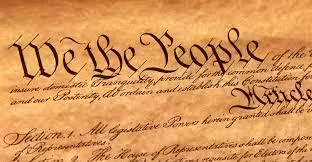
We love celebrating September 17 each year at the Finney Law Firm, in part because we — as should all Americans — celebrate the document that brought lasting freedom and prosperty to our shores through recognition and respect to property rights, respect of natural rights, and acknowledgement of the failings of man through the checks and balances it contains.  These virtures are as a general proposition underappreciated by the populace and the foundation of the liberties we depend upon, I would humbly submit.

We also love celebrating this day because many of our attorneys have been able to successfully utilize constitutional theories, in some cases cutting-edge constitutional theories, to right the wrongs of our society and the excesses of our government leaders.

Finally, one of the blessings we remember on Constitution Day each year was a special and ironic story of the distinct failure of our elected officials to understand the rights granted by the U.S. Constitution and the corresponding limitations on their powers.

[I’ll update this story when I get a chance to check the docket, but as I recall, the year was around 2011 and the offending goverment was the City of Astabula.]

The facts read like a law school exam question hypothetical.  But, it went like this:

The Ashtabula County Tea Party desired to hold a rally on Constitutuon Day in something in town they called the “Public Square.”  This was a typical town commons or “public square” in the middle of town.  For constitutional novices, it would be what the Courts commonly refer to as a “quintessential public forum,” the type of property where First Amendment liberties are given their greatest latitude.

At first, the City approved their application for the use of the square, later explaining that they thought the “Tea Party” was a group of little old ladies serving tea.  (Yes, the Tea Party was at its zenith at this time, so the City fathers simply must have been living under a rock to think this.)

But, when they learned that the topic of a Constitutuion Day rally in the Public Square was to discuss public policy and rally the faithful towards civic action, the City fathers demurred, and revoked their assembly permit.  In other words, based solely on the content of what was to be discussed and addressed that day (“pass the crumpets” versus “vote the bums out”), the City decided to prohibit the assembly and the attendant speech.

This would be a textbook example of impermissible content-based discrimination in a public forum, a violation of the First Amendment to the United States Constitution.

We, of course, immediately brought suit on behalf of the Tea Party.  Once City officials were staring at a hearing before a Federal Judge to explain themselves, they quickly “got religion” and a newfound understanding of the U.S. Constitution, and allowed the rally.

So, Constitution Day, September 17, has a special meaning for me and our firm, and the fine organizers of the Ashtabula County Tea Party.

In April of this year, the Ohio legislature passed an updated Good Funds Law for transactions involving residential real estate to mandate, among other things, wire transfers for amounts in excess of $1,000, with a few exceptions.

Now, that amount has been increased to $10,000.

So, the new rule is that a ll funds coming into a title company to fund a residential real estate transaction must come in in one of the following ways:

  • Electronically-transferred funds, including wire transfers;
  • Personal checks, cashier’s checks, money orders or Official Checks of $10,000 or less;
  • Automated clearing house (ACH) transfers; or
  •  Checks from a real estate broker’s escrow account.

We will keep you updated with further changes in the law so that we can continue to be “accurate and on-time, everytime.”

I want to extend a warm and sincere “Thank You” to the attorneys, staff, vendors, and clients of Finney Law Firm, LLC who have joined together to make our firm — dedicated to “Making a Difference” for our clients and in our profession and community — a tremendous success in our first four years in operation.

We started our new firm in Eastgate in the fall of 2013 with a great group of attorneys, a loyal and experienced staff, a top-notch lineup of vendors and a solid core of clients.  Since then, we have attracted more talented attorneys and staff, and have been met with simply overwhelming response from our clients.

We started with just four attorneys and three staffers.  Since then, we have grown to nine full-time attorneys, and are about to add our tenth.  We have expanded the law firm at Ivy Pointe in Eastgate three times, and eventually added space in the Rookwood Pottery building in Mt. Adams.  Just weeks ago, we tripled our space at Mt. Adams, so that the two offices are now roughly equal in size.

Under the leadership of attorney Rick Turner, we started Ivy Pointe Title, LLC in the fall of 2014 to support our commercial real estate closings and added to that base residential transactions.  He started with one full-time staffer, and now oversees an operation of seven full time employees. Due to tremendous success under his leadership, in November, we plan on doubling the size of the title company.

Our journey has taken us three times to the United States Supreme Court (with three unanimous victories) and numerous times to the Ohio Supreme Court.  We have handled dozens of multi-million dollar corporate and real estate transactions for our small business clients, and we have saved clients more than five million dollars in real estate taxes.  We successfully have handled numerous class actions for clients, including acting as local counsel for the ground-breaking class action against the Internal Revenue Service.  All of this is while we have daily served, client-by-client, to “make a difference” in their transaction or litigation matter.

These accomplishments are the result of the combined efforts of many people, and to each and every one of them I owe my deep gratitude.  The engine of commerce, the laboratory of legal innovation, and the commitment to client service we have made together is enduring and flourishing, ultimately, because we all work together to provide value for our loyal clients in each assignment.

Thank you, most sincerely, for making this such a fun, rewarding adventure!

Christopher P. Finney, President

In order to advance our mission of “Making a Difference,” we are pleased to announce a further expansion of our Mt. Adams office, nearly our footprint at that location.   We now have offices for seven attorneys and additional staff that that location in the Rookwood Pottery Building (1077 Celestial Street, Cincinnati, Ohio 45202).

For our clients, if you are downtown or in the area and need an outpost with a desk, WiFi, a printer and a beautiful view of the City, we have a large lounge area from which you are welcome to work. We also now have two conference rooms at that location for depositions, closings, and meetings.

Please stop by and visit; let us show you around!


Frequently, clients desire to lend money, seller-finance the sale of their business or other asset, buy and then lease out a building, or engage in some other business transaction because they are motivated by favorable business terms the transaction provides on its surface: A high rate of interest, a good return under a lease, or a more promising sale price than otherwise the seller would obtain, for example.

This entry asks a prospective private lender to think twice about the risks associated with this activity and to take as many steps to protect himself as possible under the circumstances.

Who is the “lender” and who is the “borrower”

For purposes of this entry, there are many circumstances in which a party is a “lender” and another is the “borrower.”

  • Obviously, a simple monetary loan in which there is a lender and borrower is one such transaction.
  • Another occurs where an investor either owns a building and desires to rent it, or purchases one for leasing purposes.  In addition, as a part of a leasehold transaction, the landlord may be putting into the premises significant sums in “tenant buildout costs.”   Here, the renter is “using” the landlord’s money, his credit, and his asset, in exchange for monthly (read: deferred) payments.  This is a form of “loan.”
  • When a seller is selling his busines, his building or another asset, and does anything other than take back 100% of the purchase price at the time of conveyance, he is a “lender.”  (And the worse situation is where the seller is taking a subordinate position to a lender who gets a first mortgage or other lien on the assets acquired.  In such situation, the liklihood of the seller getting his “loaned” funds is significantly impaired, and the chance of default significantly higher.)
  • Even co-signing a loan or a lease, or guaranteeing the debt of another, is “lending” your credit to the co-borrower.
Four important factors to consider

But consider these factors before “lending” your money, your asset, and your credit to a third party:

First, ask yourself: “Why can’t this buyer get conventional financing?”  Banks are in the business of assessing and taking the risks associated with lending.  If this “borrower” does not qualify for a bank loan, why should you be in the business of being a lender?  Have you really fully assessed the risks of lending to this “borrower.”

Banks know experientially and actuarially the “warning signs” that predict loan defaults.  Among these are an inability to come up with an adequate down payment, a poor credit score, a history of litigation, and other warning signs.  I spoke with one lender recently, and they said they will never lend to people who fail to pay their taxes — ever.

Second, in my experience, a buyer of an asset is much more likely to raise defenses and counterclaims against a seller than the buyer would be able to as against a third party lender: Fraud in the inducement of the sale, property defects, misrepresentations in the business accounts, and simple contract breach.  Buyers will raise any and every excuse and defense against paying money they owe.

Third, the more desperate the “borrower” is, the more likely he is to agree to generous transaction terms: a high rate of interest, a high sale price, or some other above-market remuneration.  And — I say this based on experience — borrowers who have no intention and no ability to pay back the “loan” are the most willing to agree to generous lending terms.

Fourth, if you are going to leap (into the position of being a lender), at the very least look first: do the kind of due diligence that a lender would — a credit check, a background check, reference checks, and a simple check of court clerks sites and bankrupcy court history for obvious signs of fiscal distress.

The ABCs of improving your position as a lender

So, you have made the decision to “lend.”  What steps can you take to improve your position and increase the liklihood of getting your money paid back, with interest?

A. Certainly ask for a personal guarantee of any “loan” to a corporate entity.  Accepting simply a corporate signature, whether of a note maker, a tenant or the buyer of an asset, is asking for trouble, unless that company’s creditworthiness has been thoroughly ascertained

B.  Don’t be shy about asking for the personal guarantee of the principal’s (or principals’) wife (or wives).  If the borrower is earnest about putting their name, their assets and their creditworthiness behind a promise, and they have asked you to extend credit to them — then shouldn’t their wife also stand behind the obligation?  Stating it differently, the most common and most obvious dodge of debtors avoiding their creditors is to place their assets in the name of their wife.  Don’t let them avoid their obligations to you so easily.

C. Are there third parties who can guarantee the debt?  A business partner?  A parent?  Who is interested in the success of this borrower’s business such that they would be willing to stand behind its obligations?

D.  Look for assets to lien.  Does the “borrower” (or his wife) own a house, stocks, jewelry, accounts receiveable, or equipment or inventory in their business?  Are those assets presently free from any  first lien against them?  If so, and if the borrower is earnest about paying back your debt, then he should not have qualms with providing a security interest against those assets to stand behind the loan.  (Note: Please consult an attorney about how to properly take a lien in various assets; it can be tricky.)

E. Would some patience or a reduced price yield either a cash buyer or enable the buyer you have to go and get a bank or other third party loan?  If so, it may be wise to take one of those options.

Conclusion

Lending is an ultra-hazardous activity that should not be undertaken lightly.

There are exceptions where the seller’s main motivation is not necessarily getting payback of the loan: a parent helping a child; a business or building owner who is getting a great sale price for the asset, and perhaps much of it in cash; or simply a weak market with few buyers. And so long as our clients enter into a transaction understanding the risks of being a “lender,” we are fine with that decision.

But we see many clients seduced by more favorable terms from a borrower or seller-financed buyer who desperately needs their cash versus a stingier cash buyer.

Our suggestion: Think about taking the money and running instead.

The risks inherent in being a lender is why they say: “Cash is king.”