
The Cincinnati Bar Association has provided valuable support for our firm and our profession since I became an attorney. We are proud 100% members, and (I think) always have been!



The Cincinnati Bar Association has provided valuable support for our firm and our profession since I became an attorney. We are proud 100% members, and (I think) always have been!
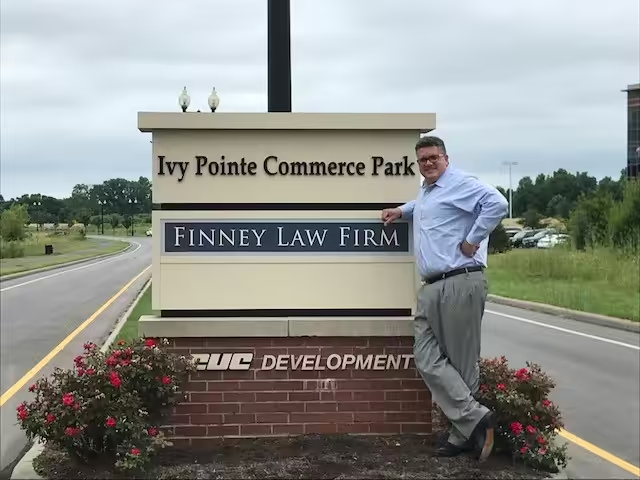
Our thanks go to Union Township for adding this identifying sign to the Ivy Pointe Commerce Park today. We have made a commitment to Union Township, and they have made a commitment to us!
The Finney Law Firm prides itself on our aggressive stance in countering the actions of bureaucratic bullies through claims resulting not just in a victory in the administrative battle being fought, but also in recovering monetary damages, attorneys fees and injunctive relief against those very bureaucrats.
However, because of abstention under Younger v. Harris, 401 U.S. 37 (1971), and its progeny (that has been significantly scaled back by a the recent Supreme Court decision in Sprint Communications, Inc. v. Jacobs, 571 U.S. __, 134 S.Ct. 584 (2013)) and other principles of administrative law and comity, it is a bit of a challenge of how to “turn the tables” on government actors and bring a challenge under 42 USC Section 1983 concurrent with the administrative proceeding.
We had such a case in 2012. There, our client was being disciplined by the Ohio Elections Commission in a proceeding we were certain was unconstitutional violation of her free speech rights.
First, we raised First Amendment defenses before the agency. They were simply deaf to such arguments. Then, when filing our Section 119 administrative appeal in Franklin County Common Pleas Court, we appended a claim for declaratory and injunctive relief under the First and Fourteenth Amendments to the United States Constitution as allowed by 42 USC Section 1983.
And, of course, to level the playing field against an agency who had the full resources of state govermment against her, such claims include the right to have the client’s attorneys fees reimbursed by the State if the Plaintiff prevails.
In Magda v. Ohio Elections Commission, Franklin County Common Pleas Court Case No. 12-CVH 10-13674, the state opposed that Complaint saying that state law did not tolerate a Section 1983 challenge to accompany an administrative appeal. The trial court disagreed, and Judge Mark Serrott wrote this decision allowing the challenge to proceed arm-in-arm with the Chapter 119 appeal.
Judge Serrott later granted the State’s Motion for Summary Judgment, denying both our administrative appeal and the Section 1983 challenge to the statute. That decision was appealed to the 10th Circuit Court of Appeals. Interestingly, the State at that level did not renew their challenge to the Section 1983 claim accompanying the Chapter 119 appeal. Thus, the issue proceeded with both claims before the appeals court.
In the end, the Court of Appeals overturned the trial court decision and granted summary judgment to our client on both the administrative appeal and the constitutuonal claims. Thus, Plaintiff won a permanent injunciton against the enforcement of the statute and reimbursement of the full measure of her attorneys fees dating back to the initiation of the action before the agency under the constitutional claim.
So, yes, a constitutuional challenge (or any claim challenging the authority of the legislature to enact the offending law or the agency to enforce the same in the manner that it has), can be brought along with a Chapter 119 administrative appeal.
This vigorous and creative response to a prosecution by bureaucrats raging out of control in Columbus is a prime example of how the attorneys at the FInney Law Firm succeed in “making a difference” for our clients.
Let us know how we can solve your business and bureaucratic challenges.
Ohio has robust laws in place to ensure that the public business is done in the public and available for public inspection. From protecting citizens’ rights to attend meetings of local government bodies, to newspaper reporters being able to access and report on the financial records of the Cincinnati Streetcar project, or new public works proposals, the Open Meetings Act and Public Records Act, together the Sunshine Laws, provide for citizen oversight of their government.
First, the Open Meetings Act, R.C. 121.22, declares that, “All meetings of any public body are declared to be public meetings open to the public at all times.” This means that, other than those limited exceptions allowing public bodies to go into “executive session,” public bodies (city councils, township trustees, school boards) must conduct their deliberations in meetings open to the public.
Next, the Open Meetings Act requires public bodies to promptly prepare, file, and maintain minutes of all regular and special meetings, and to make those minutes open to public inspection.
Finally, the Open Meetings Act puts teeth to these requirements. Any person can bring suit to enforce these mandates. If you know of a violation or “threatened violation” by your local school board or city council, you can bring suit to force compliance. If successful, the court would enter an injunction against the public body to compel the body to comply with the Open Meeting Act, as well as an award of $500 per violation or threatened violation, and your reasonable attorney fees.
Thus, determination of whether the Open Meetings Act applies requires a multi-step analysis: Is there a “public body” involved? Was there a “meeting”? Was the public excluded from that meeting? And, finally, was such exclusion improper?
In addition to the requirement that public offices and public bodies meet in public and make minutes of those meetings available to the public, Ohio’s Open Records Act, R.C. 149, requires that public offices keep and make available any document, device or item, “created or received by or coming under the jurisdiction of any public office…which serves to document the organization, functions, policies, decisions, procedures, operations, or other activities of the office.”
Again, Ohio law provides for exceptions to the general rule that public records are to be kept and made available to the public (R.C. 149.43 includes both the exceptions and provides for enforcement by the citizenry). Certain confidential records are exempt from disclosure, for instance. If an appropriate request for public records is denied improperly (or ignored), the requester can bring suit to compel the production of the records, and may be entitled to up to $1,000.00 per record, and her reasonable attorney fees.
The analysis of The Open Records Act, also requires multiple steps. Is there a public office involved? Is there a document, device or item (i.e. a “record”)? Was this record created, received or coming under the jurisdiction of the public office? Does this record “document the organization, functions, policies, decisions, procedures, operations, or other activities of the office”? Does the record come under one of the exceptions to the Open Records Act? Was a proper request made?
This area of law has been litigated numerous times, and for every simple proposition of law, there is a court decision that muddies the waters. A recent Court of Claims decision announced that records of court proceedings commenced after July 1, 2009, are not subject to the Open Records Act, and efforts to obtain such records must be brought through a mandamus action pursuant to the Rules of Superintendence under R.C. 2731. This issue will no doubt be further litigated; and ultimately the Ohio Supreme Court will be called upon to clarify this question.
Finney Law Firm currently represents plaintiffs in three cases involving violations of the Open Meetings Act, and has represented both citizen activists and public bodies on questions of the Sunshine Laws. Finney Law Firm’s attorneys have litigated nearly every aspect of Ohio’s Sunshine Laws, and have given presentations on these issues to civic groups, officeholders, and continuing education programs. If you believe a local public body is violating the Open Meetings Act or need assistance obtaining public records, or if your group would like to host a presentation on Ohio’s Sunshine Laws, contact Christopher P. Finney.
With the advent of the camera phone, the ubiquitous device in everyone’s pocket, there is no longer an excuse for failing to document “things” for posterity. And such forethought from our clients can prove decisive in a legal battle.
The best example of the value of real-time photos is in construction disputes. We find it is regular practice of owners, architects, engineers, contractors, and materialmen to take photos at each stage of the work completed, which helps to establish the quality of the work, the conformity of the work to the plans, and the stage of completion at a particular point in time, and perhaps document the development of defects in material or workmanship as they are installed. (This then, of course, helps to pinpoint the blame.) The forensic or retrospective value of photos at each stage of construction can be invaluable.
Another example of the value of photos is in commercial and residential landlord/tenant in disputes. In those disputes, the condition of the property as delivered to tenant or as surrendered to landlord is frequently contested. My sharper clients have taken the time to document the condition of the property both at the beginning and end of the relationship with their camera phone. Those photos can make a liar of a defendant (or plaintiff) and permit a party to establish his minimum elements of a case he is presenting.
The existence of photos also could be used in an automobile accident situation, a dispute over the quality of goods delivered or to prove a person was in a particular place at a point in time.
Another example for me personally is that I just hate to get parking tickets, yet many times those darned parking meter are malfunctioning. When this happens, I take a business card, note on it “out of order” and slip it into the “credit card slot” on the meter while my car is parked there. Before slipping the card into the slot, I take a picture of the meter (they all have identifying numbers on them now) and the “out of order” card.
Photos are, of course, generally going to be admissible as evidence in a trial or in alternate dispute resolution. So often at trial, I hate to say, one party or the other is outright lying to the judge. A photo can clear up the inconsistency in statements pretty effectively. The judge or jury should be thrilled to have such (nearly) incontrovertible evidence versus deciding which party is lying.
The memory capacity for photos on your telephone is almost unlimited, and it takes mere seconds to snap several pictures. Think about thoroughly preserving the record for posterity (or trial). Make the time to take several (indeed dozens) of shots — narrow and wide angle, and from every perspective — to preserve the moment for later reference.
Get with the times. Use this incredibly effective tool to enhance your position in dispute resolution. Or, saying it differently, I get frustrated when a client could have made their case stronger simply by whipping out that phone and documenting and saving information for a later date. This is especially true when the client knows the matter is heading into litigation.
Our Ohio clients frequently come to us having performed their own amateur sleuthing on questions about title to real property before an initial meeting. And the easiest place for them to have started their work is the County Auditor’s web site.
Based upon the Auditor’s information, they many times have drawn preliminary conclusions regarding who owns the property, the configuration of the property, and in some cases access road information. And they have formed preliminary opinions about the topic they want to discuss.
Thus, the client has come to see me asking to confirm what they have learned, and to seek more information about their property, and to then act upon that information, enforcing their rights through legal action.
The question addressed in this blog entry is:
How reliable — from the perspective of establishing legal title to real property — is that information on County Auditor’s web sites?
There are a host of on-line resources about real property in Ohio, including building permit issuance and code violations, recorded deed and mortgage information, City, Village and Township ordinances and resolutions establishing assessments and condemnation proceedings, aerial photographs, and maps showing improvements and public utility information. In Hamilton County, for example,
County Auditor web pages are different in each County, but as a general proposition, I find the Auditor’s web site to be among the most easily accessible and broadly informative sites on real property in Ohio. In my experience, every Ohio County has a pretty good Auditor’s website.
For example, here is the Hamilton County Auditor’s site. Each site is chock full of useful information on every tax parcel in the County: A property search function that reveals property tax valuation, information on the current and past property taxes [amount and payment history], the sale price and date, the acreage, a drawing and picture of the house and sometimes other improvements, an aerial map and a tax map.
[Note: Our office provides a valuable service to clients in helping them to reduce their real estate taxes. The essence of this service is to shallenge the County Auditor’s valuation as being too high, which frequently they are, however, in many cases — perhaps an equal or greater number of cases — the valuations are too low. The point here is that even the County Auditor’s valuation is but “one man’s opinion,” and it too can be a point of reference, but is not the last word on valuation quesitons.]
And their question, a question I received today from a client, is
“can I rely on the information on the Auditor’s web site in drawing conclusions about real estate title.”
The short answer is: “No.”
As to real property in Ohio, the County Auditor has a big job, but a relatively simple job: (a) to divide up the County into separate parcels on his records for taxation purposes and (b) to establish a valuation of each parcel for tax purposes. That’s it.
What this means is that sometimes:
A year ago, I had an instance in which a client who had purchased real property was distressed that for nearly two months the site was not updated showing him as the owner of real estate. In that instance, the Auditor had stopped updating his site for a period of time for some year-end reconciliation.
But importantly, the Auditor does not claim to be the official or last word on “who owns property.” That simply is not the function of the Auditor’s web site or the Auditor’s office.
Well, in truth, title to real property is not “a piece of paper,” but is a legal construct that is established by records from a number of offices — the County Recorder, the County Engineer, the Clerk of Courts, County Probate Court records, and Federal Bankruptcy Court records. Ohio has detailed standards for how legal title is to be established: The Ohio Title Standards prepared by the Real Property Law Section of the Ohio State Bar Association.
But the main repository of the official records of “who owns property” is the office of the County Recorder. And, unfortunately, at least at present, at least for a layman (it may depend on the County), it simply is not as informative and user-friendly as the County Auditor’s site.
To establish title to real property, which really requires a review of all of the records noted above, our firm uses the services of a professional title examiner. That examiner will, using indexing systems established in each County, find the current deed to the property, establish what other claims appear in the various records (monetary liens, easements, covenants, etc.), and based upon all of that information we should be able to establish the claim at issue.
Sometimes we determine that title or the issue in question can’t be made clear from the real estate records and either further documentation is required (by others affirmatively relinquishing their interests) or a court proceeding is necessary to “clear title.”
So, this blog entry has taken our fine readers through a shortened version of the legal maze that exists in Ohio (and most other states) to establish ownership of land, as well as easement and covenant rights of owners and their neighbors.
But the important point made here is that (a) the Auditor’s records are a great shorthand way to quickly find out information about property, including less-than-fully-reliable information about current ownership. But (b) the Auditor’s records are not — and are not intended to be — reliable information on which legal conclusions should be drawn and acted upon, especially ones that are of any importance.
Please call our real estate professionals, Isaac T. Heintz, Eli Kraft-Jacobs, Chris Finney and Rick Turner with your questions about real estate title.
In commercial tenant space, whether office, warehouse, manufacturing or retail, landlords typically want three-, five- or seven-year lease terms. And this is reasonable given the cost of tenant build-out, Realtor commissions and the demands of their mortgage lenders. It also is relatively standard in the marketplace.
However, a tenant will rightfully reason that they can’t anticipate their space needs for a year much less over a seven-year period of time. The company might need to relocate, be bought out or go out of business, the principal could die or become disabled, or the tenant’s business model could change substantially.
One concession I recommend that tenants request in a commercial lease is an early-termination option. By having the right to walk away from a lease, it gives enormous flexibility and power to a tenant. Recently, a landlord explained to me that he is glad to offer this tenant concession.
Typically, a termination option is not free. Here are typical issues a landlord will want to discuss:
So often I am consulted after the fact by a tenant who wants “out” of their lease on a document we were not asked to help negotiate, and the tenant is in a real spot. Sometimes in that circumstance the landlord is digging in his heels wanting the full rent and CAM amounts for the entire lease period — and they may well be entitled to that.
But if only the tenant had asked for this simple concession on the front end — when he had negotiating power — his life would be simpler and his finances richer.
__________
If you want to speak with our commercial leasing attorneys, ask for Issac T. Heintz, Eli N. Krafte-Jacobs or Christopher P. Finney.
On Friday, the Cincinnati Enquirer and USA Today wrote about our case, NorCal Tea Party v. IRS, the only nationally-certified class action challenging the IRS’ and Lois Lerner’s targeting of Tea Party groups for extraordinary review in their non-profit applications.
The new development in that long-running case is that Lois Lerner and her chief lieutenant, Holly Paz, seek to have their deposition testimony sealed, and indeed all pleadings relating to the sealing sealed as well. (You will remember that Lois Lerner pled the 5th before Congress and refused to testify about the scandal, and her role therein.) Indeed, Judge Barrett has ordered a sealed hearing on those motions for this Friday. You may read all about that here.
Well, today, the Gannett GP Media, Inc., the parent company of USA Today and the Cincinnati Enquirer, filed a motion to intervene in the case for the purpose of forcing open the pleadings, the deposition transcripts and the hearing.
Read about that here.
The Enquirer’s Motion is here and their tendered Memorandum in Opposition to the Lerner/Paz motions is here.
In our firm’s relentless pursuit of public interest law, we consider this issue, and this case, to be among the most consequential matters we have addressed.
As attorneys, especially in a smaller city like Cincinnati, we can be tempted to trust one another, especially experienced real estate practitioners as to the timing of recording of instruments. But that trust can be misplaced, as many times between the “closing” and “recording” things go awry.
In Ohio, particularly southwest Ohio and for residential properties, round-table closings are common. For clients from other parts of the country, this can seem like a quaint (and legally dangerous) custom.
The buyer, seller, lender, and Realtors all gather in a room with a title agent to sign and exchange documents and funds. This ceremony is a “closing” and there occurs the formal payment of the purchase price, funding of the loan and the delivery of the deed.
This can differ from closings more common in other parts of the country where the seller places in escrow the deed, the buyer places in escrow the note and mortgage and the lender and buyer pay the sums to the escrow agent. (Escrowed closings are not unheard of in the Cincinnati marketplace, especially for commercial transaction or corporate executives whose schedule will not allow them to attend a closing in person.)
In this setting, the title agent holds both the escrowed funds from the buyer and the lender, and the deed and mortgage for recording. Then, he records the instruments and checks the title to assure that “all is clear” before disbursing funds.
Thus, with an escrowed closing, there is no “gap” between funding the recording. The funds are not released until after recording and title updating showing no intervening liens or deeds.
However, with a roundtable closing, the funds are released to the seller at the closing table, and the deed and mortgage may not be recorded for hours or days. In the meantime, in theory if not in practice, a deed, easement, mortgage or involuntary lien (such as a tax lien, a judgment lien or a mechanics lien) could be recorded against the real estate.
Since Ohio is a largely race/notice state as to the order of recordation of instruments (whoever records first without actual notice of someone else’s interest in the property “wins” the contest for priority), the later-recorded deed or mortgage would lose priority to an instrument intervening beforehand.
This is a large potential risk in terms of losing value for the buyer or lender. The total value of the real estate can be lost as a result of such a priority issue.
This timeframe between closing (or the last title update) and the recordation of the title instruments is known in the real estate industry as the “gap.”
So, the issue for a buyer should be: Who is taking the risk for the gap? It goes without saying that a seller delivering a warranty deed is promising to deliver good title to the buyer. But what if the seller is a crook, bankrupt, deceased or simply un-findable after the closing?
Well, (a) if a buyer purchases an owner’s policy of title insurance, (b) specifically requests that the title company insure the “gap,” and (c) that “gap” coverage is issued at the closing table, then the buyer will be protected from losses from an intervening instrument. If all three circumstance are not present, then the buyer is going to bear this risk and have claims solely against the seller for breach of warranty covenants.
We recently were approached by a buyer from a round-table closing on a residential property. It took the title agent six days after the closing to record the deed. In the intervening timeframe, the seller gave a deed to a second buyer. (Sure, this was entirely fraudulent conduct by the seller, but nothing should surprise us anymore.) That second buyer’s deed went on before the deed of the first buyer. The first buyer even purchased an owner’s policy of title insurance, meaning at the closing he obtained a “commitment” for a title insurance policy. But that commitment did not contain “gap” coverage language, rather the policy was conditioned upon the instruments being recorded without loss of priority.
That particular matter is still in litigation, but, win or lose, this story highlights the grave risk of closing a transaction by roundtable closing, and failing to ask for and obtain affirmative “gap” coverage. This admonition applies equally in residential and commercial transactions.
Finally, this ties in with our earlier admonitions: (a) buy title insurance (Why title insurance?) and (b) Don’t just buy a title insurance policy; read the policy, on our Ivy Pointe Title blog. While it would be nice to tell clients that protecting their interest is as simple as buying an owner’s policy of title insurance, it is not. The buyer must read and understand the exceptions to coverage and also ask for “gap” coverage. Otherwise, he retains significant risks of partial or total title failure.
The need for non-compete agreements certainly looks different from the perspective of being an employee versus being an employer, but no one can doubt both the recent proliferation of and significant career impacts of non-compete agreements.
Today’s New York Times offers an important and detailed perspective on the decision to sign such documents. Read it here: Signing Away the Right to a New Job
Think carefully about signing such documents.
Finney Law Firm attorney Stephen E. Imm practices extensively in the area of both enforcing and defeating non-compete covenants and writes here about the law in Ohio relating to their enforcement: Non-Compete Agreements: Are they enforceable in Ohio?
Let us know how we can help with your labor or employment issue.