I recently was asked by a commercial real estate salesman desiring to refer to Ivy Pointe Title: “Who is your underwriter and what is the quality of their paper?”

Who is our underwriter?

We are proud to have been accepted as an agent for First American Title Insurance Co.  We write exclusively with First American as our title underwriter.

Who is First American?  

From their web site:

  • First American is the title insurance industry’s largest single brand name;
  • First American has been issuing title insurance for more than 120 years.

What are First American’s financial strength ratings?

  • Moody’s Investors Services: A3
  • AM Best: A Excellent
  • Fitch Ratings: A

Our firm obtains great support from the underwriting staff of First American and have a high degree of confidence in the coverage they provide to our clients and customers.


The Cincinnati-area adult continuing eduction series “Empower U” is presenting this Thursday night “Property Tax Valuation Reduction” by Chris Finney.

The Finney Law Firm has handled hundreds of property tax valuation complaints in Ohio and Kentucky in the past two years.  This course instructs home and business owners how they can — on their own — lower their property taxes.

The course is this Thursday night, March 3, at 7 PM at the Empower U Studio at 225 Northland Blvd.  You may RSVP here.  Also, the course will be a “virtual seminar” that you can watch on line.   Just click here after 6:50 PM on the night of the class.

The Empower U link for the announcement is here.

On Wednesday, the 6th Circuit Court of Appeals upheld the decision of Federal District Court Judge Timothy Black to strike down Ohio’s “False Statements” statute as a violation of the First and Fourteenth Amendments to the United States Constitution.  The decision in  Susan B. Anthony List v. Ohio Elections Commission is here.  The Finney Law Firm represented in this litigation the Coalition Opposed to Additional Spending and Taxes (COAST), which had joined the litigation as an intervening Plaintiff.

The litigation commenced in 2010 when the Susan B. Anthony List put out press releases and attempted to erect billboards that explained that Congressman’s Steve Driehaus’ vote for the ObamaCare legislation was a vote for taxpayer funding of abortions.  Driehaus filed a “False Statements” complaint on the pronouncements before the Ohio Elections Commission.  Susan B. Anthony List sued, claiming the statute violated its free speech rights under the U.S. Constitution.  COAST intervened in the litigation claiming that it, too, desired to make these same statements but was “chilled” by the threat of administrative and criminal prosecution.

Under Ohio’s statutory scheme, anyone can bring before the Ohio Elections Commission a claim that someone uttered a “false statement” in the course of an election campaign, intending to impact the outcome of the election.  Then, the panel had to first decide if there was “probable cause” that the utterance violated the statute.  Discovery would ensue, and then a trial would be held to ascertain if the statement was knowingly false of reckless — in the judgment of three Republicans, three Democrats and an independent.  If so, they would make a public finding of falsehood, and could refer the matter for further criminal prosecution.

The problems, of course, with this process, include that (i) it places the judgment of campaign falsehood in the hands of highly political, non-attorney, non-judicial political appointees who fail to understand the breath of First Amendment protections, (ii) it becomes a cudgel in the hands of political opponents, and (iii) therefore has the effect of suppressing entirely truthful speech for fear of a protracted and expense

Over the decades that Ohio’s False Statements statute was in effect, there have been many attempts to challenge the constitutionality of the law, but the 6th Circuit previously had ruled that a very similar statute was constitutional.  Further, each new attempt to challenge the statute was rebuffed by trial courts and the appeals court as lacking “standing” to challenge the law.

In April of 2014, the Finney Law Firm went to the United States Supreme Court on that “standing” issue and prevailed 9-0 in a Clarence Thomas-authored opinion.  That decision is here.  That case was unique for many reasons, not the least of which was the varied amicus briefs the litigation attracted, including one from Ohio Attorney General Mike DeWine attacking the law, although he is the attorney charged under Ohio’s Constitution with defending it.  That June 2014 “victory” merely placed the decision back before the trial court.  In September of that year, Judge Timothy Black ruled in favor of Plaintiffs and permanently enjoined the statute.

Wednesday’s 6th Circuit ruling upheld that decision of Judge Black.

The Ohio Elections Commission can now either accept the 6th Circuit’s ruling, or can elect to ask all 15 judges on the 6th Circuit to review the ruling en banc or appeal that ruling to the United States Supreme Court.  In oral argument and a prior ruling in United States v. Alvarez and at oral argument in the Susan B. Anthony List case, both liberal and conservative members of the Court indicated that they thought statutes like Ohio’s are unconstitutional.  Further, the High Court accepts fewer than 1% of all cases presented to it.  Thus, this should be the “end of the line” for prosecution under Ohio’s False Statements statutes.

Finally, Finney Law Firm is currently prosecuting three cases in this vein: (i) the Susan B. Anthony List case, (ii) COAST v. Ohio Elections Commission (known as the “tweets” case that is pending before the 6th Circuit), and (iii) Magda v. Ohio Election Commission that is pending before the 10th District Ohio Court of Appeals in Columbus.  Wednesday’s victory should seal the fate in the other two cases as well.

In all, Wednesday was a good day for free speech in Ohio.

Media coverage of this decision is linked below:

Professor Volokh/Washington Post: Court strikes down Ohio ban on knowing or reckless falsehoods …

Cleveland Plain Dealer: Ohio politicians can legally lie in campaign ads, appeals court says

Columbus Dispatch: Appeals court strikes down ban on campaign lying

AP: Court axes law banning campaign lies

ABA Journal: Appeals court strikes down Ohio laws banning political lies


This article from the National Association of Realtors explores some of the means by which cybercrime is hitting real estate transactions.

Finney Law Firm, LLC and Ivy Pointe Title, LLC are equipped with the latest technology, tools and standards required by the CFPB to assure secure transactions, but…you can never be too careful.

Read and implement these NAR tips to make sure you and your clients and customers are not victims!

Realtors have amazing new tools at their fingertips almost daily with emerging web sites and smart phone apps.  Still, we are impressed with the new web site and mobile app of the Hamilton County Auditor.

HamiltonCountyAuditor.org  has a smart new interface and valuable tools for Realtors, including:

  • Property search, which quickly allows you to access property description, auditor’s valuation, tax information and sales history.
  • Detailed instructions for property valuation complaints.
  • On-line forms such as the CAUV form, rental registration form, and a Homestead exemption form.
  • A calculator that estimates the impact of upcoming tax levies on your property’s taxes.
  • Streetview photos and aerial/CAGIS imaging of the property.

Dusty Rhodes also has a nifty mobile phone app available both for I-Phones and Android phones that allows for limited information under the property search function such as Auditor’s valuation, sales history and streetview and aerial images of the property.

We recommend that every Realtor, commercial and residential, load the mobile app to their phone.  It is a powerful tool.


We are proud to act as local counsel in the case Nor Cal. Tea Party v. IRS before Judge Susan J. Dlott.  We write here that last month Judge Dlott certified the matter as a class action, an important development in a very important piece of litigation.

Here, Forbes Magazine’s Peter J. Reilly writes on the litigation.  He takes a decidedly conspiratorial and liberal bent against the Plaintiffs in the matter, alleging dark money connections and “weaponization of non-profits,” a new favorite accusation from left-leaning pundits.

He concludes:

At least for the upcoming election cycle, they have pretty well defanged the IRS, but it may be that this litigation is meant to be part of stomping on it and grinding it into the dust.


Every parcel of real property in Ohio undergoes a major “reappraisal” by the County Auditor’s office every six years and then a minor “update” in the three years in the middle of that six-year cycle.  Different counties in Ohio are on a different six year and three year cycle.

Below are listed the counties that went through a major “Reappraisal” in 2015 (that new value first appearing on the January 2016 tax bill) and a minor “update” in 2015 (that new value also first appearing on the January 2016 tax bill).

The other thing important about the valuation cycle is that regardless of whether another tax complaint was brought previously, every property owner has the right to challenge his property’s assessment before the Board of Revision in the new triennial.

The schedule of counties starting a new triennial this year follows:

2015 Reappraisal Counties

Allen

Coshocton

Guernsey

Sandusky

Vinton

2015 Update Counties

Belmont

Brown

Crawford

Cuyahoga (Cleveland)

Erie

Fayette

Highland

Huron

Jefferson

Lake

Lorain

Lucas (Toledo)

Morgan

Muskingum

Ottawa

Portage

Stark

Warren

Williams

If you want our assistance with a property valuation challenge, call Anna Ausman at 513-943-6651.

After 30 years as a real estate attorney, I thought I had seen everything: Bill Erpenbeck, mortgage fraud, short sale fraud, and the massive fraud perpetrated on America by Wall Street in the housing crisis.  Indeed, well before the mortgage crisis hit with full force, I authored a continuing education course entitled “Fraud” and taught it to thousands of Realtors, builders and lenders exposing rampant fraud in the residential and commercial real estate industry .

But still I was shocked in the past two years to be personally involved in two cases involving outright theft of real property right here in Hamilton County.  One of those cases is highlighted in the Cincinnati Enquirer here.

Background: The passive, unilateral nature of our property recording system

Assuming that the Hamilton County Commissioners’ abolition of registered land has been effective (read here), the land registration system is entirely passive from the County’s perspective in both Ohio and Kentucky.  This system of land record recordation is typical throughout the nation.  What this means is that by and large the government officials responsible for accepting documents for recording do just that — they accept what is presented to them, and then index them.  They do nothing at all to check their validity.

To transfer real property, one simply brings in for recordation a deed that is purportedly signed and acknowledged (notarized) by the current owner.  In Ohio, the Auditor will transfer the real estate on his records and “green light” the deed for recording by the Recorder.  The County Recorder simply time-stamps and records whatever original instruments are presented to him in proper form and with a property legal description.  In Kentucky, the County Clerk performs these same functions.

It is no one’s job at the Auditor’s office or Recorder’s office to verify signatures — or even to check that the notary public acknowledging the signature is licensed by the state.

The system is “passive” in that the offices receive the instruments for recording, and as long as their grantor information lines up with public records, they index and record the transfer on their records.

Just prepare and sign a deed transferring property into your name

So, the new scam I have seen is follows this pattern:

  1. The fraudster forms a limited liability company that he owns and controls.  Anyone can do this with an attorney, through LegalZoom.Com or even just by completing simple forms available from the Secretary of State of each state.  (NOTE: Each state requires each LLC to have a “statutory agent” to receive formal legal notices, but many states — including Ohio do not require the ownership of the LLC to be publicly identified.  Kentucky does require LLC ownership to be disclosed.)
  2. The criminal then finds a suitable real property — presumably one that has vacant and neglected for some time.
  3. Then, the fraudster prepares a deed transferring that property into the name of his new LLC.
  4. He signs that deed or finds someone to sign it, and has it acknowledged (notarized).
  5. The notary public is required by law to verify that the signer of the deed, but many simply do not.  Further, if the target property is in a corporate name, it is unusual for the notary to check that the signer has authority in fact to sign for the seller.  (NOTE: In the fraud referenced in the article linked above above, he himself acted as the notary, and signed someone else’s name to the deed in place of the actual owner.)
  6. That fraudster then markets the property for sale and quickly — for consideration — transfers the property to a new buyer, pocketing the cash and disappearing into the woods.

The system is further undermined because office supply and stationary shops will produce a notary seal for anyone — or for a fictional name — without checking if that person is in fact a registered notary public.  Thus, the signer and the notary public can be fictional on a deed.

Experienced real estate professionals are shocked this could happen

I have had the chance over the past year to tell the story before audiences of experienced Realtors of two separate frauds in Hamilton County in which I personally participated — once representing the actual owner whose property was “stolen” in this fashion and once representing the end buyer.  In each instance, the Realtors were shocked and dismayed that our land title registration system could be so easily gamed.  But it can and does happen.

How buyers can protect themselves

As we have explained here, when buying real property there are only two layers of protection for the buyer: (i) the Seller, who makes broad promises by means of a general warranty or limited warranty deed has continuing obligations to the owner under that deed to assure that title is “good,” and (ii) the coverage provided by an owner’s policy of title insurance.

Many sellers have “nothing to their name,” and thus the promises they make under warranty deeds could be worthless — and it is difficult for a buyer to ascertain whether a seller has the means to stand behind their promises.  Thus, when I sit at a closing table and hear a buyer tell me why they have no need for an owners’  policy of title insurance — or worse, for their Realtor to explain that it is worthless — I cringe.  I don’t want to argue to convince a buyer to purchase something that I am selling and profiting from, but at the same time  I do know there are risks the buyer is undertaking if he does not obtain that coverage.  The “theft of real property” described above is one of these risks that is difficult or impossible for the closing agent to detect, but one fully covered by title insurance.

The end of the stories

We mention two scenarios above where our clients were victims of property theft.  In the first instance, our client was the buyer — and he had purchased an owners’ policy of title insurance.  Thus, he was made whole by the underwriter as son as the real owner made a claim to title to the real estate.  In the second instance, our client was the owner at the time of the “theft.”  He instituted a “quiet title” action to recover record ownership of his property and won a default judgment against the wrongdoer, vesting title back in the rightful owner’s name.  That client elected not to pursue the tortfeasors — the thieves, the notary, the closing agent — any further to save time and money.

Conclusion

The moral to this story is twofold: (i) don’t kid yourselves, it is dangerous out there, and (ii) title insurance covers a multitude of “sins” when real estate title goes bad.

Let Finney Law Firm and Ivy Pointe Title, LLC help you avoid and insure over these risks of real estate investing.  Call Rick Turner of Ivy Pointe Title with any questions at 513-943-5660.

Chris and Dusty

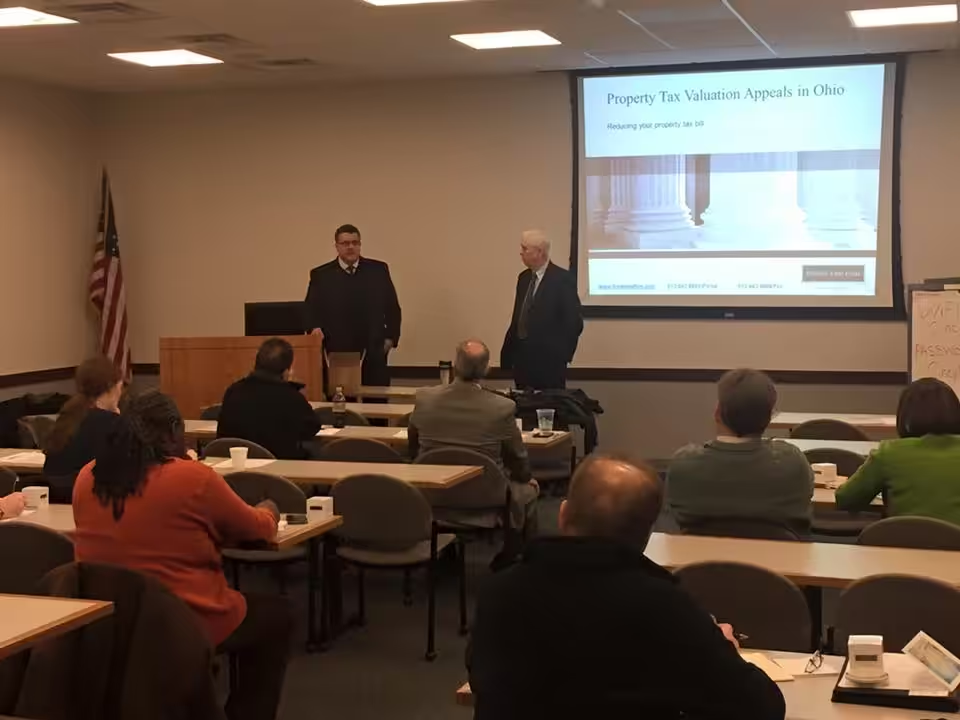
On Friday, January 20th, our own Chris Finney taught a 3-hour continuing education class before the Cincinnati Area Board of Realtors with Hamilton County Auditor Dusty Rhodes.  Rhodes has graciously co-taught this course — approximately 12 times — over the past seven years with us.

The class, presented to about 35 Realtors, teaches about intricacies of the property tax bill, as well as hands-on, step-by-step, do-it-yourself instructions about how to prepare a complaint and present a case before the Boards of Revision in each of Ohio’s 88 counties.

A detailed self-help video of a similar presentation is available here.

The filing deadline in Ohio is March 31 of each year.  If you want this firm to assist you in the presentation of your Complaint, please contact Anna Ausman at (513) 943-6651.