
Whether one agrees or disagrees with the Ohio Department of Education’s adoption of Critical Race Theory and the 1619 Project’s for implementation throughout Ohio’s school systems, we should all agree that an open and robust debate about that policy before public bodies is appropriate and required under the U.S. Constitution. But that’s not how the Ohio Board of Education sees things.

Once they hastily adopted the new policies, they then formally forbade speakers before them from criticizing their decision. The ODE allows public comment on all other topics, but specifically not these two.

So, last week, the Finney Law Firm filed suit against ODE challenging these restrictions on speech during the public comment section of Board meetings. Read that suit here.

The Board did not just quietly and unconstitutionally squelch in a public forum,  but they explained why they were privileged — indeed compelled — to trample on the Constitution in this instance:

  • “[O]ur board president has instituted a policy that prevents people from speaking to our group in reference to any of these issues about critical race theory, etc.…  I’m not sure why we have a filter on what we’re allowed to hear here, but we do.”
  • “I was really glad when [LAURA KOHLER] said we weren’t going to have those speeches anymore”
  • “I would just prefer that we not have a conversation about critical race theory, or 1619….”
  • “I don’t want to sit here again and listen to two months of people – they have their opinions….  This is not what I’m here for”
  • “I’m using race and I don’t feel ashamed about that”
  • That if such public comments or testimony were allowed then the meeting of the OHIO STATE BOARD OF EDUCATION “would not longer be a safe space for me”

I suppose if you are that delicate and thin-skinned, perhaps you should not sign up for the rough and tumble of public office. Just a thought.

Media coverage of this is below:

For inquiries on this story, contact Curt Hartman (513.379.2923) or Chris Finney (513.943.6655).

Today, President Joseph Biden announced immediate and significant changes to the Paycheck Protection program, as follows:

  1. Priority period for businesses with fewer than 20 employees for two weeks starting this Wednesday, February 24th.
  2. Different loan (grant) calculation for sole proprietors and a set-aside of $1 billion for businesses in low- and moderate income areas.
  3. Made eligible those with non-fraud felony convictions.
  4. Made eligible business owners with student loan defaults.
  5. Made eligible all lawful U.S. residents with visas or Green Cards.

Forbes magazine has more details on these breaking developments here.

The second round of stimulus signed by then-President Trump in December extended the Centers for Disease Control limited federal eviction moratorium (started in October) through January 31, and then immediately upon taking office, President Biden extended the stay on evictions through March 31. So, landlords of qualifying non-paying tenants continue to be legally prohibited from recovering possession of their properties.

And a related component of the second stimulus bill was a rental assistance program that allowed tenants — with federal subsidy — to continue to pay their rent, and even recoup back rental accrued, so landlords could be made whole despite the eviction prohibition.

Today’s New York Times writes on the toll the pandemic is taking on the housing industry, including landlords and tenants, which led us to update on “what is the status of the rental assistance component of the stimulus bill?”

What do we know:

  • The rental assistnce is being given from the federal government to the states, who will then each establish their criteria, and application and distribution programs. Some states will be distributing the money to counties and cities for further distribution. What this will mean is a patchwork of criteria for qualification, multiple software portals, and delays in implementation.
  • We have inquired to to roll-out dates and assistance criteria and, at least as to Ohio and Kentucky, not only are none of the application and distribution procedures known, there does not even appear to be discussions with stakeholders taking place as to how best to get the assistance to those in need.
  • Thus, we had hoped that tenants and landlords could get relief by some time in March, but that does not appear feasible. Our best bet right now is April/May, but that is just speculation.

The fact that Ohio paid out $330 million in fraudulent unemployment claims in 2020 will likely slow the process to assure that bogus rental assistance claims do not slide through.

We will attempt to keep our readers informed of developments on the moratorium and rental assistance programs as they emerge.

Every year, the Auditor of each of Ohio’s 88 counties publishes a chart like this showing the tax rates for each taxing district in each County.

In Hamilton County, there are 241 distinct taxing districts, each having a complex calculation to develop the net residential and commercial rates of taxation (taxing districts being greater in number than either municipalities and townships or school districts, because the boundaries of some frequently overlap one another). Here are the five highest commercial and residential taxing districts in Hamilton County:

Highest Commercial rates
Municipality Township School District Commercial millage Commercial percentage
Wyoming Springfield Finneytown 135.54 4.765%
Colombia Mariemont 131.356 4.618%
Springfield Finneytown 128.589 4.521%
Lincoln Heights Princeton 123.75 4.351%
Mt. Healthy Springfield Mt. Healthy 121.665 4.277%
Highest Residential rates
Municipality Township School District Residential millage Residential percentage
Lincoln Heights Princeton 111.466 3.919%
Wyoming Springfield Finneytown 110.344 3.879%
Mt. Healthy Springfield Mt. Healthy 104.619 3.678%
Springfield Finneytown 103.394 3.635%
Golf Manor Cincinnati 101.26 3.560%

As you can see, several Hamilton County commercial districts well exceed 4.0% in annual tax rates (approaching 5.0%) and the highest residential rates are bumping up against the 4.0% threshold.


We were just notified that attorney Christopher P. Finney, founder of the Finney Law Firm, again has been named “Leading Lawyer” by Cincy Magazine for 2021. The specific practice category in which Mr. Finney was selected is “First Amendment Law.”

These awards are on top of “Ohio Lawyer of the Year” by Ohio Lawyer Magazine, “AV Preeminent” by Martindale Hubbell, and the the firm’s recognition in “Best Lawyers” by US News.

We thank our clients for the opportunity to work on such rewarding and meaningful cases and these services for recognizing our proficiency.


The Cincinnati Area Board of Realtors today reported December 2020 home sales numbers. And once again reported record-breaking home sales:

  • The most home sales of any December in Greater Cincinnati.
  • Average sales and median pricing continued their ongoing increases.
  • Closings in December exploded, up 21.04% against a strong December 2019 with total sales volume up 35.66%.
  • December 2020 home sales were 2,267 compared to 1,873 in December 2019.

You may read the CABR release here.

One of Joe Biden’s first acts as President yesterday was extending the residential eviction moratorium until March 31, 2021. Read the CDC statement on that here.

We are hearing there will be extensive changes to the moratorium processes and procedures that will tilt the scales decidedly in favor of non-paying tenants. We will keep our blog readers updated on those changes as they occur.

The CDC in its release attributes the moratorium to “a housing affordability crisis” that they now place even more so on the books and backs of landlords to resolve.

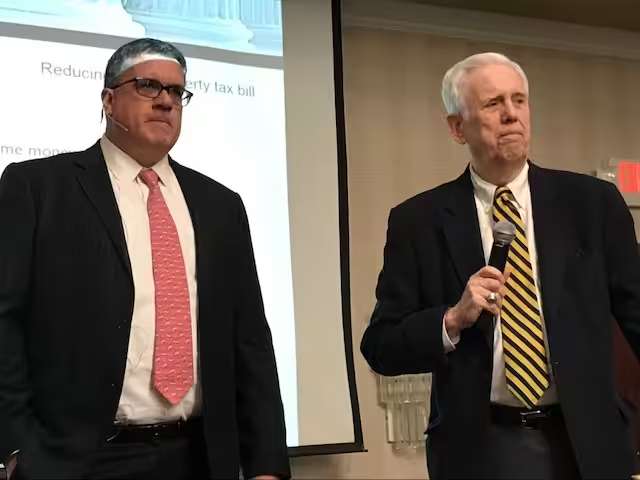
Today, Hamilton County Auditor Dusty Rhodes joined Finney Law Firm Chris Finney at a webinar hosted by the Cincinnati Area Board of Realtors to educate the public on “Ohio Property Tax Valuation Reduction.” Our thanks go to Auditor Rhodes and Christy Beaver, Director of Education the Board, for organizing and hosting this course.

Here is a link to the video. Please feel free to share it.

If our Property Tax Valuation Group can be of assistance to you, please contact Casey Jones (513.943.5673).