

Finney Law Firm has the honor to represent citizen journalist Patricia Meade before the Ohio Supreme Court in her efforts to expose the workings of her hometown’s government to public scrutiny.

In State ex rel. Meade v. Village of Bratenahl, we are appealing lower courts decisions that permit public bodies in Ohio to vote on any issue by secret ballot. The opportunity for mischief is readily apparent.

The Ohio Supreme Court accepts only approximately 5% of appeals, so just getting the case accepted is a major accomplishment. We are cautiously optimistic that the Ohio Supreme Court will be convinced by our argument and longstanding precedent and overturn the decision of the Cuyahoga County Court of Appeals.

Today we filed our merits brief. Read the brief online here or below. We expect that one or more “friends of the court” (interest groups or others who are not a party to the case, but are concerned with the outcome) will also file a brief in support of our position (an amicus brief) in the coming days. The village will have thirty days to file their own brief, and then we will have fifteen days to file a reply.

This case is an important case for all Ohioans, as it will determine what, if any, information the people are entitled to know about how their elected officials vote on particular issues and whether citizens will have an ability to hold their elected officials accountable for their official action.

View all case filings on the Ohio Supreme Court website, here.

We expect the Ohio Supreme Court will hear oral argument in the case sometime in early 2019.

Update – The Ohio Coalition for Open Government, Reporters Committee for Freedom of the Press, and the Ohio Association of Broadcasters filed an amicus brief today in support of our position. Read their brief here.

[scribd id=385107210 key=key-LlVsGVD75PeBy8u7osNx mode=scroll]

Ohio Revised Code Section 3503.06(C)(1)(a) declares that “Except for a nominating petition for presidential electors, no person shall be entitled to circulate any petition unless the person is a resident of this state and is at least eighteen years of age.”

Pretty straightforward, right? Not exactly.

Why? Because in 2015, U.S. District Court Judge Michael Watson correctly determined that the law was unconstitutional and permanently enjoined the state from enforcing the law:

Accordingly, the Court PERMANENTLY ENJOINS Defendants from enforcing the residency requirement for circulators of petitions for candidates and initiatives set forth in Ohio Revised Code § 3503.06(C)(1)(a).

Citizens in Charge, Inc. v. Husted, S.D.Ohio No. 2:13-cv-935, 2015 U.S. Dist. LEXIS 184669, at *10 (Mar. 16, 2015)

This is also included in Chapter 11 of the Ohio Secretary of State’s Ohio Election Official Manual, “A circulator is not required to be an Ohio elector or an Ohio resident.”

So, while the law remains “on the books” it is not, in fact, the law.

Citizens in Charge involved a statewide initiative petition, but the injunction applies to the all enforcement of the residency requirement for any initiative or referendum petitions, and any candidate petitions.

Finney Law Firm has on numerous occasions co-counseled with the attorney for Citzens in Charge, Maurice Thompson of the 1851 Center for Constitutional Law and are disappointed that this case is not more well known among Ohio political activists.

The issue has come up recently relating to the Hamilton County Sales Tax petition effort, and ongoing efforts to return Cincinnati City Council to two year terms. And it appears that confusion abounds, even among experienced political hands.

If you are circulating a petition or considering using out of state circulators for a petition effort, and someone tells you that circulators must live in Ohio; politely let them know that they are wrong and ask them to stop spreading such misinformation. If the person spreading the misinformation is a government official, contact the petition committee so that they can engage their legal counsel.

Finney Law Firm has assisted in drafting petitions and litigating initiative and referendum efforts throughout Ohio. If you or your petition group need assistance, contact Christopher P. Finney at 513-943-6655 or use our online contact form.

Attorneys in the Cincinnati Solicitor’s office filed a motion to withdraw its prior filing opposing intervention by Derek Bauman and a motion for additional time to file a new response, in our suit alleging violations of the Open Meetings Act.

Bauman’s attorney Paul DeMarco raised the question of conflict in a letter July 17, 2018 letter, questioning whether the City’s response was on behalf of Dennary, Landsman Sittenfeld, Seelbach,  and Young; or if the Solicitor’s office would be filling a separate memo on their behalf. And if so, whether the Solicitor’s Office had obtained conflict waivers from their various clients.

Read the filings here and here.

Hon. Judge Ruehlman

Today Finney Law Firm, on behalf of our client Mark Miller, filed a memorandum in opposition to the recent motion filed by one-time City Council candidate Derek Bauman, to intervene in our Open Meetings Act suit against five members of the Cincinnati City Council.

Attorneys for the City of Cincinnati also filed a memorandum opposing the intervention.

Judge Robert Ruehlman has scheduled oral argument on the motion for July 30 at 11:30 a.m. in Room 300 of the Hamilton County Courthouse, 1000 Main Street, Cincinnati, Ohio. The public is welcome to attend the oral argument.

We oppose intervention because the filing appears to be a poorly disguised effort at political gamesmanship rather than a sincere piece of litigation. Read the Motion to Intervene here. Read our memorandum here or below. Read the City’s memorandum here.

[scribd id=383979087 key=key-dda6L1oQ2UXSlIZtO4L1 mode=scroll]

Finney Law Firm represents Mark Miller in two lawsuits against Cincinnati City Councilmembers Dennard, Landsman, Seelbach, Sittenfeld, and Young. The first involving violations of Ohio’s Open Meetings Act; the second involving violations of Ohio’s Public Records Act. Read about recent filings in the Open Meetings Act case here.

In the Public Records Act case – before the Hamilton County Court of Appeal – the Councilmembers filed a motion for in camera review and for a protective order to prevent dissemination of the Councilmembers’ text messages and emails

They Councilmembers admit that there are additional emails and text messages that should have been provided in response to our public records request but contend that they somehow are not “public records” as that term is defined in Ohio law.

We find the Councilmember’s motion disingenuous, particularly in light of their own recent leaking of some text messages to a friendly attorney who then filed a motion to intervene in the Open Meetings suit on behalf of their political ally, Derek Bauman.

The Councilmembers’ motion can be read here.

Our memorandum in opposition can be read here and below.

[scribd id=383740777 key=key-dtiBHqAv2KOmi5vluPzF mode=scroll]

Finney Law Firm represents Mark Miller in two lawsuits against Cincinnati City Councilmembers Dennard, Landsman, Seelbach, Sittenfeld, and Young. The first involving violations of Ohio’s Open Meetings Act; the second involving violations of Ohio’s Public Records Act. Read about recent filings in the Public Records Act case here.

In the Open Meetings case – before Judge Ruehlman of the Hamilton County Court of Common Pleas – the Councilmembers recently filed a motion to limit and prevent discovery and publication of any documents produced in discovery. Today we filed our memorandum in opposition to that motion.

The Councilmembers ask the Court to prevent discovery because they claim some of the emails and text messages may contain information embarrassing to themselves or third parties. We point out to the Court that those third parties can easily be invited to state for themselves whether they want the materials released to the public; and that the law requires more than simply reciting the words “risk of embarrassment” before the Court can limit discovery.

Ohio’s Courts, like every other public body, are to be open to the public. By attempting to prevent public access to information produced in discovery, the Councilmembers ask the Court to facilitate their violations of the Open Meetings Act.

The Court has scheduled oral argument for this motion on August 16 at 11 a.m. in Room 300 of the Hamilton County Courthouse.

The Councilmember’s motion can be read here.

Our memorandum in opposition can be read here and below.

[scribd id=383738790 key=key-1gnTG4Ik6Opw29XE8e3I mode=scroll]


This morning the Ohio Supreme Court accepted our appeal from a Cuyahoga County Court of Appeals case questioning whether Ohio’s Open Meetings Act permits public bodies to vote by secret ballot.

A 2011 Ohio Attorney General’s Opinion Letter says no, as does a 2011 Hamilton County Common Pleas Court decision. But to date, the Ohio Supreme Court has not addressed this question. But the Cuyahoga County Courts disagreed.

This is an important case, meriting an amicus brief in support of jurisdiction from the Ohio Coalition for Open Government. Learn more about OCOG here.

The Ohio Supreme Court now has an opportunity to declare once and for all that secret ballot voting is not consistent with the demands of open government.

Case documents in State of Ohio ex rel. More Bratenahl et al. v. Village of Bratenahl et al.  are available on the Ohio Supreme Court’s website, here.

We will post updates as briefing is completed. Read more about this case here.

Today, attorneys for the City of Cincinnati filed the self-proclaimed “Gang of Five’s” answer to the April 9, 2018 Open Meetings Complaint (read the complaint here, read additional blog posts about the case here and here).

Surprisingly, the Gang of Five deny that they conducted meetings via telephone, email, and text message.  We say surprisingly, because the emails and text messages attached to the complaint make clear that the Gang of Five did conduct such meetings.

The councilmembers’  responses to interrogatories and requests for documents are due later this month, and depositions are set to begin shortly.

[scribd id=380988345 key=key-xzHGFm3H8LOpoQ42PC7i mode=slideshow]

As has been discussed in numerous posts on our firm’s blog, see here, here, and here, the changes to Ohio’s property valuation law enacted in 2012 are slowly coming into effect as the Ohio Supreme Court has been consistently ruling that the changes made by the legislator mean exactly what they say.

Notably, R.C. 5713.03 was amended specifically to require that real property be valued for taxation purposes, “as if unencumbered.” But auditors and school boards have resisted calls to apply the plain meaning of “as if unencumbered” to include leases, arguing that “as if unencumbered” refers only to liens or easements.

Yesterday (May 22, 2018) the Ohio Supreme Court weighed in again on the question in Lowe’s Home Centers, Inc. et al. v. Washington County Board of Revision, et al., Slip Opinion No. 2018-Ohio-1974, that “it is plain that a lease is an encumbrance and that R.C. 5713.03’s directive to value the realty ‘as if unencumbered’ means to value the realty as if it were free of encumbrances such as leases.” Id. at ¶19.

In Lowe’s, the County’s appraiser compared leased fee properties to the subject property to ascertain the value, and made adjustments to account for the leases. The Board of Tax Appeals adopted the value proposed by the County’s appraiser, but appeared to rely on a case decided prior to the amendments to R.C. 5713.03, thus leaving some question whether the Board of Tax Appeals analyzed the lease adjustments.

Unquestionably, the changes, aimed mostly at commercial property valuation, bring with them new challenges for Ohio’s auditors and school boards (the major recipient of property tax dollars). And there are certain to be calls for new amendments to undo some or all of the recent changes.

The deadline for filing Board of Revision Challenges has passed for this year. To learn about the Board of Revision process in preparation for next year, watch Chris Finney’s presentation here. Contact us here if you have questions about your commercial property valuation.

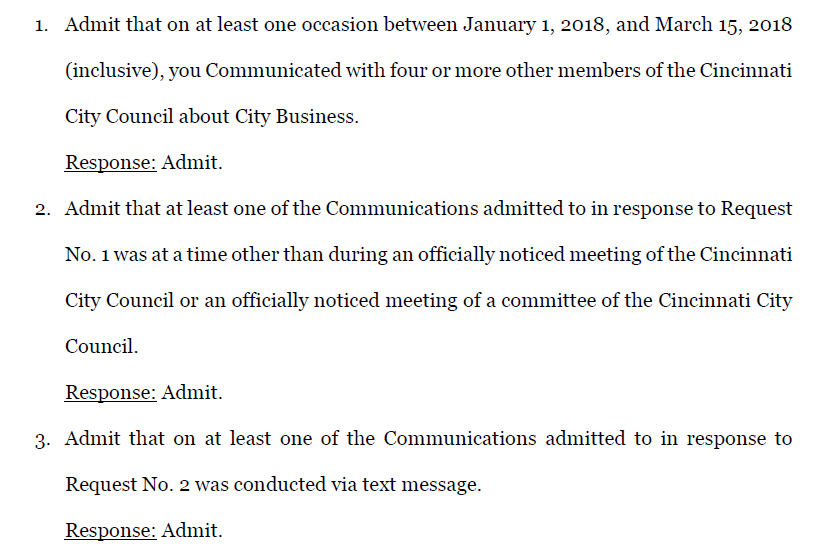
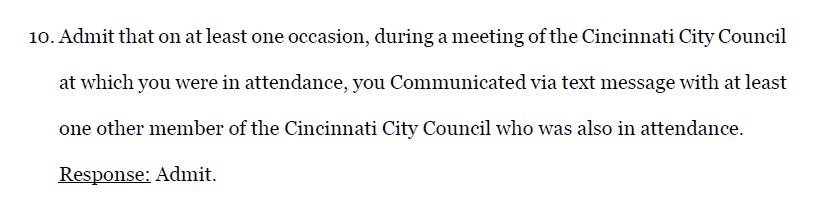
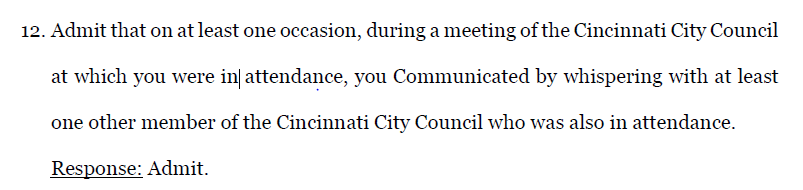
As part of their responses to the first round of discovery in our Open Meetings lawsuit, Cincinnati City Council Members PG Sittenfeld, Chris Seelbach, Wendell Young, Tamaya Dennard, and Greg Landsman – the Self-Proclaimed “Gang of Five” – have now admitted to additional Sunshine Law violations: other meetings conducted via text message, and whispering and texting to each other during City Council meetings.

Thus far, the Gang of five have only responded to our requests for admission, still outstanding are responses to our interrogatories and requests for documents. The City asked for, and we granted, an extension of time to respond to the interrogatories and document requests. Those responses will shed even more light on the topics of discussion during the illegal meetings and result in the production of additional text message correspondence between the Gang of Five.

What is unquestionable now is that the question of firing the City Manager was not the first time the Gang of Five discussed public business outside the public eye, in clear violation of Ohio’s Sunshine Laws and the Cincinnati City Charter.

Next steps are to obtain the additional written discovery responses and then depose the Gang of Five under oath.