In August of 2019, a unanimous Ohio Supreme Court declared that secret ballot voting violates Ohio’s Open Meetings Act in a win for Finney Law Firm and its client, Pat Meade.  The decision was authored by Justice R. Patrick DeWine and can be read here and below.

The issue: Do votes of public bodies have to be made in public?

In the Bratenahl case, the City Council had selected its president pro tem by secret votes on slips of paper handed to their law director, so others on Council and the audience could not see how their council members individually voted.  The secrecy was quite intentional. The result, ultimately after three separate rounds of paper ballots, was then announced by the law director. Thus, the question was squarely presented in court as to whether votes could be made in secret.

To us, the question of whether “opening meetings” includes public votes was obvious, but it was not so obvious to the Cuyahoga County Common Pleas Court, which ruled against our client on summary judgment.  The Cuyahoga County Court of Appeals (8th District) agreed with the trial court by a 3-0 decision.

Finney Law Firm heads to the Ohio Supreme Court

So, having lost unanimously before all four Judges to hear the issue, we, along with our client, determined to proceed before the Ohio Supreme Court, an against-the-odds process as the Ohio Supreme Court accepts only approximately 5% of appeals presented.  Thus, it was a significant accomplishment just to have the case heard by the Justices.

In March of this year, Mr. Hartman presented argument for the client before the seven Justices of the Court.  The City’s defenses included that (a) they can legally vote in secret and (b) because of the passage of time, the case was moot.

The Ohio Coalition for Open GovernmentThe Ohio Association of Broadcasters, and the Reporters Committee for Freedom of the Press filed an excellent amicus brief in the case.

Victory before the Ohio Supreme Court 

Today’s 7-0 decision held — something that seemed simple to this firm and our client — that it is not possible to comply with the mandate that Ohio meetings of public bodies be open, without deliberations and votes being in public as well.  They also quickly dispatched of the mootness argument.  It is a short and well-reasoned decision that firmly decides this this issue that otherwise was of first impression before the Court.

The precedent

The message for public bodies in Ohio by a series of decisions of the Ohio Supreme Court is that they mean business about openness in Ohio government.  They have ruled against public bodies trying to do end-arounds to evade Ohio’s openness requirement through deliberations by e-mails and a series of round-robin or revolving door meeting of fewer than a majority of the body.

Conclusion

We appreciate the firmness expressed by Justice DeWine and a unanimous Ohio Supreme Court demanding openness from all of Ohio’s governmental bodies.  The message should now be unmistakable for elected and appointed bodies desiring to conduct their work in secrecy.

The experience also shines a bright spotlight on the sophistication and persistence of Finney Law Firm’s litigators in the strategy, briefing and argument of this case beyond defeats at the trial court and the court of appeals.  The trial and appellate practice team we have assembled can be used to help “Make a Difference” for your own litigation challenges.

It has been an honor to represent our client Pat Meade in this important case.

The Decision

Read the full decision below:
[scribd id=421844918 key=key-BsieQbDRQkMIbo7zIke1 mode=scroll]

While discussing pay may foment worker dissatisfaction and be considered rude in polite circles, an employer may not prohibit the discussions from taking place or punish an employee for discussing pay or benefits with their coworkers. These discussions are protected by the National Labor Relations Act (“NLRA”). Among other things, the NLRA protects the right of workers to engage in “concerted activity,” which includes discussing wages, benefits, and other conditions of employment. This right to engage in “concerted activity” exists regardless of whether the workplace is unionized or the employee’s membership in a union. As a result, employers who prohibit, punish, or discharge employees for discussing their pay with coworkers are subject to discipline from the National Labor Relations Board (“NLRB”).

Because the penalties levied by the NLRB can be onerous, employers should be especially cautious when implementing policies, whether verbal or written in a handbook, which prohibit or dissuade employees from discussing their pay or benefits with coworkers. While most of these policies are ostensibly well meaning and meant to promote or foster synergy, collegiality, and comradery, the intent of the policy is of little value in defending against an unfair labor practice.

If you believe that your employment policies may not be compliant with the labor and employment laws, consider speaking to one of the qualified labor and employment attorneys at the Finney Law Firm: Stephen E. Imm (513-943-5678) or Matt Okiishi (513-943-6659).


We’ve seen to over and over again, individual lenders “conned” by a borrower into making a supposedly secured loan, but in fact the same borrower has “pledged” the same collateral to multiple lenders for duplicate loans.  That means, of course, when it comes time to pay the money back, there is not enough cash to go around to the various lenders and someone is left holding the bag (or everyone is left holding the bag).

This blog entry explains the scam, and tells our readers how to carefully avoid it.

The scam

Here’s how the scam works: The borrower has control of an asset.  It might be a piece of real estate or a business.  Using that asset, he is able to convince the lender of his “bona fides.”

The borrower says: “If I had enough cash, I could complete the improvements on this property, and repay you your money with a good rate of interest.”  Or, “if I had enough money, I could  stock the shelves of this business, sell more inventory, and pay you a good return on your loaned funds.”

Wanting to help the fraudster, or, more likely, motivated by the greed of an above-market rate or return, the lender lends money.

But either trusting the borrower or trying to save money on legal fees and other expenses like an appraisal, the individual lender advances the cash in anticipation of great rewards when the property sells or the inventory turns, but the lender fails to properly document and  secure his loan.

Because nothing is recorded in terms of a security interest from the first lender, the borrower then goes to a second, a third and a fourth lender, promising the same high returns, and showing unsecured business assets (real estate, inventory, accounts receivable) as assets to stand behind the obligation.   These subsequent lenders are similarly fooled.

The out-of-town investor

I once had an investor from Chicago.  He was lured in to a scheme whereby his Cincinnati borrower was purchasing single family homes, and supposedly renovating them with the investor’s cash.  For simplicity and to save legal fees, the investor did not get a mortgage against the real estate and did not come to Cincinnati to check on the progress of the improvements.  He simply trusted what the Cincinnati borrower was telling him, and relied upon some phony cell phone photographs of the progress on the improvements.  And he wrote check after check after check to the borrower.

What was really happening was that the local borrower was taking my client’s cash for the purchase and improvement of property, but (a) the borrower was not in fact completing the improvements and (b) he had pledged the proceeds from the same properties to three other lenders.

The result

The result of these scams is entirely predictable: eventually the lenders want to be repaid, usually when the real property sells, the inventory “turns,” or the business is supposed to become profitable.

And each of the multiple lenders wants their cash more or less simultaneously.

Of course, there is no cash to pay these various lenders, or perhaps even one of them.  The lenders are left holding the bag.

Sure, the lenders can try to recover their investment through either litigation or — more likely — bankruptcy court.  But in all likelihood the borrower has no assets and the process will be a big, expensive mess.

A $1.3 billion version of the scam

We were recently reminded of this scam by this article from the Los Angeles Times.  There, a scammer conned “thousands of investors” out of more than $1.3 billion in a more complicated version of the same scam.

One wonders why someone did not ask for proper documentation and a first mortgage position in these supposed real estate investments and why someone did not blow the whistle on this guy earlier.  Of course, folks still are asking the same question about Bernie Madoff

How to avoid being scammed

First, “neither a borrower nor lender be” /1/ is not a bad admonition for individuals with cash to loan.  The lure of high rates of return may not be — likely are not — worth the risk.  Banks are in the business of lending money — and collecting it back.  And they are pretty good at it: Assessing the risk, securing the asset, obtaining guarantors for debt, assuring a proper down payment.  These folks have actuaries who assess the risk of certain kinds of lending and have the experience to avoid pitfalls that amateurs make.

Thus, as a general rule, if a borrower needs to borrow funds, tell him to go to a bank, which can spread the risk among many loans, assess the risks make prudent lending decision, and require appropriate down payments, guarantees, and security.  They also know to check for pre-existing liens and to properly document each loan.  They also don’t tolerate excuses for late payments that private lenders might.  They do this for a living.

But if you feel you must lend privately (or simply elect to do so), here are some pointers:

  • Do your best to prudently assess the risk the best that you are able,
  • Lend only against assets that can secure the repayment of the debt — real estate, jewelry, stocks or a lien on inventory and demand that the borrower post adequate security for the funds borrowed.
  • Think about getting third party guarantees for the funds loaned.
  • Make sure the borrower’s husband or wife are also guaranteeing the debt, as the easiest place to hide assets and income is in the name of the spouse of the borrower.
  • Whether through a real estate title examination or a “UCC lien search” for liens on personal property, ascertain whether there are existing liens that stand before yours.
  • Obtain a first lien position in those assets.  There are different ways under Ohio law to assure that you are in “first position” as to real estate, as to stocks, as to inventory and other personal property and special assets such as cars or jewelry.
  • Purchase a lender’s policy of title insurance for the loan amount.  In fact, make the borrower pay the cost of this insurance.
  • Properly document the loan, the security, and the guarantees.
  • Properly track loan payments and vigorously enforce the note and other lending covenants.

Using these techniques, a private lender can avoid the “multiple lenders” scam, and or at least — among all the others — be properly documented and secured in a first lien position against assets to pay the indebtedness.

Our firm knows each of these methods and can help you implement them properly them.

Conclusion

You have worked hard and invested carefully to accumulate the assets you have.  But others don’t have that same success, that same diligence and that same honesty.  There are millions of fraudsters out there glad to take your cash today on the promise of paying you tomorrow.  And they have neither the intention or the ability to fulfill that promise.

Use a Finney Law Firm transactional attorney — Isaac Heintz (513-943-6654), Eli Kraft-Jacobs (513-797-2853), Rick Turner (513-943-5661), Chris Finney (513-943-6655) or Kevin Hopper (513-943-6650) — to make certain that you are properly secured in for the money you are lending.

__________________________

/1/ From the web site “LiteraryDevices.Net“:

This is a line spoken by Polonius in Act-I, Scene-III of William Shakespeare’s play, Hamlet. The character Polonius counsels his son Laertes before he embarks on his visit to Paris. He says, “Neither a borrower nor a lender be; / For loan oft loses both itself and friend.”

It means do not lend or borrow money from a friend, because if you do so, you will lose both your friend and your money. If you lend, he will avoid paying back, and if you borrow you will fall out of your savings, as you turn into a spendthrift, and face humiliation.

It”s amazing this same advice applies more than 400 years after this noted author’s death.

Ohio statutes provide that no person, without privilege to do so, shall knowingly enter or remain on the land of another or recklessly enter or remain on the land of another, where notice against unauthorized access is given by actual communication to the offender or by posting in a manner reasonably calculated to come to the attention of potential intruders or by way of fencing manifestly designed to restrict access.

Trespass is prohibited under Ohio law and subject to both criminal penalties and fines as well as subjecting the trespasser to a civil action in trespass. If individuals are trespassing on your Property by parking vehicles on the same, Ohio law sets forth the steps necessary to establish a tow zone on your private property.

O.R.C. §4513.601 provides that an owner of private property may establish a private tow-away zone on their property if the owner posts on the property a sign at least eighteen inches by twenty-four inches, that is visible from all entrances to the property and includes all of the following information:

(a) A statement that the property is a tow-away zone;

(b) A description of persons authorized to park on the property. If the property is a residential property, the owner of the private property may include on the sign a statement that only tenants and guests may park in the private tow-away zone, subject to the terms of the property owner. If the property is a commercial property, the owner of the private property may include on the sign a statement that only customers may park in the private tow-away zone. In all cases, if it is not apparent which persons may park in the private tow-away zone, the owner of the private property shall include on the sign the address of the property on which the private tow-away zone is located or the name of the business that is located on the property designated as a private tow-away zone.

(c) If the private tow-away zone is not enforceable at all times, the times during which the parking restrictions are enforced;

(d) The telephone number and the address of the place from which a towed vehicle may be recovered at any time during the day or night;

(e) A statement that the failure to recover a towed vehicle may result in the loss of title to the vehicle as provided in division (B) of section 4505.101 of the Revised Code.

Some other points of the statute:

  • In addition, the towing service utilized by the owner must ensure the vehicle is located within 25 linear miles of the Property, is well-lighted and is within a reasonable distance of a regularly scheduled route of one or more modes of public transportation.
  • If a vehicle is parked on private property that is established as a private tow-away zone without the consent of the owner of the private property or in violation of any posted parking condition, the owner may cause the removal of the vehicle by a towing service.
  • The vehicle owner and the operator of the vehicle are considered to have consented to the removal and storage of the vehicle, to the payment of the applicable fees and to the right of a towing service to obtain title to the vehicle if it remains unclaimed.
  • No towing service shall remove a vehicle from a private tow-away zone except pursuant to a written contract for the removal of vehicles entered into with the owner of the private property on which the private tow-away zone is located.
  • Additional requirements for the tow company exist within the statute.

If you’d like our assistance with a real property issue,please use our secure contact page, or call us at 513-943-6650.


Our firm was recently retained to represent Stacy and Jason Hinners in a suit against the city of Huron Ohio and its council members for violating Ohio’s Open Meetings Act.

In 2017 and 2018 the city council voted during an executive session to award a Bonus and salary increase to the city manager. Ohio’s Open Meetings  Act is clear, while the council can deliberate on these issues in executive session, they can never take formal action or vote in executive session. But by authorizing a pay increase and bonus payments, that’s exactly what the Council did.

In this case in Erie County, Ohio, Hinners v City of Huron, Case No. 2019 CV 0275 the Hinners actually alerted the city to the violations and asked the city to undo the illegal payments. Instead the city informed the Hinners that the council would simply “ratify” the illegal payments.

The Hinners filed suit; and true to their word, the council voted the next day to ratify the illegal payments. But not before first arresting Mrs. Hinners on the pretext of “disrupting a public meeting” in violation of her civil rights.

Mrs. Hinners is represented by Subodh Chandra in the criminal case. You can read more about the criminal case at the Chandra Law Firm’s website.

A visiting judge has been appointed to hear the Open Meetings case, retired judge Michael Jackson formerly of the Cuyahoga County Common Pleas court. Judge Jackson has set a short schedule for the case. Trial is scheduled for February 2020.

Given that the city’s first response was to arrest our client, we expect that the city will mount an aggressive defense and we are prepared to mount an equally aggressive offense. We have already issued our first round of written discovery and anticipate deposing the council members in the next few months.

Read the Complaint below or here. And read the City’s Answer here.

[scribd id=419874630 key=key-AeIUceCLZP9RZIKCPjpA mode=scroll]

Attorney Christopher Finney

In our relentless drive to provide value to clients in commercial litigation, one immeasurably painful exercise is convincing opposing counsel and adverse parties to comply with the civil rules in producing discovery responses in a timely fashion.

In one case our firm has underway at present, we have granted two 30-day extensions of time to respond to written discovery beyond the 30-days the civil rules provide, and beyond that opposing counsel is still 10 more days late.  Opposing counsel — despite repeated promises — has refused to provide a single responsive document or answer.  We thus filed a motion to compel.

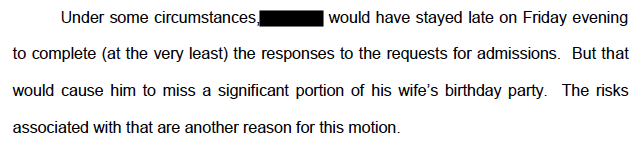
His response, in part, contained the following:Yes, he actually told the Court that he feared “the risks associated with”… “miss[ing] a significant portion of his wife’s birthday party,” after already having had more than 100 days to respond to written discovery.

It’s such a joy to argue these motions.  It’s sublimely absurd.

Attorney Casey A. Taylor

We’ve all heard of bankruptcy being used as a shield to protect against creditors’ attempts at debt collection. However, in the practice of law especially, the automatic stay is no longer an issue reserved for those who file bankruptcy, nor does it exist solely within the confines of the bankruptcy courts. Sure, the bankruptcy court generally governs matters involving the “stay” but, particularly in our increasingly adversarial society, these issues tend to bleed over into other legal proceedings as well, such that every litigator (and perhaps every litigant) should be apprised of the ways in which the automatic stay could impact them and their claims.

The bankruptcy petition triggers the automatic stay – imaginary armor that then cloaks the debtor (the person who files bankruptcy), halting all collection efforts by creditors (those seeking to collect money from the debtor).  Uponfiling bankruptcy, a debtor is immediately protected by the automatic stay which prohibits, among other things, “any act to collect, assess, or recover a claim against the debtor that arose before the commencement of the case. . . .” 11 U.S.C. § 362(a)(6). The automatic stay imposes on creditors an affirmative dutyof compliance. Sternberg v. Johnston, 595 F.3d 937, 943 (9th Cir. 2010).

In other words, once you file bankruptcy, your creditors (whether that be the telephone company merely seeking to collect a past-due bill, or someone intending to sue you on a $1 million tort claim) are no longer allowed to take any steps toward recovering that which they think you owe them, in court or otherwise. They cannot call you, they cannot send you a letter threatening action against you if you refuse to pay, they cannot file a lawsuit against you, and they cannot continue to pursue claims that are already pending against you without explicit relief from the bankruptcy court in which your petition is filed. Violating the automatic stay is a very serious offense that often results in an award of damages and attorney’s fees against the violating party.  11 U.S.C. 362(k).

Perhaps you represent a defendant in a contract case, your client filed for bankruptcy (invoking the stay), and the plaintiff’s attorney then serves you with discovery request asking your client to admit that he owes the money sought in the lawsuit. The automatic stay protects your client. Or, maybe you are a passenger who was injured in a car accident, and you are preparing to sue the at-fault driver (a debtor in bankruptcy) for reimbursement of medical expenses. The automatic stay likely prevents you from doing so.

In a practical sense, the affirmative duty of compliance placed on creditors even goes beyond just monitoring their own conduct to ensure that they are not violating the stay – it imposes a duty to police against others, namely courts, violating the stay, as well. This may seem a harsh result, but the Sixth Circuit has explicitly held that creditors cannot sit idly by and allow stay violations occur. See generally Wohleber v. Skurko, 2019 Bankr. LEXIS 653 (6th Cir. March 4, 2019).

In the Wohleber case, the husband-debtor was subjected to a post-petition sentencing hearing arising out of a pre-petition contempt proceeding (i.e., he failed to pay a property settlement previously ordered by a domestic relations court and the hearing was to determine his consequences). At the hearing, the debtor was put in jail until he paid the amount ordered by the domestic relations court (also pre-petition). The husband-debtor later argued that the wife-creditor and her attorney violated the automatic stay by allowing the sentencing to proceed. The bankruptcy court, initially, rejected this argument on the grounds that neither the wife-creditor, nor her attorney took any affirmative action to collect the debt post-petition. However, the Sixth Circuit reversed, holding that the wife-creditor and her attorney had an affirmative duty to “prevent the use of the sentencing hearing and [subsequent confinement] of the [debtor-husband] to coerce payment of the dischargeable property settlement.” Id., at *44.

In sum, the automatic stay is not a concept reserved for bankruptcy courts and the attorneys who practice primarily within it. Instead, it intersects with nearly every area of the law and, frequently, in litigation.  Because the stakes are so high for stay violations and missteps can be costly, it is important that creditors (or potential creditors, or their counsel) are in-tune with what the stay means and the type of conduct it prohibits. It is likewise important for debtors to know their rights so that they can recognize improper conduct if and when it occurs to their detriment.

______________________

For assistance with all of your commercial litigation needs, contact Casey A. Taylor at 513.943.5673 or Bradley M. Gibson at 513.943-6661.

Unless you live under a mossy rock, last week you read or saw that the Finney Law Firm won a swift and important victory for our clients in an important civil rights case.

At 10 PM Monday night, our firm filed a lawsuit exposing the unlawful handcuffing, arrest and search of a black Realtor and his homebuyer by nine police officers responding to a caller falsely claiming a breaking and entering at a home for sale in Price Hill.

At the same time as the filing, Channel 19 broke the story with a detailed newscast using body cam videos from the officers showing guns drawn, handcuffing for a protracted 4-5 minutes, and an illegal search of the innocent pair.  The house was for sale and had a “for sale” sign in the yard and a lockbox providing keyed access to the home.  The Realtor properly had made an appointment for the showing and legally made entry into the home via the key provided.

Our clients, Realtor Jerry Isham and his home buyer Tony Edwards, entrusted the important case to our firm.

In addition to the constitutional violations by the responding police officers, the City had illegally destroyed seven of the body camera videos months after our firm formally requested them, in itself actionable in a law suit.

At 2:30 PM the following day, fewer than 16 hours and 30 minutes after the filing of the suit, the City settled the case for 100% of the demand of the clients, including police and Realtor training seminars on police interaction on home sales.

In this instance, the Finney Law Firm provided swift and full justice for the Plaintiffs, but also sent a message into the community about respect for the constitutional rights of African American citizens engaged in entirely lawful behavior.

You may see the Channel 19 story here and read about the settlement in the Enquirer here.

In addition to our appreciation to our clients for entrusting our firm with this case, we also thank the City Solicitor’s office and Mayor Cranley for their leadership in quickly recognizing the legitimacy of the claims and settling them.

Tonight, Channel 19 has a well-researched story by Jennifer Edwards Baker of our clients, Jerry Isham — Realtor — and his buyer Tony Edwards, innocently looking at a house in West Price Hill for possible sale, when they were rousted by eight Cincinnati Police Officers with guns drawn.  The police then illegally detained and handcuffed the pair, and illegally searched Mr. Isham’s pockets.

They had done absolutely nothing illegal; they had done absolutely nothing wrong.

It’s truly as if CPD officers have received no training on the constitutional limit on the exercise of their their policy powers.

Incidentally, CPD illegally destroyed seven of the body cam and dash cam videos of the incident after they were subject to a formal public records request from the City.

Read the Ch. 19 story here:   Lawsuit: Realtor, prospective home buyer illegally detained by CPD after retired cop calls 911.

The Fox 19 video story is here.

For more information, call Chris Finney at 513-720-2996.


In May, Finney Law Firm notched its fourth in a series of wins in class actions against point-of-sale inspection ordinances in Ohio and Kentucky.  Previous judgments or settlements have been achieved against Covington, Kentucky, Oakwood, Ohio and Portsmouth, Ohio.  Each Ohio case was co-counseled with attorney Maurice Thompson and the non-profit law firm the 1851 Center for Constitutional Law.

It seems to have become a trend for municipalities to enact ordinances that mandate municipal inspections of rental properties (interior and exterior) either before a new tenant moves in or annually and pre-sale.  Very simply, all of these ordinances are unconstitutional searches of property under the Fourth Amendment to the United States Constitution.

Maurice Thompson of the 1851 Center has proficiently developed and pursued this line of cases and the legal theory underlying each case.

Our suits have succeeded in each instance in obtaining injunctive relief against the impermissible enactment, and the class action recovers the illegally-obtained inspection fees for the property owners affected.

For more information on our public interest litigation practice, contact Christopher P. Finney at 513-943-6655.