Finney Law Firm represents Mark Miller in two lawsuits against Cincinnati City Councilmembers Dennard, Landsman, Seelbach, Sittenfeld, and Young. The first involving violations of Ohio’s Open Meetings Act; the second involving violations of Ohio’s Public Records Act. Read about recent filings in the Open Meetings Act case here.

In the Public Records Act case – before the Hamilton County Court of Appeal – the Councilmembers filed a motion for in camera review and for a protective order to prevent dissemination of the Councilmembers’ text messages and emails

They Councilmembers admit that there are additional emails and text messages that should have been provided in response to our public records request but contend that they somehow are not “public records” as that term is defined in Ohio law.

We find the Councilmember’s motion disingenuous, particularly in light of their own recent leaking of some text messages to a friendly attorney who then filed a motion to intervene in the Open Meetings suit on behalf of their political ally, Derek Bauman.

The Councilmembers’ motion can be read here.

Our memorandum in opposition can be read here and below.

[scribd id=383740777 key=key-dtiBHqAv2KOmi5vluPzF mode=scroll]

Finney Law Firm represents Mark Miller in two lawsuits against Cincinnati City Councilmembers Dennard, Landsman, Seelbach, Sittenfeld, and Young. The first involving violations of Ohio’s Open Meetings Act; the second involving violations of Ohio’s Public Records Act. Read about recent filings in the Public Records Act case here.

In the Open Meetings case – before Judge Ruehlman of the Hamilton County Court of Common Pleas – the Councilmembers recently filed a motion to limit and prevent discovery and publication of any documents produced in discovery. Today we filed our memorandum in opposition to that motion.

The Councilmembers ask the Court to prevent discovery because they claim some of the emails and text messages may contain information embarrassing to themselves or third parties. We point out to the Court that those third parties can easily be invited to state for themselves whether they want the materials released to the public; and that the law requires more than simply reciting the words “risk of embarrassment” before the Court can limit discovery.

Ohio’s Courts, like every other public body, are to be open to the public. By attempting to prevent public access to information produced in discovery, the Councilmembers ask the Court to facilitate their violations of the Open Meetings Act.

The Court has scheduled oral argument for this motion on August 16 at 11 a.m. in Room 300 of the Hamilton County Courthouse.

The Councilmember’s motion can be read here.

Our memorandum in opposition can be read here and below.

[scribd id=383738790 key=key-1gnTG4Ik6Opw29XE8e3I mode=scroll]


Whether they planned it this way since (or even before) they granted certiorari to both Janus v. AFSCME and National Institute of Family and Life Advocates v. Becerra, or whether things just fell into place, two of the three the crowning decisions from the last week of the current term of the U.S. Supreme Court will deal with the important and still-evolving “compelled speech” doctrine under the First Amendment.  And we predict these two cases will be decided in such a way as to advance this doctrine as a bulwark against state and local governments compelling certain speech from private citizens and enterprises.

The compelled speech doctrine

The compelled speech doctrine is that legislators, regulators and other government actors cannot require an individual or group to engage in certain expression. We typically think of the First Amendment as limiting the government from punishing someone because of  his speech.  The compelled speech doctrine also prevents those same government officials from punishing someone for refusing to advance the government’s approved messages.

In West Virginia State Board of Education v. Barnette (1943) SCOTUS advanced the compelled speech doctrine by ruling that a state cannot force a child to stand, salute the flag, and recite the Pledge of Allegiance.  The Court allowed school children who are Jehovah’s Witnesses (for religious reasons) to refuse to participate in the district-required speech. From the decision:

If there is any fixed star in our constitutional constellation, it is that no official, high or petty, can prescribe what shall be orthodox in politics, nationalism, religion, or other matters of opinion or force citizens to confess by word or act their faith therein.

Just last decade, in  Rumsfeld v. Forum for Academic and Institutional Rights (2006), Chief Justice John G. Roberts Jr. stated the principle more directly:

Some of this Court’s leading First Amendment precedents have established the principle that freedom of speech prohibits the government from telling people what they must say.

And this doctrine has been advanced in other cases, such as Wooley v. Maynard (1977) (state officials could not punish a man for covering the state’s motto — “Live Free or Die” — on his license plate) and Hurley v. Irish-American Gay, Lesbian and Bisexual Group of Boston (1995) (government actors violated the rights of parade organizers by requiring that they include a gay rights group and its messages).

Notably as to the Janus decision (discussed below), the court addressed this issue in Abood v. Detroit Board of Education (1977).  However, because that decision did not go as far as the Janus petitioners seek, the Janus case (we predict) will overturn the Aboud precedent.  In Aboud, the Court allowed states to mandate public union membership, but split the dues between collective bargaining activities (compulsion OK) and political activities (compulsion forbidden).

Roberts Court loves the First Amendment

Then, as we have expressed previously, if the Roberts Court stands for anything, it is advancing First Amendment protections, including into areas not previously sacrosanct.  We expect the Janus and NIF&LA cases will continue that trend, but in these cases in the specific area of compelled speech.

Janus

The Janus decision is the third try recently to overturn the “halfway” decision in Abood. Again, in Abood, the Court ruled that the Plaintiff could be forced by the Detroit School District to pay a “fair share” or “agency” fee to the labor union for collective bargaining services, reasoning that not to do so would allow them to be a “free rider” for those services.   The Janus decision directly challenges that hair-splitting, arguing that compelling union membership is indeed compelling support of all of those things the union supports, including their position in contract negotiations, with which a member may disagree.

In 2014, the high court decided Harris v. Quinn, a curve-ball case of the State of Illinois compelling payment of union “agency fees” for collective bargaining by home health care workers who were not direct employees of the state, or in the words of the court “full-fledged public employees.”  The court ruled “no.”  In doing so, however, it did not directly overturn Abood, but Justice Scalia invited Abood challenges by stating in his opinion that it had been incorrectly-decided.

That invited the case of Friedrichs v. California Teachers Association in the 2015-16 term, which certainly would have extinguished the Abood precedent, except that Justice Scalia — who started the firestorm — died after oral argument but before the case could be decided.  The Friedrichs case, which appears to be indistinguishable from Janus, was thus decided 4-4 with the Scalia-short court, upholding the 9th District opinion that was consistent with Abood.

Thus, this coming week we expect that the compelled speech doctrine will get a substantial shot in the arm, albeit by a 5-4 vote, by the Supreme Court in its Janus decision broadly preventing government actors from negotiating union contracts that compel union membership or union dues as a condition employment.

National Institute of Family and Life Advocates v. Becerra

And that brings us to NIF&LA v. Becerra which seeks to invalidate a California law requiring pro-life counseling centers that counsel against abortion (“crisis pregnancy centers”) to to provide patients with specific kinds of information, including, for some, the availability of low-cost or free abortions.

We believe the Court will again advance the compelled speech doctrine by striking the California law.

(This will then raise the further question about pro-life state legislatures who require abortion clinics to provide certain information to patients arguably advancing an anti-abortion message.)

So, a big week is expected for the First Amendment and the Compelled Speech doctrine

Thus, it appears to me that the Supreme Court has written the theme for the last week of the Court term by joining the timing of announcing these decisions (if not the decisions themselves)  for the same day or week.

Crescendoing the 2017-2018 term with these two decisions, the Roberts Court will firmly boost the compelled speech doctrine.

This morning the Ohio Supreme Court accepted our appeal from a Cuyahoga County Court of Appeals case questioning whether Ohio’s Open Meetings Act permits public bodies to vote by secret ballot.

A 2011 Ohio Attorney General’s Opinion Letter says no, as does a 2011 Hamilton County Common Pleas Court decision. But to date, the Ohio Supreme Court has not addressed this question. But the Cuyahoga County Courts disagreed.

This is an important case, meriting an amicus brief in support of jurisdiction from the Ohio Coalition for Open Government. Learn more about OCOG here.

The Ohio Supreme Court now has an opportunity to declare once and for all that secret ballot voting is not consistent with the demands of open government.

Case documents in State of Ohio ex rel. More Bratenahl et al. v. Village of Bratenahl et al.  are available on the Ohio Supreme Court’s website, here.

We will post updates as briefing is completed. Read more about this case here.

Nearly every aspect of the modern world is regulated, in one manner or another, by the use of contractual agreements. As a result of their ubiquity, it is unrealistic to expect the average person to read every word of every contract they sign. To be clear, under no circumstance do we advise signing a contract without reading it, but one must discard reality to believe that such advice will be received, much less heeded. That said, the purpose of this article is to provide guidance for the average person to use when faced with a contract, particularly in light of the general propensity to sign contracts without reviewing them.

Ordinary contracts and adhesion contracts

Insofar as this article is concerned, the most prominent aspect of contract law is the distinction between ordinary contracts and adhesion contracts. Consider ordinary contracts to be agreements between two or more parties that are reached by negotiation. For example: (i) a real estate purchase contract where one party must sell his or her property in exchange for a negotiated purchase price or (ii) an employment contract where one party must perform work in exchange for negotiated income and benefits. As these contracts are bargained for, the parties need to be absolutely sure that the terms agreed upon are, in fact, the terms contained in the written agreement. This concern is exacerbated by the endless spectrum of legal clauses that can be drafted into a contract. As a result, the only way to achieve certainty is to read the contract, and consult with legal counsel regarding any provisions that: (i) you do not understand, (ii) you are not comfortable with agreeing to, and/or (iii) are contrary to your understanding of the agreement of the parties.

On the other hand, adhesion contracts are best defined as agreements between two or more parties wherein the terms are set by one party without negotiation. Examples of adhesion contracts include: insurance contracts, cell phone provider agreements, loan agreements, etc.

Less risk in Adhesion Contracts

Again, this is not advice to sign contracts without reading, but, for those persons who are going to do so anyway, it is worth noting that between the two types of contracts, adhesion contracts pose less concern for a variety of reasons including, but not limited to, the following:

1. If you want the product being offered, then you have to agree to the terms being offered. Why? Because you have no bargaining power to negotiate them. For example, if you walk into Verizon and ask them to change a provision in their cell phone provider agreement, then you will, in all likelihood, leave the store without a cell phone plan.

2. Countless people before you have signed an agreement with identical or nearly identical terms. This does not in and of itself mean that a contract is risk free; however, continuing with Verizon as an example, it is reasonable to equate the number of long term Verizon customers with the acceptability of Verizon’s contractual terms.

3. Other than notice provisions (i.e., requirements to notify other parties upon the occurrence of a triggering event) and negative covenants (i.e., promises to refrain from doing something), consumer obligations under adhesion contracts typically revolve around money to be paid in exchange for a service or product. In other words, the consumer side of an adhesion contract is less likely to have obligations beyond the payment of money.

4. Analyzing a dozen or more pages of legalese can be a burden for the most brilliant of legal minds, so the idea that the average person can read through the same while standing at a check-out counter is nothing short of absurd. While every contractual provision is important, the average consumer is mainly concerned about the cost of the product or service. Thus, the decision to execute a contract is more often based on the consumers’ desire to obtain the service or product rather than their agreeability to convoluted contractual provisions.

5. Unconscionable contract provisions are not enforceable. A provision is unconscionable if it is substantively unfair or oppressive to one party, or otherwise represents a degree of unreasonableness. If there are unconscionable terms in a contract, then a court will either strike the provision from the contract or declare the contract void in its entirety.

Ohio Consumer Sales Practices Act

In addition to those reasons stated above, Ohio consumers are protected under the Consumer Sales Practices Act (the “CSPA”), which states among other things that suppliers cannot commit unconscionable acts or practices in connection with a consumer transaction. A supplier is defined as “a seller, lessor, assignor, franchisor, or other person engaged in the business of effecting or soliciting consumer transactions, whether or not the person deals directly with the consumer.” To determine if a transaction or contract is unconscionable, CSPA asks if the supplier: (i) knowingly took advantage of a consumer because of the consumer’s physical or mental infirmities; (ii) charged a price that substantially exceeded the price of similar property or services that are readily obtainable; (iii) knew the consumer could not receive a benefit from the property or services; (iv) knew the consumer was unable to pay; (v) required consumer to enter a transaction where supplier knew the terms were substantially one sided; (vi) knowingly made a misleading statement that the consumer was likely to rely on, or (vii) refused to make a refund for a return unless there is a sign posted at the establishment stating such refund policy.

The CSPA also regulates suppliers by proscribing unfair and/or deceptive acts in connection with consumer transactions. Moreover, CSPA lists a series of acts and practices that are per se deceptive. That list includes, but is not limited to, a supplier’s false representation to a consumer of any of the following: (i) a product or service contains benefits that it does not have; (ii) a product or service is of a particular grade or quality, when it is not; (iii) a product is new or unused, when it is not; (iv) the product or service is available for a reason that does not exist; (v) a replacement or repair is needed, when it is not; and (vi) that a price advantage exists, when it does not. If a supplier runs afoul of this statute—or any CSPA provision—the consumer may bring a cause of action for the actual damages he or she incurred plus an amount not to exceed five thousand dollars ($5,000.00).

Conclusion

Ultimately, you should read every contract that you sign, regardless of any representations or verbal agreements. It does not matter what you agreed to verbally if you signed a document that states otherwise. This article is not intended and shall not be construed as providing advice to sign documents without reading them. Rather, this article merely offers a pragmatic view of the all-too-common practice of signing contracts without reading them.


Today, attorneys for the City of Cincinnati filed the self-proclaimed “Gang of Five’s” answer to the April 9, 2018 Open Meetings Complaint (read the complaint here, read additional blog posts about the case here and here).

Surprisingly, the Gang of Five deny that they conducted meetings via telephone, email, and text message.  We say surprisingly, because the emails and text messages attached to the complaint make clear that the Gang of Five did conduct such meetings.

The councilmembers’  responses to interrogatories and requests for documents are due later this month, and depositions are set to begin shortly.

[scribd id=380988345 key=key-xzHGFm3H8LOpoQ42PC7i mode=slideshow]

A general durable Power of Attorney granted by a person (“Principal”) to a designated attorney-in-fact (“Agent”) provides full power, authority and discretion to do all things required or permitted to be done in carrying out the purposes for which the Power of Attorney is granted as fully as the Principal could do if personally present (unless it is a Limited Power of Attorney granting specific limited powers to the Agent).

It is very important for the Principal to appoint an Agent that is trustworthy and who the Principal believes will fulfill his or her fiduciary obligations to the Principal.  No matter how selective a Principal may be in appointing the Agent, there is always the possibility of the Agent abusing his or her fiduciary obligations.

  1. Theft and Improper Asset Transfers.

There is no question that an Agent acting under a durable Power of Attorney has a fiduciary obligation to the Principal, which includes both the duty to act in the Principal’s best interest, and the duty not to use the relationship improperly for the Agent’s advantage.  If an Agent transfers the Principal’s funds in a way that the Principal would not have wanted, the transfer seems abusive.  Such a transaction may even rise to the level of theft.  Many times there are cases where Agents use durable Powers of Attorney to extract money or assets from their Principals.  If the Agent is not a family member or a close friend, it seems clear that transfers of assets to the Agent are abusive.

Most people name family members as their Agents.  Determining whether a transfer is abusive becomes much more difficult in a family context.  A family member Agent who transfers funds or other assets to himself or herself may believe that the Principal would have wanted the Agent to make the transfer.

Therefore, it is important for the Principal to discuss his or her wishes with the Agent regarding transfers, and to make sure that the Power of Attorney authorizes the Agent to make any desired transfers.  If the Principal wishes the Agent to have the power to make only gifts that would qualify for the Federal gift tax annual exclusion, this limitation should be included as a provision in the Power of Attorney and also discuss it with the Agent.

Further, if a Principal does not want to grant the Agent authority to transfer assets, it is imperative that a provision be included in the general durable Power of Attorney restricting the Agent from making such transfers.

  1. Interference With Principal’s Estate Plan.

An Agent may be faced with dealing with property that has been specifically disposed of in the Principal’s estate plan.  This type of interference ranges from an act by an Agent performed with the specific intent to deprive a specific beneficiary named in the Principal’s estate plan to receive a gift, to a transfer made without thought of the Principal’s estate plan.

  1. Remedies for Abuse.

Attorneys are often asked what remedies are available for abusive acts by Agents appointed in a durable Power of Attorney.  In most cases, courts seem to agree that an Agent under a durable Power of Attorney is governed by some fiduciary standard.

It is possible that an improper transfer could be prosecuted as theft, and a court could order restitution to the Principal.  Also, improperly transferred funds could be recovered through a civil lawsuit for breach of fiduciary duty.  The funds may not be recoverable because the abuse cannot be proven, or because the Agent has dissipated the funds.


As has been discussed in numerous posts on our firm’s blog, see here, here, and here, the changes to Ohio’s property valuation law enacted in 2012 are slowly coming into effect as the Ohio Supreme Court has been consistently ruling that the changes made by the legislator mean exactly what they say.

Notably, R.C. 5713.03 was amended specifically to require that real property be valued for taxation purposes, “as if unencumbered.” But auditors and school boards have resisted calls to apply the plain meaning of “as if unencumbered” to include leases, arguing that “as if unencumbered” refers only to liens or easements.

Yesterday (May 22, 2018) the Ohio Supreme Court weighed in again on the question in Lowe’s Home Centers, Inc. et al. v. Washington County Board of Revision, et al., Slip Opinion No. 2018-Ohio-1974, that “it is plain that a lease is an encumbrance and that R.C. 5713.03’s directive to value the realty ‘as if unencumbered’ means to value the realty as if it were free of encumbrances such as leases.” Id. at ¶19.

In Lowe’s, the County’s appraiser compared leased fee properties to the subject property to ascertain the value, and made adjustments to account for the leases. The Board of Tax Appeals adopted the value proposed by the County’s appraiser, but appeared to rely on a case decided prior to the amendments to R.C. 5713.03, thus leaving some question whether the Board of Tax Appeals analyzed the lease adjustments.

Unquestionably, the changes, aimed mostly at commercial property valuation, bring with them new challenges for Ohio’s auditors and school boards (the major recipient of property tax dollars). And there are certain to be calls for new amendments to undo some or all of the recent changes.

The deadline for filing Board of Revision Challenges has passed for this year. To learn about the Board of Revision process in preparation for next year, watch Chris Finney’s presentation here. Contact us here if you have questions about your commercial property valuation.

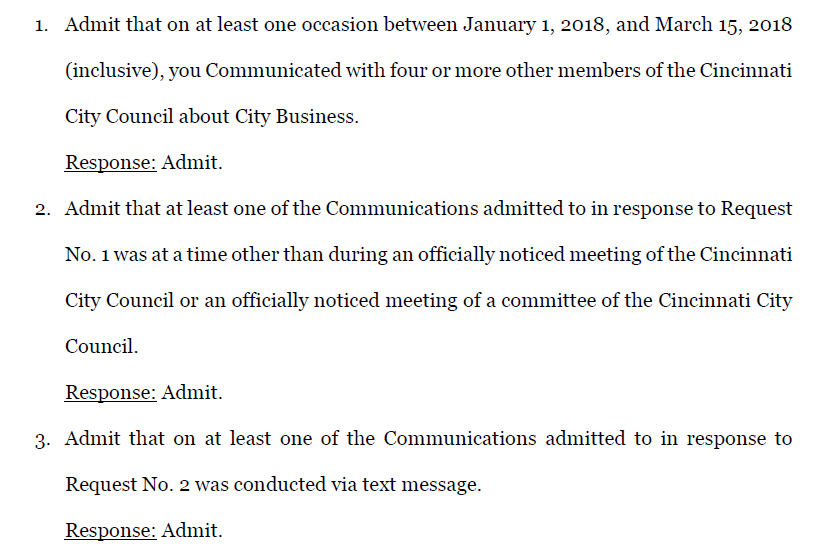
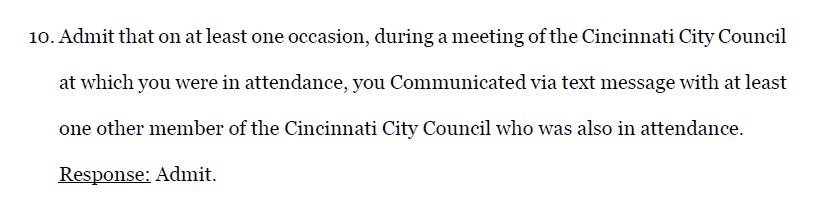
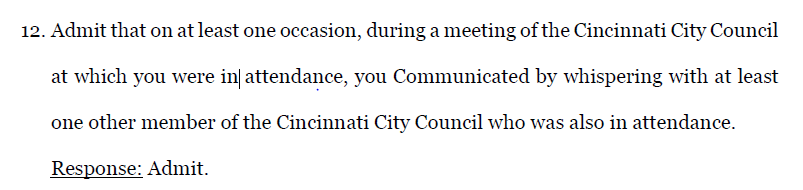
As part of their responses to the first round of discovery in our Open Meetings lawsuit, Cincinnati City Council Members PG Sittenfeld, Chris Seelbach, Wendell Young, Tamaya Dennard, and Greg Landsman – the Self-Proclaimed “Gang of Five” – have now admitted to additional Sunshine Law violations: other meetings conducted via text message, and whispering and texting to each other during City Council meetings.

Thus far, the Gang of five have only responded to our requests for admission, still outstanding are responses to our interrogatories and requests for documents. The City asked for, and we granted, an extension of time to respond to the interrogatories and document requests. Those responses will shed even more light on the topics of discussion during the illegal meetings and result in the production of additional text message correspondence between the Gang of Five.

What is unquestionable now is that the question of firing the City Manager was not the first time the Gang of Five discussed public business outside the public eye, in clear violation of Ohio’s Sunshine Laws and the Cincinnati City Charter.

Next steps are to obtain the additional written discovery responses and then depose the Gang of Five under oath.