


Labor and employment attorney Stephen E. Imm
In an age where almost everyone carries a smartphone almost all the time, it is possible for each of us to make a video or audio recording of events and conversations at the touch of a button. YouTube, as we all know, is filled with impromptu video recordings people have made with their cell phones.
What implications does this have for the modern workplace? Are employees permitted to record conversations they have at work with their co-workers or supervisors? What if an employee wants to gather “evidence” of sexual harassment that they believe is taking place? What if a worker wants to record a conversation with his or her boss when the worker is being reviewed or disciplined? Do they have the right to do that? Do they have to tell the other people who are being recorded?
Federal and Ohio law permit an individual to make such recordings, as long as at least one party party to the conversation being recorded – such as the party recording it – has given permission. Importantly, the individual making the recording does NOT have to have the permission of the OTHER parties being recorded – as long as the person recording is himself a party to the conversation.
(This contrasts with hiding a microphone or cell phone in a location in which the people being recorded are not a part of a conversation with the ower of the device.  That likely would be illegal.)
Employers, however, may want to prohibit such recordings in their workplaces. And many employers have instituted policies against it. They feel that their workers should be able to express themselves at work without worrying about whether they are being recorded. They believe a policy against recording encourages candor in meetings and other interactions. If people are concerned that they may be recorded, they are likely to be more guarded in what they say. This may discourage open and honest communication.
Can an employer bar its employees from making any recordings in the workplace, at least if they are made without the permission of the company or the person being recorded?
It may surprise you to know that such policies have been ruled to be illegal. The National Labor Relations Board has held the a blanket prohibition against recordings in the workplace can inhibit the rights workers have to engage in “concerted activity.” This right – which exists in both union and non-union workplaces – guarantees that employees can talk and work together regarding their working conditions, and regarding other terms and conditions of their employment.
In a case involving the retailer Whole Foods, the NLRB ruled that the company’s policy prohibiting all workplace recordings was impermissible, because it could have a chilling effect on the employees’ right to engage in “concerted activity.” That ruling was recently upheld by a federal appeals court. Other courts, and maybe the Supreme Court, may weigh in on the issue in the future.
For now, employers should have any policies regarding workplace recordings reviewed by legal counsel, to make sure they are in line with the NLRB’s decision. And employees should know that, in most instances, they have the right to make such recordings.
Give us a call if you have any questions about this important and evolving area of the law.
_____________________
Stephen E. Imm is an experienced labor and employment attorney who can help with your workplace issues.  He can be reached at 513-943-5678.

Frequently, clients desire to lend money, seller-finance the sale of their business or other asset, buy and then lease out a building, or engage in some other business transaction because they are motivated by favorable business terms the transaction provides on its surface: A high rate of interest, a good return under a lease, or a more promising sale price than otherwise the seller would obtain, for example.

This entry asks a prospective private lender to think twice about the risks associated with this activity and to take as many steps to protect himself as possible under the circumstances.

Who is the “lender” and who is the “borrower”

For purposes of this entry, there are many circumstances in which a party is a “lender” and another is the “borrower.”

  • Obviously, a simple monetary loan in which there is a lender and borrower is one such transaction.
  • Another occurs where an investor either owns a building and desires to rent it, or purchases one for leasing purposes.  In addition, as a part of a leasehold transaction, the landlord may be putting into the premises significant sums in “tenant buildout costs.”   Here, the renter is “using” the landlord’s money, his credit, and his asset, in exchange for monthly (read: deferred) payments.  This is a form of “loan.”
  • When a seller is selling his busines, his building or another asset, and does anything other than take back 100% of the purchase price at the time of conveyance, he is a “lender.”  (And the worse situation is where the seller is taking a subordinate position to a lender who gets a first mortgage or other lien on the assets acquired.  In such situation, the liklihood of the seller getting his “loaned” funds is significantly impaired, and the chance of default significantly higher.)
  • Even co-signing a loan or a lease, or guaranteeing the debt of another, is “lending” your credit to the co-borrower.
Four important factors to consider

But consider these factors before “lending” your money, your asset, and your credit to a third party:

First, ask yourself: “Why can’t this buyer get conventional financing?”  Banks are in the business of assessing and taking the risks associated with lending.  If this “borrower” does not qualify for a bank loan, why should you be in the business of being a lender?  Have you really fully assessed the risks of lending to this “borrower.”

Banks know experientially and actuarially the “warning signs” that predict loan defaults.  Among these are an inability to come up with an adequate down payment, a poor credit score, a history of litigation, and other warning signs.  I spoke with one lender recently, and they said they will never lend to people who fail to pay their taxes — ever.

Second, in my experience, a buyer of an asset is much more likely to raise defenses and counterclaims against a seller than the buyer would be able to as against a third party lender: Fraud in the inducement of the sale, property defects, misrepresentations in the business accounts, and simple contract breach.  Buyers will raise any and every excuse and defense against paying money they owe.

Third, the more desperate the “borrower” is, the more likely he is to agree to generous transaction terms: a high rate of interest, a high sale price, or some other above-market remuneration.  And — I say this based on experience — borrowers who have no intention and no ability to pay back the “loan” are the most willing to agree to generous lending terms.

Fourth, if you are going to leap (into the position of being a lender), at the very least look first: do the kind of due diligence that a lender would — a credit check, a background check, reference checks, and a simple check of court clerks sites and bankrupcy court history for obvious signs of fiscal distress.

The ABCs of improving your position as a lender

So, you have made the decision to “lend.”  What steps can you take to improve your position and increase the liklihood of getting your money paid back, with interest?

A. Certainly ask for a personal guarantee of any “loan” to a corporate entity.  Accepting simply a corporate signature, whether of a note maker, a tenant or the buyer of an asset, is asking for trouble, unless that company’s creditworthiness has been thoroughly ascertained

B.  Don’t be shy about asking for the personal guarantee of the principal’s (or principals’) wife (or wives).  If the borrower is earnest about putting their name, their assets and their creditworthiness behind a promise, and they have asked you to extend credit to them — then shouldn’t their wife also stand behind the obligation?  Stating it differently, the most common and most obvious dodge of debtors avoiding their creditors is to place their assets in the name of their wife.  Don’t let them avoid their obligations to you so easily.

C. Are there third parties who can guarantee the debt?  A business partner?  A parent?  Who is interested in the success of this borrower’s business such that they would be willing to stand behind its obligations?

D.  Look for assets to lien.  Does the “borrower” (or his wife) own a house, stocks, jewelry, accounts receiveable, or equipment or inventory in their business?  Are those assets presently free from any  first lien against them?  If so, and if the borrower is earnest about paying back your debt, then he should not have qualms with providing a security interest against those assets to stand behind the loan.  (Note: Please consult an attorney about how to properly take a lien in various assets; it can be tricky.)

E. Would some patience or a reduced price yield either a cash buyer or enable the buyer you have to go and get a bank or other third party loan?  If so, it may be wise to take one of those options.

Conclusion

Lending is an ultra-hazardous activity that should not be undertaken lightly.

There are exceptions where the seller’s main motivation is not necessarily getting payback of the loan: a parent helping a child; a business or building owner who is getting a great sale price for the asset, and perhaps much of it in cash; or simply a weak market with few buyers. And so long as our clients enter into a transaction understanding the risks of being a “lender,” we are fine with that decision.

But we see many clients seduced by more favorable terms from a borrower or seller-financed buyer who desperately needs their cash versus a stingier cash buyer.

Our suggestion: Think about taking the money and running instead.

The risks inherent in being a lender is why they say: “Cash is king.”

In a major ruling in favor of religious freedom, the Supreme Court struck down a provision in the Missouri State Constitution prohibiting churches and other religious organizations from receiving any public funds. In Trinity Church v. Comer, the Supreme Court found that the state’s “Blaine Amendment” violates the First Amendment. The Court’s 7-2 ruling (Justices Sotomayor and Ginsberg dissented), continues a recent trend in support of the First Amendment protections for religious liberty and free speech. You can read the opinion here.

Missouri funds a grant to help charities pay to replace playground equipment using recycled tires. Trinity Lutheran Church, which runs a day care program, applied for a grant. Despite being otherwise eligible for the grant, the state refused to allow the church to participate citing the state constitution’s prohibition:

That no money shall ever be taken from the public treasury, directly or indirectly, in aid of any church, sect or denomination of religion, or in aid of any priest, preacher, minister or teacher thereof, as such; and that no preference shall be given to nor any discrimination made against any church, sect or creed of religion, or any form of religious faith or worship.

Similar provisions exist in approximately thirty states. Named after 19th Century Senator from Maine, James G. Blaine, the Amendments were aimed at preventing public funding of parochial schools.

In issuing its ruling, the Supreme Court distinguished a previous case in which a state prohibition against providing a scholarship to a student who wished to study to become a minister was upheld (Locke v. Davey). “Davey was not denied a scholarship because of who he was; he was denied a scholarship because of what he proposed to do—use the funds to prepare for the ministry. Here there is no question that Trinity Lutheran was denied a grant simply because of what it is—a church.”

“The Free Exercise Clause ‘protect[s] religious observers against unequal treatment’ and subjects to the strictest scrutiny laws that target the religious for ‘special disabilities’ based on their ‘religious status.’” This ruling makes clear that blanket prohibition against any religious based organization from qualifying for a state benefit will not pass constitutional muster.

The Finney Law Firm prides itself on our aggressive stance in countering the actions of bureaucratic bullies through claims resulting not just in a victory in the administrative battle being fought, but also in recovering monetary damages, attorneys fees and injunctive relief against those very bureaucrats.

However, because of abstention under Younger v. Harris, 401 U.S. 37 (1971), and its progeny (that has been significantly scaled back by a the recent Supreme Court decision in Sprint Communications, Inc. v. Jacobs, 571 U.S. __, 134 S.Ct. 584 (2013)) and other principles of administrative law and comity, it is a bit of a challenge of how to “turn the tables” on government actors and bring a challenge under 42 USC Section 1983 concurrent with the administrative proceeding.

We had such a case in 2012.  There, our client was being disciplined by the Ohio Elections Commission in a proceeding we were certain was unconstitutional violation of her free speech rights.

First, we raised First Amendment defenses before the agency.  They were simply deaf to such arguments.  Then, when filing our Section 119 administrative appeal in Franklin County Common Pleas Court, we appended a claim for declaratory and injunctive relief under the First and Fourteenth Amendments to the United States Constitution as allowed by 42 USC Section 1983.

And, of course, to level the playing field against an agency who had the full resources of state govermment against her, such claims include the right to have the client’s attorneys fees reimbursed by the State if the Plaintiff prevails.

In Magda v. Ohio Elections Commission, Franklin County Common Pleas Court Case No. 12-CVH 10-13674, the state opposed that Complaint saying that state law did not tolerate a Section 1983 challenge to accompany an administrative appeal.  The trial court disagreed, and Judge Mark Serrott wrote this decision allowing the challenge to proceed arm-in-arm with the Chapter 119 appeal.

Judge Serrott later granted the State’s Motion for Summary Judgment, denying both our administrative appeal and the Section 1983 challenge to the statute.  That decision was appealed to the 10th Circuit Court of Appeals.  Interestingly, the State at that level did not renew their challenge to the Section 1983 claim accompanying the Chapter 119 appeal.  Thus, the issue proceeded with both claims before the appeals court.

In the end, the Court of Appeals overturned the trial court decision and granted summary judgment to our client on both the administrative appeal and the constitutuonal claims.  Thus, Plaintiff won a permanent injunciton against the enforcement of the statute and reimbursement of the full measure of her attorneys fees dating back to the initiation of the action before the agency under the constitutional claim.

So, yes, a constitutuional challenge (or any claim challenging the authority of the legislature to enact the offending law or the agency to enforce the same in the manner that it has), can be brought along with a Chapter 119 administrative appeal.

This vigorous and creative response to a prosecution by bureaucrats raging out of control in Columbus is a prime example of how the attorneys at the FInney Law Firm succeed in “making a difference” for our clients.

Let us know how we can solve your business and bureaucratic challenges.

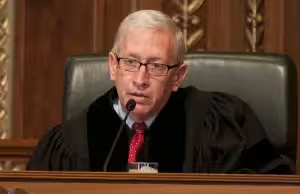
Ohio Supreme Court Justice Pat Fischer

In a case that was previously discussed here,  the Ohio Supreme Court issued an important ruling in a real estate valuation case, Terraza 8, LLC v. Franklin County Board of Revision, 2015-2063, yesterday.

R.C. 5713.03 was amended in 2012 – allowing that the auditor may consider a recent sale price as the true value of real estate rather than shall, and requiring that the property be valued “as if unencumbered.”

Writing for a unanimous Court, Justice Fischer agreed with the property owner that recent changes to R.C. 5713.03 mean that County Auditors are no longer required to adopt a recent sale price as the true value of real estate, and that the purchase price in sale and lease back transactions can be rebutted by a showing that the sale price does not reflect the value of unencumbered fee-simple estate. The decision is available online here.


Ohio has robust laws in place to ensure that the public business is done in the public and available for public inspection. From protecting citizens’ rights to attend meetings of local government bodies, to newspaper reporters being able to access and report on the financial records of the Cincinnati Streetcar project, or new public works proposals, the Open Meetings Act and Public Records Act, together the Sunshine Laws, provide for citizen oversight of their government.

First, the Open Meetings Act, R.C. 121.22, declares that, “All meetings of any public body are declared to be public meetings open to the public at all times.” This means that, other than those limited exceptions allowing public bodies to go into “executive session,” public bodies (city councils, township trustees, school boards) must conduct their deliberations in meetings open to the public.

Next, the Open Meetings Act requires public bodies to promptly prepare, file, and maintain minutes of all regular and special meetings, and to make those minutes open to public inspection.

Finally, the Open Meetings Act puts teeth to these requirements. Any person can bring suit to enforce these mandates. If you know of a violation or “threatened violation” by your local school board or city council, you can bring suit to force compliance. If successful, the court would enter an injunction against the public body to compel the body to comply with the Open Meeting Act, as well as an award of $500 per violation or threatened violation, and your reasonable attorney fees.

Thus, determination of whether the Open Meetings Act applies requires a multi-step analysis: Is there a “public body” involved? Was there a “meeting”? Was the public excluded from that meeting? And, finally, was such exclusion improper?

In addition to the requirement that public offices and public bodies meet in public and make minutes of those meetings available to the public, Ohio’s Open Records Act, R.C. 149, requires that public offices keep and make available any document, device or item, “created or received by or coming under the jurisdiction of any public office…which serves to document the organization, functions, policies, decisions, procedures, operations, or other activities of the office.”

Again, Ohio law provides for exceptions to the general rule that public records are to be kept and made available to the public (R.C. 149.43 includes both the exceptions and provides for enforcement by the citizenry). Certain confidential records are exempt from disclosure, for instance. If an appropriate request for public records is denied improperly (or ignored), the requester can bring suit to compel the production of the records, and may be entitled to up to $1,000.00 per record, and her reasonable attorney fees.

The analysis of The Open Records Act, also requires multiple steps. Is there a public office involved? Is there a document, device or item (i.e. a “record”)? Was this record created, received or coming under the jurisdiction of the public office? Does this record “document the organization, functions, policies, decisions, procedures, operations, or other activities of the office”? Does the record come under one of the exceptions to the Open Records Act? Was a proper request made?

This area of law has been litigated numerous times, and for every simple proposition of law, there is a court decision that muddies the waters. A recent Court of Claims decision announced that records of court proceedings commenced after July 1, 2009, are not subject to the Open Records Act, and efforts to obtain such records must be brought through a mandamus action pursuant to the Rules of Superintendence under R.C. 2731. This issue will no doubt be further litigated; and ultimately the Ohio Supreme Court will be called upon to clarify this question.

Finney Law Firm currently represents plaintiffs in three cases involving violations of the Open Meetings Act, and has represented both citizen activists and public bodies on questions of the Sunshine Laws. Finney Law Firm’s attorneys have litigated nearly every aspect of Ohio’s Sunshine Laws, and have given presentations on these issues to civic groups, officeholders, and continuing education programs. If you believe a local public body is violating the Open Meetings Act or need assistance obtaining public records, or if your group would like to host a presentation on Ohio’s Sunshine Laws, contact Christopher P. Finney.

With the advent of the camera phone, the ubiquitous device in everyone’s pocket, there is no longer an excuse for failing to document “things” for posterity.  And such forethought from our clients can prove decisive in a legal battle.

Examples where photos are helpful

The best example of the value of real-time photos is in construction disputes.  We find it is regular practice of owners, architects, engineers, contractors, and materialmen to take photos at each stage of the work completed, which helps to establish the quality of the work, the conformity of the work to the plans, and the stage of completion at a particular point in time, and perhaps document the development of defects in material or workmanship as they are installed.   (This then, of course, helps to pinpoint the blame.)  The forensic or retrospective value of photos at each stage of construction can be invaluable.

Another example of the value of photos is in commercial and residential landlord/tenant in disputes.  In those disputes, the condition of the property as delivered to tenant or as surrendered to landlord is frequently contested.  My sharper clients have taken the time to document the condition of the property both at the beginning and end of the relationship with their camera phone. Those photos can make a liar of a defendant (or plaintiff) and permit a party to establish his minimum elements of a case he is presenting.

The existence of photos also could be used in an automobile accident situation, a dispute over the quality of goods delivered or to prove a person was in a particular place at a point in time.

Another example for me personally is that I just hate to get parking tickets, yet many times those darned parking meter are malfunctioning.  When this happens, I take a business card, note on it “out of order” and slip it into the “credit card slot” on the meter while my car is parked there.  Before slipping the card into the slot, I take a picture of the meter (they all have identifying numbers on them now) and the “out of order” card.

Admissibility and use of photos

Photos are, of course, generally going to be admissible as evidence in a trial or in alternate dispute resolution. So often at trial, I hate to say, one party or the other is outright lying to the judge.  A photo can clear up the inconsistency in statements pretty effectively.  The judge or jury should be thrilled to have such (nearly) incontrovertible evidence versus deciding which party is lying.

Number of photos

The memory capacity for photos on your telephone is almost unlimited, and it takes mere seconds to snap several pictures.  Think about thoroughly preserving the record for posterity (or trial).  Make the time to take several (indeed dozens) of shots — narrow and wide angle, and from every perspective —  to preserve the moment for later reference.

Conclusion

Get with the times.  Use this incredibly effective tool to enhance your position in dispute resolution.  Or, saying it differently, I get frustrated when a client could have made their case stronger simply by whipping out that phone and documenting and saving information for a later date.  This is especially true when the client knows the matter is heading into litigation.

Our Ohio clients frequently come to us having performed their own amateur sleuthing on questions about title to real property before an initial meeting.  And the easiest place for them to have started their work is the County Auditor’s web site.

Based upon the Auditor’s information, they many times have drawn preliminary conclusions regarding who owns the property, the configuration of the property, and in some cases access road information.  And they have formed preliminary opinions about the topic they want to discuss.

Thus, the client has come to see me asking to confirm what they have learned, and to seek more information about their property, and to then act upon that information, enforcing their rights through legal action.

The question addressed in this blog entry is:

How reliable — from the perspective of establishing legal title to real property — is that information on County Auditor’s web sites?

Information available on line about real property in Ohio

There are a host of on-line resources about real property in Ohio, including building permit issuance and code violations, recorded deed and mortgage information, City, Village and Township ordinances and resolutions establishing assessments and condemnation proceedings, aerial photographs, and maps showing improvements and public utility information.  In Hamilton County,  for example,

  • Here is the Recorder’s site;
  • Here is the CAGIS (Cincinnati Area Geographic Information System) site; and
  • Here is the site with building permit and violation information.
Information available on Ohio County Auditor’s web sites

County Auditor web pages are different in each County, but as a general proposition, I find the Auditor’s web site to be among the most easily accessible and broadly informative sites on real property in Ohio.  In my experience, every Ohio County has a pretty good Auditor’s website.

For example, here is the Hamilton County  Auditor’s site.  Each site is chock full of useful information on every tax parcel in the County:  A property search function that reveals property tax valuation, information on the current and past property taxes [amount and payment history], the sale price and date, the acreage, a drawing and picture of the house and sometimes other improvements, an aerial map and a tax map.

[Note: Our office provides a valuable service to clients in helping them to reduce their real estate taxes.  The essence of this service is to shallenge the County Auditor’s valuation as being too high, which frequently they are, however, in many cases — perhaps an equal or greater number of cases — the valuations are too low.  The point here is that even the County Auditor’s valuation is but “one man’s opinion,” and it too can be a point of reference, but is not the last word on valuation quesitons.]

Can I rely upon that County Auditor’s information in forming opinions about title?

And their question, a question I received today from a client, is

“can I rely on the information on the Auditor’s web site in drawing conclusions about real estate title.”

The short answer is: “No.”

As to real property in Ohio, the County Auditor has a big job, but a relatively simple job: (a) to divide up the County into separate parcels on his records for taxation purposes and (b) to establish a valuation of each parcel for tax purposes.  That’s it.

What this means is that sometimes:

  • the parcel maps are not fully informative as to the parcel identities;
  • the tax bill’s parcel descriptions are many times similarly short-hand;
  • the County Auditor’s site does not necessarily show comlicated ownership and contractual relationships that may be of record such as the fact that a property is subject to a Land Installment Contract; and
  • the owner information is either not quickly updated, incomplete (the Auditor’s site does not and does not purpose to type in all the owners’ names or the complete name as recited on the deed) or inaccurate.

A year ago, I had an instance in which a client who had purchased real property was distressed that for nearly two months the site was not updated showing him as the owner of real estate.  In that instance, the Auditor had stopped updating his site for a period of time for some year-end reconciliation.

But importantly, the Auditor does not claim to be the official or last word on “who owns property.”  That simply is not the function of the Auditor’s web site or the Auditor’s office.

How, then, is legal title established?

Well, in truth, title to real property is not “a piece of paper,” but is a legal construct that is established by records from a number of offices — the County Recorder, the County Engineer, the Clerk of Courts, County Probate Court records, and Federal Bankruptcy Court records.  Ohio has detailed standards for how legal title is to be established: The Ohio Title Standards prepared by the Real Property Law Section of the Ohio State Bar Association.

But the main repository of the official records of “who owns property” is the office of the County Recorder.  And, unfortunately, at least at present, at least for a layman (it may depend on the County), it simply is not as informative and user-friendly as the County Auditor’s site.

To establish title to real property, which really requires a review of all of the records noted above, our firm uses the services of a professional title examiner.  That examiner will, using indexing systems established in each County, find the current deed to the property,  establish what other claims appear in the various records (monetary liens, easements, covenants, etc.), and based upon all of that information we should be able to establish the claim at issue.

Sometimes we determine that title or the issue in question  can’t be made clear from the real estate records and either further documentation is required (by others affirmatively relinquishing their interests) or a court proceeding is necessary to “clear title.”

Conclusion

So, this blog entry has taken our fine readers through a shortened version of the legal maze that exists in Ohio (and most other states) to establish ownership of land, as well as easement and covenant rights of owners and their neighbors.

But the important point made here is that (a) the Auditor’s records are a great shorthand way to quickly find out information about property, including less-than-fully-reliable information about current ownership.  But (b) the Auditor’s records are not — and are not intended to be — reliable information on which legal conclusions should be drawn and acted upon, especially ones that are of any importance.

Please call our real estate professionals, Isaac T. Heintz, Eli Kraft-JacobsChris Finney and Rick Turner with your questions about real estate title.