The 6th Circuit en banc released an opinion today that allowed an an “extreme and ill-mannered evangelical group” to march on public streets through City streets in Dearbourn, Michigan “with banners, signs, and tee-shirts that displayed messages criticizing Islam and Mohammed.”  The demonstrations occurred during the annual Arab International Festival that attracts more than 300,000 persons over three days.

The group made themselves intentionally controversial, carrying around a severed pig’s head on a spike and and signs that said, “Islam is a Religion of Blood and Murder.” However, all their activities were on publicly-dedicated streets and sidewalks.

The County had argued that the speech of Bible Believers constituted “fighting words” and “incitement to violence” and thus could be banned.

The issue was whether Bible Believers had a right to engage in street preaching, and to parade around with their printed messages. The festival allowed groups to register for an assigned table, under the information tent, but not parade about the festival.  The Plaintiffs, Bible Believers, preferred to move around on the public streets and sidewalks where they could be seen.

The 6th Circuit decision says “fighting words” only means words directed at an individual who is present.  As to incitement, the decision says that Bible Believers did not ask anyone listening to do anything violent.

The case is Bible Believers v Wayne County, Michigan, 13-1635.

Even with proper estate planning, clients can take actions that unintentionally “undo” their estate planning desires.

Joint Accounts

It is not uncommon for an elderly client to set up a joint account with a child or other caretaker to facilitate such party’s handling of the client’s financial affairs.  In such situations, the joint account will transfer to the joint account holder without probate of the account.  Frequently, a client will not consider this aspect of setting up a joint account which may result in an imbalance in the division of a client’s estate.

Life Time Gifts

From time to time, a client will make monetary gifts to a child when the child is in need.  It is often the intention of the client (and the understanding of the family) that these gifts should be considered part of the child’s inheritance; however, without putting into place the appropriate paperwork, these gifts will not “legally” be considered in connection with the division of the client’s estate.

Loans

As with gifts, a client will make loans to a child when the child is in need, and it is the intention of the client (and the understanding of the family) that these loans will be paid back to the client.  Unless such loans are properly documented, it is difficult to determine the amount of the loans, and/or to enforce repayment of the same.  Even if the loans are documented between the client and the borrower, the documentation may be misplaced or destroyed prior to repayment.  Without repayment of the loan, it could result in the loan amount remaining with the borrower and the reduction of the estate of the funds that would have otherwise been received.

Updating Beneficiaries

Life insurance policies and retirement accounts will be distributed to the named beneficiaries.  If there is not a named beneficiary, then such amounts will most likely be payable to the client’s estate.  Clients do not revisit the beneficiary designations on a regular basis.  This can lead to the payment of these amounts to individuals designated years ago who the client no longer would want to receive such funds.  For example, a client may designate a brother or sister as a primary or secondary beneficiary of a life insurance policy with the idea that the brother or sister will see that the funds are used to take care of a client’s minor children.  However, the funds may not be paid until years later and the payee may not remember or appreciate the purpose for the payment.

Advancement Clauses

One way to address these types of issues is the inclusion of an advancement clause within a client’s estate planning documents.  An advancement clause creates the presumption that gifts given to a person’s heir during that person’s life are intended as an advance on what that heir would inherit upon the death of the client.  The concept of an advancement clause could be extended to assets received on the death of the client from a non-probate asset.

Sharing Information

Another way to help address these types of issues is by sharing information with the client’s beneficiaries and legal counsel.  If the client’s beneficiaries are aware of the intention of the client by creating joint accounts and/or making gifts, loans, and/or beneficiary designations, then the client’s wishes will be known to the affected parties, which could lead to the beneficiaries working together to see that the client’s wishes are honored.  A client’s sharing of information with his or her attorney can help the attorney advise the client on how to document and address such items within the client’s estate planning.

__________________

For help with planning the disposition of your estate according to your intentions, please contact Isaac T. Heintz at 513-943-6654.

One issue that often arises in medical malpractice cases is whether the doctor properly informed the patient about a surgical procedure and its attendant risks. Ohio law imposes a duty upon doctors to obtain “informed consent” from their patients prior to conducting a medical procedure. But, what exactly qualifies as informed consent? How must that consent be obtained? Does it matter if the surgery is “routine,” “experimental,” or somewhere in between? The Twelfth District Court of Appeals recently considered these questions in the case of Shell v. Durrani.

After 30 years of suffering from chronic back pain, the plaintiff in this case consulted Dr. Durrani who performed a surgery on her in 2007. A year later, the plaintiff again experienced back pain. Dr. Durrani informed her that the screws he had inserted in her spine had loosened and that a second surgery was required. The day before the surgery, the plaintiff signed two separate written consent forms. After the surgery, the plaintiff suffered complications that required two additional surgeries performed by Dr. Durrani. Following these surgeries, the plaintiff suffered from bowel and bladder control issues, nerve damage, pain in her legs and feet, and required a leg brace.

The plaintiff sued Dr. Durrani alleging that he failed to obtain her informed consent before the surgery. The jury ruled in favor of Dr. Durrani. The plaintiff appealed the decision, arguing that the she was entitled to a judgment notwithstanding the verdict because she was not provided with informed consent in accordance with Revised Code 2317.54. This statute provides that a medical consent form should set forth the general terms of the procedure along with what it is expected to accomplish, together with the reasonably known risks and the name of the doctor performing the surgery. It further calls for the consent form to include an acknowledgement that the disclosure of this information has been made to the patient, and should be signed by the patient.

The plaintiff essentially argued that one of the consent forms she executed violated the statute because it did not identify Dr. Durrani as the operating physician, nor did it describe the procedure to be performed. The appellate court was unpersuaded. First, the court noted that a physician is not required to provide a consent form that meets the requirements of R.C. 2317.54. Instead, when a written consent form is executed that meets the statutory requirements, it simply creates a presumption that valid and effective consent was obtained. Failure to comply with the statute does not in and of itself create a lack of informed consent claim. The facts of a case may even demonstrate that informed consent was obtained orally.

As to our questions raised at the beginning of this article, the appellate court stated that a lack of informed consent is established when three factors are met: (1) the physician fails to disclose to the patient and discuss the material risks and dangers inherently and potentially involved with respect to the proposed therapy, if any; (2) the unrevealed risks and dangers which should have been disclosed by the physician actually materialize and are the proximate cause of the injury to the patient; and (3) a reasonable person in the position of the patient would have decided against the therapy had the material risks and dangers inherent and incidental to treatment been disclosed to him or her prior to the therapy. These are the factors that must be analyzed whether the consent was allegedly obtained in writing, or orally.

In Shell, the court determined that the second consent form the patient signed did, in fact, comply with the requirements of R.C. 2317.54 for a presumptively valid informed consent. The court noted that Dr. Duranni had additionally discussed the procedures with the plaintiff orally. As a result, the appellate court upheld the trial court’s dismissal.

Informed consent is just one of the issues to consider for a client who has suffered complications from a medical procedure. Medical malpractice claims may turn on a variety of other facts in any particular case. We frequently meet with potential clients in this unfortunate situation, and understand that their health is an invaluable asset. We evaluate all aspects of their cases in order to protect their future. Please do not hesitate to contact us if you would like our litigation team to review a potential medical malpractice claim.


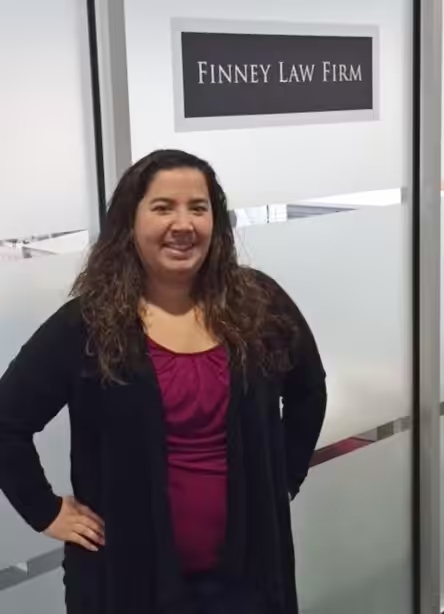
Katherine Fox

Finney Law Firm  is pleased to to announce the addition of Katherine Fox to our administrative staff.  Katherine previously worked for our team, when she departed to Chicago to get her Masters Degree and then worked for Miami University of Ohio for three and a half years.  We are thrilled that she has agreed to re-join the attorneys and paralegals at our firm to further improve the service we provide to clients.

Katherine earned her B.A. in Political Science and History from Bradley University in 2006 and her M. Ed. in Higher Education from Loyola University Chicago in 2010.

Empower U not only has assembled a top-notch lineup of free seminars to enrich its participants (see its remaining fall programs here), but it now has placed some of the courses online — with a sophisticated interface that allows the audio, a video of presenters and the PowerPoint presentation simultaneously to be displayed.

Thus, Tuesday night’s program featuring Finney Law Firm estate planning attorney Isaac Heintz and financial Planner Bill Lyon of the Lyon group is now available on line for your viewing pleasure and education.

You may view it here.

Thanks to Empower U, Bill Lyon, Isaac Heintz, the full house of participants and another 17 on-line virtual participants for making the event a resounding success!

If you have questions after viewing the presentation or need help in planning the disposition of your estate, please feel free to call Isaac Heintz at 513-943-6654 or reach him via email here.


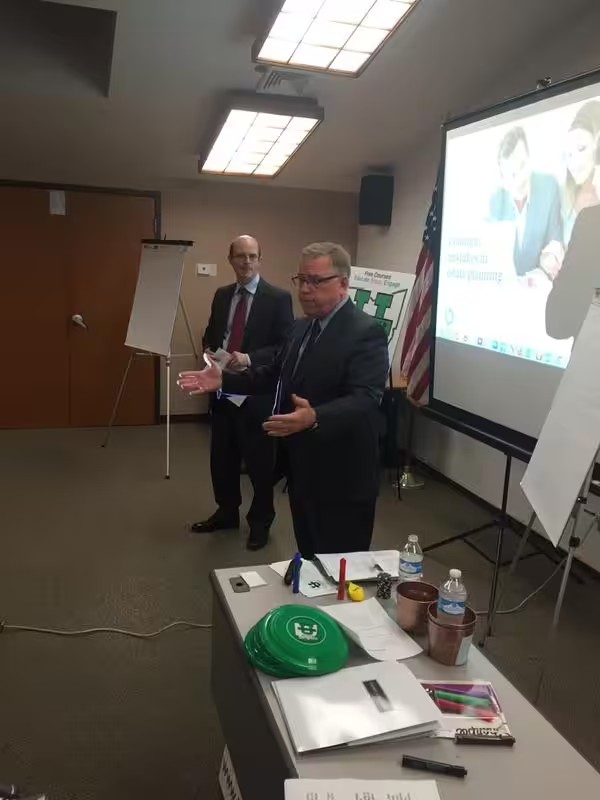
Heintz and Lyons

Finney Law Firm attorney Isaac Heintz teamed up with Bill Lyon of the Lyon Group tonight to present to Empower U — a free adult continuing education series — “10 Common Mistakes in Estate Planning.”  The event was well-organized and well attended, a credit to Dan Regenold and Nita Thomas, the organizers of Empower U.  The seminar also was presented “virtually,” which means via live, on-line video, and attracted a good number of participants online.

The video will soon be available online 24-7, and we will share the link when it is available.

Thanks to everyone who made this important event a success.

The lengthy saga that is the challenge to the Ohio statute making it a criminal offense to lie during the course of a political campaign reaches its latest chapter on December 10 at 9 AM.

Followers of our blog know that Susan B. Anthony List, et al. v. Ohio Elections Commission was first brought in 2010 to challenge the Ohio statute arising from the 1st District Congressional Campaign of Chabot v. Driehaus.  In that campaign, a third party group wanted to advertise that Steve Driehaus’ vote for OabamaCare was a vote in favor of taxpayer funding of abortions.  Steve Driehaus challenged that statement as a lie and a criminal offense with a complaint before the Ohio Elections Commission.

In response, Susan B. Anthony List challenged the constitutionality of the statute in federal court, and Finney Law Firm client, COAST, joined the suit asserting that it wanted to make similar statements but was “chilled” as a result of the oppressive enforcement scheme.

The District Court and the 6th Circuit found that Plaintiffs did not have standing as they “abstained” while the OEC matter was pending.  That issue ascended to the United States Supreme Court in 2014, resulting in a 9-0 decision in favor of our clients.  But all that Supreme Court decision did was place the matter back before the District Court.

In September of last year, Judge Timothy Black declared the statute unconstitutional and enjoined its further application — a complete win on the merits for the Plaintiffs.  That decision has been on appeal for more than a year to the 6th Circuit, and the December oral argument signals a decision by mid-2016 that, hopefully, will affirm Judge Black’s decision.

So, we have maybe another year of litigation over this issue, but soon the OEC’s control of speech in Ohio will be ended.

CFS
Chris Finney with accountants Tom Cooney and Crystal Faulkner on CFS radio

Today, Chris Finney appeared with accountants Crystal Faulkner and Tom Cooney of the Hyde Park accounting form of Cooney, Faulkner and Stevens on their WNKU radio program “CFS Radio.”

Finney spoke about two years of growth and client service at the Finney Law Firm.

Faulkner and Cooney not only offer quality accounting services, but also connect through others through their community involvement, their radio program, and use of social media.

Thanks for including us!

The Finney Law Firm is interviewing for a secretary/receptionist position at its Eastgate office.  The job description is below.  If you know of a qualified candidate, let us know!

Job Summary:

  • Answer designated phone lines
  • Greet and attend to clients and visitors of the firm upon arrival
  • Collect and distribute incoming mail and packages. Assist with outgoing mail as needed
  • Coordinate conference room scheduling
  • Provide administrative support to firm paralegal staff at the direction of the Director of Administration

Position Qualifications:

  • Possession of two or more years working experience in a medium to high volume law office
  • Ability and willingness to perform both reception and administrative functions
  • High degree customer service and a pleasant attitude on phone and within the office
  • Possession of strong communication skills both oral and written
  • Keen attention to detail, ability to perform multiple tasks, and work effectively with other members in a team setting
  • Proficiency in Microsoft Outlook, Word, and Excel

Please send your resume and cover letter to Anna J. Ausman at: Anna@FinneyLawFirm.com.