Today’s New York Times has an instructive tale in insurance coverage in a high-profile U.S. Supreme Court case.  There, Harvard University is embroiled in expensive and protracted litigation over its affirmative action policies.

For such litigation, it had an initial $2.5 million deductible under its primary carrier, and then $25 million in primary coverage.  It however, failed to notify its “excess coverage” carrier, which provided an additional $15 million in coverage.  Because the litigation lasted so long and cost so much, that failure to timely notify the carrier — a policy requisite — it may have deprived itself of that needed $15 million in coverage.

The lesson, as quoted in the article, is, as to coverage: “you’ve got to provide notice early and often.”  Our position is: “When in doubt, notify.” (Clients are rightly concerned that notice causes increased rates and/or cancelation.  Our experience is different: If you are an overall responsible insured, even with occasional claims, even meritorious claims, it should not impact rates or coverages, or if so not greatly.)

The matter is pending in court, and in the hallowed halls at Harvard the question of whether someone is going to lose their job is open as well.

Our favorite Courts reporter — really focused on the US Supreme Court — Alan Liptak, brings us this report.

Legal disputes are rarely cut-and-dried to the point that the other party is without any legal defense to the action.  It seems there is always something about which to argue (read here, for example).  But it certainly seems to us — by reading the statute and by using it — that a statutory partition action in Ohio (O.R.C. Chapter 5307) is just such a “perfect” solution.

Two or more parties own property; one or more parties wants “out”

In this case, the statute addresses the issue where two or more parties own real property together but cannot agree if or when to sell it.

We are not addressing multiple shareholders in a corporation that owns real property or co-members of an LLC that own real property, but two or more parties named as grantees in a deed who own property together (known in the law as co-tenants).  Those shareholder or member disputes are handled in another manner.

Perfect power of partition

In short, in a partition action, one party can force the judicial sale of the property to the highest bidder with the net proceeds divided among the co-owners (the parties may argue, and this firm has argued about proper adjustments to the distribution of net proceeds).  There is no defense to the action although the process can take time as the Court permits discovery over the course of the partition proceedings.  However, the right to partition of jointly owned property is statutory – if one party brings the action, the property will ultimately be judicially sold.

How to proceed to partition

Thus, if you own property jointly in Ohio and you want to liquidate your interest (for any reason at all or for no real reason at all), but the other party or parties do not wish to sell what are your options?

For this situation, let’s assume two things:

  • The co-owners are not married as that would be handled in Domestic Relations Court.
  • There is no written agreement, what we call a co-tenancy agreement (see here), whereby the parties have established in writing how they will handle disagreements between them as to how the property will be held and disposed.  In that case, the agreement likely will control.

Then, what options do you have to resolve differences over the ownership and disposition of jointly owned real estate? The answer lies in an action in partition.

What is partition?

A real estate partition is a formal legal proceeding through which a joint owner of real estate can ask the court to split the property.   An “action for partition is equitable in nature, but it is controlled by statute.”  McGill v. Roush, 87 Ohio App.3d 66, 79, 621 N.E.2d 865 (2d Dist. 1993). A Partition Action is a lawsuit which existed at the common law for the purpose of passing down family farms.[1] When the heirs could not agree on how to run the farm together, one or more could commence a partition action, asking the court to fairly divide the farm between the heirs. Partition of the property itself is favored over sale and division of proceeds, however a property may be sold if it can be shown that it cannot be divided without manifest injury.[2]

Sale if property cannot reasonably be divided

Thus, a party can ask that the property be sold if it is determined that it cannot be divided. Certainly, this is the usual case for typical residential properties today. In this situation, the Court will appoint a commissioner or commissioners under O.R.C. § 5307.09.  When the commissioner(s) are of the opinion that the estate “cannot be divided without manifest injury to its value” they will provide a “just valuation of the estate” to the Court. One or more of the parties can elect to take the estate at the appraised value and pay to the other parties their proportion of the same. Alternatively, if neither party desires to purchase the property or cannot agree on the proportionate purchase of the same, the property will be sold at auction to the highest bidder.  Often, cases are resolved and settled among the parties prior to this occurring.

Under O.R.C. §5307.07, when partition of more than one tract is demanded, the Court will set off to each interested party its proper proportion in each of the several tracts. Thus, when multiple parcels of land are owned jointly, the separate parcels can be conveyed to separate owners so that each owner will have total control over their now separately owned parcel.

If a property was acquired upon someone’s death, a partition cannot be ordered within one year from the date of the death of the decedent, unless it is proven that either (i) all claims against the estate have been paid, (ii) secured to be paid, or (iii) that the personal property of the deceased is sufficient to pay those claims.

Attorney’s Fees

Under O.R.C. §5307.25, reasonable attorney’s fees can be paid from the proceeds of the sale to Plaintiff’s counsel and may also be paid to “other counsel for services in the case for the common benefit of all the parties” as the Court determines.

Conclusion

Thus, a Partition Action can be used to force the sale of jointly owned property where a recalcitrant party refuses to act.  Partition is a powerful tool to unwind and unstick a longstanding problem with a co-owner that will not budge.


______________________________________

[1] The Appellees assert that the “Commissioner made a good faith effort to partition the Property, but there is no way to physically divide this family farm into four sections based on the lack of frontage, the inconsistent and varying nature and uses of the land, and the physical location of the parcels. Simon v. Underwood, 2017-Ohio-2885, ¶ 65 (Ct. App.).

[2] “Since the partition of property is to be favored over the sale of property, when a party objects to a commissioner’s report, that party should have a right to a hearing to contest the commissioner’s findings before the property is appraised and subsequently sold.” Stiles v. Stiles, 3d Dist. Auglaize No. 2-89-3 (May 10, 1991)]. Court must comply with statutory procedures to appoint a commissioner, make an independent valuation and recommendation regarding whether the property could be divided without a manifest injury to the property’s value and providing a joint owner opportunity to elect the property, and no was provided. Thrasher v. Watts, 2011-Ohio-2844, (Ohio Ct. App., Clark County 2011).

Ohio Rule of Evidence 408 generally provides that settlement discussions are “not admissible to prove liability for or invalidity of the claim or its amount.”

Public policy behind inadmissibility of settlement discussions.

Why not? Shouldn’t the judge or jury know all of the facts of a situation in determining liability and in assessing damages, for if a Defendant offered to pay he more or less must be liable, correct? Or shouldn’t the amount — the range — of settlement amount discussed, be some indication of the value of the claim?

Well, Courts have decided as a matter of public policy that the answer is “no.”  It would discourage good faith settlement discussions if the fact of such discussions and what was discussed were admissible.  We want parties to settle their disputes and bringing settlement conversations into Court would throw a cold wet towel on those conversations.

But Rule of Evidence 408 is not perfect

But Rule 408 is not all-encompassing.  It excepts party admissions of liability jnd, if agreement is reached, — or claimed to be reached — that oral settlement can be enforceable — sometimes much to the surprise and chagrin of one of the parties.

Further, in our experience, impermissibly and unethically, what happens in the course of settlement discussions is that those conversations seep into court proceedings and discovery.  Further, invariably opposing counsel will share some morsel of the tenor, tone or dialogue with a Judge to gain an advantage in the litigation.  In other words, opposing counsel and parties are not always trustworthy.

“We Can Talk Agreements”

As a result, before engaging in settlement discussions with opposing parties or counsel, Finney Law Firm frequently has the parties sign what we call a “We Can Talk Agreement” that generally provides two things:

  • Nothing said in the course of the settlement discussions will come into play in any manner in the litigation proceedings: Not in discovery, not in “in Chambers” conversations with the Judge, and not in Court.
  • No claimed oral settlement agreement will be binding unless and until it is memorialized in writing and signed by our client.  Period.

I recently had opposing counsel ask me: “Why would you ask me to sign such an agreement?”  It was a case in which we had the upper hand and the defendant was flailing around for some foothold for a defense.  Opposing counsel already had engaged in motion and discovery abuse, needlessly and substantially driving up the cost of litigation, and after 26 months of writing, twisting and turning, he had run out of underhanded tactics, and was approaching facing the music before the Judge.  My answer: “Because I don’t trust you. You, in this case and attorneys at your firm over the years, have engaged in underhanded tactics, and we won’t sit and talk except on our terms.”

Setting the proper tone for settlement conversations

In addition to beefing up the protections of Rule of Evidence 408, the “We Can Talk Agreement” establishes, shall we say, imposed mutual respect between the parties.  We find it a powerful tool to set the proper tone in settlement discussions.

Direct client conversations

Other times, clients want to talk directly — without the filter of attorneys.  Again, it’s not just what our client may say during the course of those conversations that is potentially problematic, but what the other party will claim they said.  (Side note: Assume all conversations these days are being recorded, especially those in situations of conflict.)  Further, sometimes clients want to use an intermediary, such as a priest, pastor or mutual friend to resolve a dispute.

In these instances, we also recommend a “We Can Talk Agreement” to enable and encourage a full and robust conversation.

Conclusion

When you already know you are in the midst of a conflict with another party, caution is the watchword and a “We Can Talk Agreement” can greatly advance the cause of a cautious approach to settlement discussions.

__________________________________________________

The text of Ohio Rule of Evidence 408 is below:

Evidence of (1) furnishing or offering or promising to furnish, or (2) accepting or offering or promising to accept, a valuable consideration in compromising or attempting to compromise a claim which was disputed as to either validity or amount, is not admissible to prove liability for or invalidity of the claim or its amount. Evidence of conduct or statements made in compromise negotiations is likewise not admissible. This rule does not require the exclusion of any evidence otherwise discoverable merely because it is presented in the course of compromise negotiations. This rule also does not require exclusion when the evidence is offered for another purpose, such as proving bias or prejudice of a witness, negating a contention of undue delay, or proving an effort to obstruct a criminal investigation or prosecution.

Hamilton County Common Pleas Court Judge Wende Cross has certified two classes in White v. Cincinnati, litigation in which both the 1851 Center for Constitutional Law and Finney Law Firm represented payors of the illegal and unconstitutional Cincinnati tax on security alarm systems.  The two distinct classes certified are (a) residential and (b) non-residential payors of the Cincinnati alarms tax.

The City charged residential alarm-system-owners $50 per year to register their systems and commercial owners $100 to register their systems.  Last fall, the 1st District Court of Appeals unanimously ruled the tax illegal under Ohio law and unconstitutional, overruling a trial Court ruling on the same subject.  In March of this year, the Ohio Supreme Court preserved that victory for Cincinnati property owners when it refused to accept discretionary review of the case.

We now proceed to an an Order that will establish the amount and procedures for the restitution of the illegally-collected sums, a fairness hearing, and then distribution of the refunds to payors.  We aim for the conclusion of those steps this calendar year.  The amount of restitution is expected to be more than $3.6 million.

For questions, contact Chris Finney at 513.943.6655.

You may read the order issued April 22 here.


Truth can be stranger than fiction.  And the last few weeks at the Finney Law Firm that has been the case.

Yesterday, Chris Finney, Jessica Gibson and Julie Gugino racked up a unanimous jury verdict (8-0) to defeat a case of claimed retaliation in response to a tenant’s claimed request for a disability accommodation that was met with a non-renewal of a residential lease.  The case was styled Ohio Civil Rights Commission v. Abundant Life Faith Fellowship in front of Judge Christian Jenkins in Hamilton County Common Pleas Court.  The Civil Rights Commission was also suing the Church’s pastor who had served for 41 years.  In candor, the Civil Rights Commission did a terrible job of vetting its own case with a terrible, dishonest plaintiff and a very sympathetic defendant.  Its attorneys at trial also were not exactly prepared or stellar.

The Civil Rights Commission case was full of demonstrable untruths about a kind-hearted 74-year-old African American minister who had suffered two strokes.  By the testimony of two of her fellow tenants in the building, the complaining tenant had plotted starting fewer than two weeks into her tenancy to drum up a fictitious lawsuit against the landlord as a way to extract money from him — she told this to her fellow tenants.  And for a year, she made his life a living hell, with incessant complaints about inadequate heat and fabrication about needing more light for a vision disability (in fact, her complaints about lighting had been adequately addressed early in her tenancy).  Dozens of complaints were addressed by visits by with servicemen, engineers, and repairmen to cater to her many whims and incessant gripes.  The Cincinnati Health Department came out and confirmed the unit in every room was heated to a comfortable 72°F to 73°F (the tenant lied to the jury — never a good idea — and said the readings were 62°F, 64°F and 66°F).

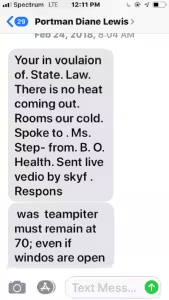
In the funniest part of the trial, the tenant at first denied and then admitted sending a bizarre text message to the landlord in the depth of winter, after he noticed that the windows of every unit in the building were open, including those of the tenant who constantly complained it was too cold!  Here is the text message, grammatical errors and misspellings included:

Yes, her crazy assertion to the landlord was that he must maintain the heat in the unit at 70°F even if the windows of the unit are left open!

Of course Pastor Brown and the Church had to fund the 4-year defense of the Civil Rights Administrative Complaint and the lawsuit, which he did with aplomb, but at great expense.  For the benefit of all landlords subject to outrageous prosecutions from obstinate public agencies, he saw this case through to its appropriate and proper end.  He refused to be bullied by the Ohio Civil Rights Commission, the office of the Ohio Attorney General and Housing Opportunities Made Equal (H.O.M.E.) (which manufactured evidence and knowingly lied to the Civil Rights Commissions in “building their case”).

For more information or to avoid being bullied by these same agencies: (a) DO NOT TALK TO THEM in an investigation EVER and (b) contact Jessica Gibson  (513.943.5677) for assistance with your case.

As we wrote here, in November the Ohio First District Court of Appeals in White v. Cincinnati unanimously ruled in favor of clients of the 1851 Center for Constitutional Law and Finney Law Firm in a challenge to the City of Cincinnati’s alarm tax scheme. The City of Cincinnati asked the Ohio Supreme Court to review that decision, a discretionary call by Court.  Historically, Ohio’s top Court accepts only about 5% of such cases for consideration.

Today, the Ohio Supreme Court declined to accept for review the First District decision.  Since that was the last stop on the railroad for the City, the inevitable next legal steps are injunction against further collection of the tax, class certification and an order of restitution before Common Pleas Court Judge Wende Cross.

Amazingly, even after the First District ruled that the tax was illegal, through today the City of Cincinnati insisted on continued collection of the tax. So, an injunction by the trial court now will be necessary.

If you are a Cincinnati alarm fee payor, you should be expecting a refund once the amount has been calculated and the procedural hurdles cleared, perhaps later this year.  If the City continues to attempt to extract alarm charges from you, respectfully decline and send them this blog entry!

Do you own land on one of the seven hills of Cincinnati? Has your downhill neighbor started digging on their land? Has such digging threatened to cause or caused your land to slide? If you answered yes to the preceding questions, then you might be entitled to an injunction or damages due to your neighbor removing the “lateral support” to your land.

This blog post will address a (i) background on lateral support; (ii) neighbor’s liability for removing lateral support from a landowner’s land when such land is in its natural or improved state; and (iii) landowner’s recourse when their land is going to start or starts to slide due to their neighbor’s digging.

Background:

The right to lateral support is a landowner’s right to have their land supported laterally by their neighbor’s land. The right varies based on whether the damaged land is natural or improved. Land in its natural state is always entitled to lateral support. However, improved land is not so entitled unless provided by statute or a neighbor negligently removes lateral support. Ohio provides such a statute.

Natural Land:

If a neighbor’s digging causes damage (e.g., sliding) to a landowner’s natural land, then the neighbor is liable for the damages that flow from such digging. There is no need for the landowner to show fault; it is a strict liability standard. To prove strict liability, the landowner must show (i) that their land was injured by the removal of its lateral support, (ii) that the injury resulted from the neighbor’s digging, and (iii) ascertainable damages.

Improved Land:

The Ohio Revised Code, under Sections 723.49 – 723.50, allows a neighbor to excavate down to (i) nine feet below the curb or street grade and (ii) the full depth of the foundation wall of any building on the landowner’s land, without liability. That said, if a neighbor digs to a depth greater than nine feet below the curb of the street, and such digging causes damage to any of a landowner’s buildings, then the neighbor is liable regardless of whether the neighbor is negligent. However, the neighbor’s digging must be the proximate cause of the damage.

Under a negligence standard, a neighbor might also be liable when the neighbor’s digging causes damage to a landowner’s building. The landowner must demonstrate that the neighbor was negligent by showing that the neighbor’s digging (i) removed the lateral support to the landowner’s building, (ii) caused injury thereto, and (iii) caused ascertainable damages.

Note: Concerning negligence, a neighbor has a duty to perform work, even if on their land, in such a manner as not to damage an uphill landowner’s land.

Landowner’s Recourse:

When dealing with the possible removal or the removal of lateral support, a landowner may seek an injunction or sue for damages. A landowner may seek an injunction to ask the court to prevent a neighbor from taking actions that will remove the lateral support to the landowner’s land. Alternatively, a landowner may seek monetary damages after a neighbor damages the landowner’s land. Such damages are based on “the time required to repair and a comparison of the cost to repair to the diminution in the fair market value of the [landowner’s land] before and after the damage.”[1]

Note: If a landowner lives uphill from a neighbor, and the neighbor removes soil downhill from the landowner’s land resulting in damage to the landowner’s land, then the neighbor must make the repairs.

Conclusion:

If (i) you own land on one of the seven hills of Cincinnati; (ii) your downhill neighbor started digging on their land; and (iii) such digging threatened to cause or caused your land to slide, then call the Finney Law Firm today, where an experienced professional can provide insight as to whether you have a claim for an injunction or damages.

[1] 1 Ohio Real Property Law and Practice § 8.07 (2021).

The business buzzword for 2022 is: Inflation.

The inflation rate in 2021 was 7.5%, a rate that the the Federal Reserve says took them completely by surprise.  And 2022?  Many prognosticators (this author included) believe inflation will hit double digits for the first time in more than 30 years.  This comes after rates of inflation consistently at or below 2% for the past decade.  As a result, many marketplace participants simply are not aware of strategies that will enable them to navigate the shoals of an inflationary environment.

This blog entry may pivot between references to rates of inflation and rates of interest for borrowing.  These two concepts, while different, are addressed interchangeably as (a) inflation is a widely accepted indicator of an over-stimulated economy and (b) the predictable response to inflation is raising interest rates charged to banks by the Fed to dampen that economic activity.  In turn, banks will then raise the rates charged to consumer and commercial borrowers.  So, higher inflation inevitably begets higher interest rates.  The Fed has forecasted both (i) the possibility of front-loaded rate increases, meaning sharp rises in the coming months (as opposed to sequential rate hikes being stretched out over months and years) and (ii) as many as seven rate hikes in 2022 alone.  This means interest rates could rise by a full 2% or more from today’s rates before January of 2023.  How high can rates go? In March of 1980 the prime rate of interest peaked at 19.5%.  Imagine the impact of interest rate adjustments on your business model at those exorbitant rates.

Here are a few things to consider to protect yourself in inflationary times:

  1. Utilize commercial rent adjustments to your advantage.  During low inflationary times, landlords and tenants have commonly avoided complex periodic calculations for rent increases based upon Consumer Price Increases (CPI) increases, in favor of either fixed rent rates during the term of a lease or rent increases only pursuant  to a fixed schedule (say, for example 5% increases every 3 years).  As inflation accelerates and persists at high levels, landlords will hope they had full CPI adjustments built into their leases past and will start demanding then in leases in the future.  Conversely, tenants will cherish fixed-rate, longer-term leases that create a benefit to them of inflation (but the rapidly-changing office and retail markets might cause devaluation of spaces that previous saw decades of stability and strength).  As always, we recommend that tenants consider asking for an early termination provision in all commercial leases.
  2. Anticipate and avoid mortgage interest rate surprises. Many residential mortgages and most commercial mortgages have fixed interest rates only for a few years.  As to residential rates, after the period of the fixed rate, frequently rate increases are capped, but will still be painful.  But for commercial borrowers, when the fixed term expires, the rate increase is typically unlimited.  As a result, commercial borrowers locked into mortgages that might not be paid off for a decade or more could have dramatic, uncapped and unanticipated increases in the interest portion of the mortgage payment that continues to escalate each adjustment period.  To mitigate these impacts, consider refinancing into a new fixed-rate term that gives you breathing room before the impact of higher rates hits with full force.  Also, the sale of parts of your portfolio to pay down debt could lift your P&L from the greatest impacts of interest rate hikes.
  3. Be careful of fixed-rate pricing.  Home builders, contractors and manufacturers are experiencing difficulties fulfilling obligations under fixed-price contracts for matters that have a delivery date well into the future, shrinking their profit margins or turning winning contracts into losers.  Our office then is seeing instances of home builders trying to walk away from contracts and contractors seeking to convert fixed-price contracts into cost-plus agreements, shifting material and subcontractor pricing increases to buyers.  If you are that builder or contractor, consider adding an automatic or negotiated inflation adjustment in the contract and as a buyer, you want to lock in that fixed pricing firmly.
  4. Anticipate suppliers walking away from contracts. Similarly, we have seen manufacturers and distributors of certain products avoiding their obligations to supply certain goods or equipment.  As a buyer, do you have your supply contracts documented correctly and have you diversified your supply pipeline to protect yourself if a supplier lets you down?  Is the party with whom you are contracting sufficiently capitalized to stand behind their contractual obligations?
  5. Consider inflation and interest-rate contingencies.  The Cincinnati Area Board of Realtors/Dayton Area Board of Realtors form residential purchase contract allows a buyer to state the specific terms of the mortgage it is seeking as a contingency to ia buyer’s performance under the contract.  If you specify a “fixed rate loan for 80% of the purchase price at a rate below 3.5% per annum fixed for a period of 30 years,” and interest rates rise before the closing, the buyer has a perfect out.  Similarly, buyers and sellers can include in any contract an “out” for high rates of inflation and higher interest rates.
  6. Be wary of options.  Options to renew leases and options to purchase may seem innocuous and predictable in stable times.  But in a dynamic high-interest rate marketplace, an option acquired today to buy a property at a fixed price three, five or ten years into the future (say under a long-term commercial lease) can unexpectedly enrich the option holder.  Options can be a way a way to leverage dramatic profits to the option holder.
  7. Be prepared to offer seller financing.  A close partner to higher interest rates are tighter lending standards.  Fewer and fewer buyers can afford to buy at inflated interest rates, and lenders also frequently tighten their loan eligibility standards.  As a result, a eligible buyers — abundant today — become frighteningly scarce.  In the worst of the inflationary period at the end of 1977 to 1981, sellers had to offer loan assumptions, land contracts, leases with options (or obligations) to purchase (with the warning noted above) and simple notes with accompanying mortgages to get any property sold.
  8. Be prepared to buy at foreclosure sales.  Foreclosure sales, which have virtually disappeared for the past two years, could come roaring back as commercial and residential owners cannot afford their new, higher mortgage payments, and, of course, mortgage foreclosure moratoria have been lifted.
  9. Be prepared to offer seller financing.  A close partner to higher interest rates are frequently tighter lending standards.  Fewer and fewer buyers can afford to buy at inflated interest rates, and lenders also frequently tighten their loan eligibility standards.  As a result, a eligible buyers — abundant today — become frighteningly scarce.  When lending is loose (as today), it seems readily available to anyone.  And when it tightens, it seems to strangle the marketplaces.  In the worst of the inflationary period at the end of 1977 to 1981, sellers had to offer loan assumptions, land contracts, leases with options (or obligations) to purchase and simple notes with accompanying mortgages to get almost any property sold.

We saw with the rapid deterioration of the real estate market from 2006 to 2010 that buyers many times would willfully breach their contractual obligations to buy or rent.  In this process, they would search for a contingency or loophole — any argument whatsoever — to evade their contractual promises.  And in other instances, they would just outright walk away.  Accompanying these contractual breaches were also insolvency and bankruptcy, making collection impractical or impossible.  Similarly, as the real estate marketplace has heated up over the past five years, we have seen sellers work to evade their contractual obligations so they could retain an appreciating investment or simply realize a higher price from a second buyer.

How can you protect yourself in this type of dynamic market to assure performance by a buyer or seller?

  • Consider escrow deposits, guarantees and other security. Sellers can demand higher earnest money deposits, non-refundable deposits and short contingency periods. Buyers can use tools we have written about here and here of Affidavits of Facts Relating to Title and legal actions for specific performance. Further, consider adding personal guarantees to contractual promises from corporate and LLC buyers or sellers.  Additionally, the performance by buyers and sellers can be further secured with mortgages against real property and secured positions in other assets.
  • Add an attorneys fee provision.  Also, consider adding a contract provision shifting the expense of attorneys fees to the breaching party in a contract.  That can sometimes change the calculus of a prospective breaching party.
  • Tighten your contract language. To lock buyers and sellers into real estate and supply contracts and leases, carefully consider ways the other party might find a contingency or loophole in their performance. Contingencies (commonly for inspection or financing) are the tunnel through which most buyers drive to walk away from a contract.  Ohio law provides that a buyer must “reasonably” attempt to fulfill a contract contingency, but many still attempt to use contingencies to artificially and intentionally avoid their legal obligations.  Fraud on the part of a seller (such as an undisclosed material defect discovered before closing) can also arguably be the basis for a buyer not performing.  Conversely, typically there are no contingencies to a seller’s performance under a contract.  But consider everything in the instrument — the date, the property description, the parties’ names, the “acceptance” language and timing, in considering how the other party might try to squirm away from their promises.

As the economy becomes more unpredictable and more dynamic in terms of pricing, supply shortages and interest rates, market participants would be wise to carefully think about the impact of inflation and interest rate hikes on their contractual obligations and market positioning.


We all know of creative and incessant attempts to defraud us of our hard-earned money, many (but not all) internet- and email-based.  But nonetheless (i) the efforts of snooker us never stop, and (ii) we must constantly tell others in our family and our organization to be wary.  Eternal vigilance is a business and personal requisite these days.  The criminals are absolutely relentless.

Just this last week, our firm and my family were “almost” taken in by two of these international criminals:

  • Our firm (because we have a great web site and use internet marketing tools) constantly gets “new client inquiries” (usually via our web portal or regular email) from fraudsters asking us “do you review contracts?” or “can you sue someone for us?,” pretty generic and bland (but transparently fraudulent) inquiries.  I generally just “delete,” but one of these made it to one of our newer associates.  It was a client from Dubai who wanted us to assert certain contractual claims against another party.  We did so, and the matter instantly settled with a $385,000 certified check payable to our firm escrow account.  The fraudulent client then wanted us to wire the escrowed monies to him and a third party, both overseas (major red flag there!).  Fortunately, our crack bookkeeping staff saw the certified check was dishonored before we wired out the funds — disaster averted!.  But it was a close call.

[Something to note about these fraudulent inquiries: (i) they never want to communicate via telephone (but rather by email), (ii) the phone number they provide is always bad, and (iii) they always have some bland *@Gmail address.”  I sometimes respond to the email address they provide “please call me,” and they never do.  I call the phone number and it is bad for one reason or another.]

  • Sunday, right before the Superbowl, I stopped to have lunch with my wife.  She related to me that a piece of furniture she had for sale in Facebook Marketplace had sold to a buyer in California.  He was going to send us “certified funds” and then wanted us to pay his moving company to bring the piece to California.  “Wait a minute,” I said.  “why would we pay his mover,” and it vaguely reminded me of a fraud scheme I had heard from a client or read about on the internet.  Sure enough, I Googled “pay the mover” and found out this is a common scam.  You wire or pay funds to a mover, and later the “certified funds” are dishonored.  The victim is “out” the moving fee and the scammer never intended to pay for your furniture!  My wife told the would-be buyer that we would hold the “certified funds” for 10 days before shipping the goods, and he went radio silent immediately.  Fraudster!

Our firms, and our title company in particular, are attacked by fraudsters almost daily.  Fortunately, we are alert to the most common scams, and have avoided them all (we have clients who have not been so lucky).  But these two close calls — at the office and at home – remind us that vigilance is required and gullibility, and trust, in the internet era are simply foolish!

Be cautious with your funds and your property.  There are loads of fraudsters — some anonymous on the internet and some that you think are your friends — who will gladly and shamelessly steal your money and leave you wondering why you fell for their scam!

Be cautious!  Be aware!  Trust very few.

Earnest Money vs. Liquidated Damages

As Chris Finney has addressed extensively in prior blog entries, “a common misunderstanding of parties to a purchase contract is that the escrow money is some sort of measure of or limitation on damages for the buyer’s breach, or, conversely, that the return of the earnest money ‘cures’ the seller’s breach and is the limitation on his damages as well. However, unless the real estate purchase contract specifically calls out either of those limitations, neither of those propositions is true.” In other words, an earnest money deposit is in no way representative of the amount of “damages” caused by a breach of the contract unless the parties to that contract say it is.

Consider the following example: A Buyer contracts to purchase a home for a purchase price of $350,000. Buyer deposits $5,000 in earnest money. Buyer decides to buy a different home instead and breaches the contract to purchase the first home. The Seller of the first home has a tough time selling it after Buyer backs out but, eventually, finds someone else to buy the home. However, the new buyer will only pay $320,000. Seller can typically seek damages from Buyer based on the difference in the purchase price, i.e., $30,000, because that is the amount that places Seller in the position he would have been but for Buyer’s breach. Seller is NOT limited to merely collecting the $5,000 earnest money.

So then what does the phrase “unless the parties to the contract say it is” really mean? How can the parties to a contract predetermine what the damages will be if one of them breaches?

A liquidated damages clause is a contractual vehicle through which the parties can stipulate – in advance – the amount of damages due and owing should one of them breach the contract. It can be a fixed amount or a percentage of the total contract price. Relative to real estate contracts, particularly in the commercial context, parties will sometimes agree, in the purchase contract, that the earnest money will act as liquidated damages in the event of breach. Thus, while liquidated damages are not necessarily equal to the amount of earnest money deposited, they can be if the parties so agree.

Are liquidated damages clauses enforceable?

As the Ohio Supreme Court has long held, “parties are free to enter into contracts that contain provisions which apportion damages in the event of default.Lake Ridge Academy v. Carney, 66 Ohio St. 3d 376, 381 (1993). However, many parties who later breach a contract after having agreed to such a provision unsurprisingly attempt to defeat the same by arguing that the provision to which they agreed is somehow unenforceable – most often, by arguing that the clause operates a “penalty.”

Ohio courts utilize a three-part test to evaluate whether a liquidated damages clause is, indeed, enforceable.

Where the parties have agreed on the amount of damages, ascertained by estimation and adjustment, and have expressed this agreement in clear and unambiguous terms, the amount so fixed should be treated as liquidated damages and not as a penalty, if the damages would be (1) uncertain as to amount and difficult of proof, and if (2) the contract as a whole is not so manifestly unconscionable, unreasonable, and disproportionate in amount as to justify the conclusion that it does not express the true intention of the parties, and if (3) the contract is consistent with the conclusion that it was the intention of the parties that damages in the amount stated should follow the breach thereof.

Samson Sales, Inc. v. Honeywell, Inc., 12 Ohio St. 3d 27, Paragraph 2 of the Syllabus (1984).

Courts routinely uphold these clauses in the real estate context, in large part due to the unpredictability of the market. See, e.g., Cochran v. Schwartz, 120 Ohio App. 3d 59, 62 (2d Dist. 1997); Kurtz v. Western Prop., L.L.C., 2011-Ohio-6726 (10th Dist. 2011); Ottenstein v. Western Reserve Academy, 54 Ohio App. 2d 1, 4 (9th Dist. 1977); Schottenstein v. Devoe, 83 Ohio App. 193, 198 (1st Dist. 1948); Curtin v. Ogborn, 75 Ill. App. 3d 549, 555 (Ill. App. 1979) (outlining a general rule that liquidated damages are appropriate in amount where ten percent or less of the purchase price). This is because “although the contract price is easily ascertainable, the fair market value of real estate fluctuates, in some cases dramatically, and these fluctuations, based upon numerous independent variables, are unpredictable.” Kurtz, at ¶ 30 (relative to the first prong in the Samson test). “Difficulties inherent in assessing the fair market value of property due to the volatility of the real estate market have been the impetus for Ohio courts giving effect to liquidated damages provisions in real estate transactions.” Id., at ¶ 31.

Who does a “liquidated damages” clause benefit?

While it is perhaps easier to envision how liquidated damages provisions tend to benefit the non-breaching party, they can be just as advantageous to a breaching party. For example, consider a situation where Buyer is under contract to purchase a $1 million retail center with a $100,000 liquidated damages clause. Buyer elects not to purchase the property and breaches the contract. A week after Buyer’s breach, there is a down-turn in the real estate market and, now, Seller can only get $800,000 for the property. Rather than potentially being on the hook for the $200,000 difference between the contract price and ultimate sale price, Buyer’s liability is capped at the fixed liquidated damages amount of $100,000 because that is what the parties agreed to in the contract.

Liquated damages clauses can also be mutually advantageous inasmuch as it allows the parties to know what to expect. Circumstances may arise that require a party to choose between breaching the contract or incurring some other loss. In such a situation, the clause helps that party weigh their options and explore all possible outcomes in order to make an informed decision.

Is a liquidated damages clause a good idea?

Like so many legal questions, the answer is unfortunately the rather frustrating “it depends.” Ultimately, whether to include a liquidated damages clause in your contract or whether to agree to such a clause being proposed by the other side, is a decision that should be made on a case-by-case basis after considering all of the potential factors that may come into play.

Our firm has significant experience in dealing with these types of provisions – from drafting, to review, and to enforcement – and we can help you explore how including such a provision in your real estate contract may impact you, as well as answer any other real estate contract questions you may have.