

Attorney Casey A. Taylor


We have previously written on the different types of deeds (Real Estate 101: Different Types of Deeds in Ohio, Kentucky, and Indiana), as well as how costly it can be to breach your covenants under a general warranty deed (Real Estate 101: Breach of General Warranty Covenants Can Be Costly Mistake).  Perhaps the most common breach occurs when you transfer property that is encumbered in some way, such as by an easement or lien, and that easement or lien is not excepted from the deed. However, one of the less discussed components of a general warranty deed is the covenant to defend. Whether you are the grantor or grantee with respect to a general warranty deed, you should be aware of when this duty arises, and what it means, in order to protect yourself, your rights, and your checkbook.

Statutory duty to defend in “short form” general warranty deeds

R.C. 5302.06 states:

In a conveyance of real estate, or any interest therein, the words “general warranty covenants” have the full force, meaning, and effect of the following words: “The grantor covenants with the grantee, his heirs, assigns, and successors, that he is lawfully seized in fee simple of the granted premises; that they are free from all encumbrances; that he has good right to sell and convey the same, and that he does warrant and will defend the same to the grantee and his heirs, assigns, and successors, forever, against the lawful claims and demands of all persons.

(Emphasis added). This means that a grantor who conveys property under a general warranty deed promises to defend the grantee and the grantee’s title against all “lawful claims and demands” of others.

What are “lawful claims and demands”?

Unfortunately, Ohio law does not provide much guidance as to what “lawful claims and demands” encompasses – this is not a defined term under the statute, nor have the courts ventured to define it in this context. A lawsuit is generally defined to be “the lawful demand of one’s right.” Ludlow’s Heirs v. Culbertson Park, 4 OHIO 5 (1829).

Additionally, in various contexts, Ohio courts have provided the following guidance as to each of the terms separately:

  • State ex rel. Grant v. Brown, 39 Ohio St. 2d 112, 116 (1974) (“To say of an act that it is ‘lawful’ implies that it is authorized, sanctioned, or at any rate not forbidden, by law.”);
  • La Fon v. City Nat’l Bank & Trust Co., 3 Ohio App. 3d 221, 223 (10th Dist. 1981) (adopting the definition of “claim” as “to assert . . . to state; to urge; to insist . . . a right or title.”);
  • Crozier, v. First National Bank of Akron, 9th Dist. Summit No. 10140, 1981 Ohio App. LEXIS 13717, *6-7 (defining “claim” as “a ‘broad comprehensive word’ that includes ‘an assertion’ and ‘a cause of suit or cause of action.’”); and
  • Eighth Floor Promotions v. Cincinnati Ins. Cos., 3d Dist. Mercer No. 10-15-19, 2016-Ohio-7259, ¶ 26 (“‘Demand’ is defined as ‘the assertion of a legal right or procedural right.”).

Thus, read collectively, a “lawful claim or demand” can be defined as “an authorized or unforbidden assertion of a right.”

Do we first have to ascertain is a “claim or demand” is lawful before duty to defend arises?

However, courts have found that the term “lawful” does not require the “claim or demand” to be meritorious before the duty to defend is triggered since this would essentially render the covenant meaningless. See Sediqe v. I Make the Weather Prods., 6th Dist. Lucas No. L-15-1250, 2016-Ohio-4902, ¶ 29 (holding that the claim or demand as it relates to the underlying duty, e.g., that the property is not free from encumbrances as warranted, need not be proven or successful before the duty arises, as “such a rule would render the duty to defend ineffective and eliminate the grantor’s right to control the defense against the claim.”). Thus, for example, a party claiming to have a lien on conveyed property need not prove the validity of their lien before the grantor’s duty to defend the grantee against such claim arises. The idea is that the grantor will step in before it gets to that point in order to defend the grantee’s title against such claims.

Does a suit have to be filed to trigger a duty to defend?

Indeed, the party asserting the claim likely isn’t even required to file suit to trigger the grantor and grantee’s respective rights and obligations under the general warranty deed. As discussed (Here), the Court in Hollon v. Abner, 1st Dist. Hamilton No. C960182, 1997 Ohio App. LEXIS 3814 (Aug. 29, 1997) did not require that the party asserting the adverse, “lawful claim or demand” bring suit before the grantor’s duties under the general warranty deed arose. In fact, the Court awarded the grantee attorney’s fees as damages in a suit initiated by the grantee because the grantee would not have incurred those fees had the grantor lived up to his obligations under the general warranty deed.

Conclusion

If you are a grantee under a general warranty deed and someone asserts a claim against your property (even if they haven’t yet filed suit), the first step to getting your grantor to defend your title as warranted is by informing the grantor that someone is asserting such a claim. As a grantor, if you receive notice that someone is asserting a claim against property that you conveyed by general warranty deed, proven or not, you will want to step up sooner rather than later. A delay in honoring your covenant to defend likely only exacerbates your grantee’s attorney’s fees (especially if your grantee has to file suit to defend his or her own title), for which you will ultimately be responsible.


What due diligence steps should a tenant undertake with respect to a commercial property before signing a lease?

Due diligence customary in a commercial real property purchase

Step back and consider for a moment that when we buy a piece of real property — for our home or for our business — it is prudent and customary by both the buyer and the lender to conduct due diligence investigations of the property:

  • title,
  • survey,
  • physical inspections of the structure and mechanical systems,
  • environmental, and
  • checks of governmental records for notices of liens for violations, zoning, traffic engineering, etc.

The list can seem endless.

Isn’t a commercial lease low-risk for the tenant?

But when simply signing a lease for a term of years, why should the tenant be concerned with these things?  After all, his upfront cash may not be significant (relative to a purchase) and if things don’t work out, the tenant can just leave, right?

Well, sometimes that is the case.  The cost and time needed for due diligence would outweigh the risk the tenant is undertaking by simply signing the lease and moving in.  If so, then by all means, proceed.

But, wait, consider this!

But consider these countervailing factors:

  • Tenant is spending significant monies on tenant buildout costs.
  • Tenant is spending significant monies to move, including moving of furniture, fixtures and equipment, the installation of computer and phone systems, and printing of letterhead, envelopes and business cards.
  • The disruption of your business arising from a move (and if things don’t work out a second move).
  • The image you are building at the new location.  What will be lost if a second move is necessary?  Think of a restaurant or bar, retail store,  or bank branch.  The location is intricately tied to a business’s identity in the mind of the consumer.  It may not be easy to just pick up and move.

The reality is that if the tenant does not undertake the kinds of due diligence implemented for a property purchase, he could “lose” the property in many of the same ways as in a purchase — i.e., he could lose the out-of-pocket costs associated with the activities noted above and have the inconvenience and loss to reputation by relocating to a second location.

The types of risk potentially borne by a tenant that due diligence could avoid

Indeed, in certain circumstances the tenant could be obligated to pay rent throughout the lease term, but the property cannot be occupied for its intended purpose.  (Consider a situation where the property cannot be occupied but where the landlord does not appear technically in default of his obligations under the lease.)

  • When signing a significant lease for property, a title examination, possibly a survey, and assuring lender buy-in of the lease can be absolutely critical.
  • If, for example, the landlord has a mortgage against the property, and the mortgage is in default, that lender legally can extinguish a later–signed lease concurrent with the foreclosure.
    • To avoid this risk, one asks a landlord to execute a subordination, non–disturbance and attornment agreement agreeing that so long as tenant makes prompt and full payment of rent (to the landlord or– when in default of the mortgage — to the lender), the lender or a successor buyer will honor the lease.
    • A tenant’s policy of title insurance can be issued, transferring that risk to a title insurer.
  • If the property does not comply with the regulatory requirements, zoning for example, of the jurisdiction in which the property is located, the tenant could be required to make extensive property modifications or to move.
  • If the property has environmental problems, the cost of compliance — in an unlimited manner — could be transferred to the tenant.
  • If the property has structural problems or the HVAC system is old and inoperable, depending on the lease language (shifting repairs and replacement of the HVAC to the tenant), the burden of fixing the problem could fall to the tenant.

Conclusion

Many times tenants will assume these risks in smaller leases.  Negotiating with the landlord’s lender and conducting full-scale inspections and other due diligence may just not be practical.

But a tenant in a commercial setting should carefully consider the risk-benefit to foregoing certain due diligence steps to prudently protect their investment in their new premises.

Call Isaac Heintz (513-943-6654) or Eli Krafte-Jacobs (513-797-2853) to address your commercial leasing questions.


As first-year law students and many even outside of the legal community know, the “statute of frauds,” codified in Ohio R.C. 1335.04, requires that any interest in land be evidenced by a writing.

Principle of Part Performance

But this general principle is not without exception. One of the more commonly referenced exceptions is part performance. Sites v. Keller, 6 Ohio St. 483, 489-490 (1834) (“Whenever an agreement has been partly performed, and the terms of it are satisfactorily found, it will be enforced notwithstanding the statute.”); Shahan v. Swan, 48 Ohio St. 25, 37, 26 N.E. 222 (1891) (“[I]f the acts of part performance clearly refer to some contract in relation to the subject matter in dispute; its terms may then be established by parol.”).

Other exceptions

However, lesser-known exceptions exist, as well, and are frequently neglected in the statute of frauds discussion. This has resulted in a misunderstanding among many as to the scope of the statute of frauds and when it precludes a claimed interest in land. Specifically, there are two types of equitable trusts that effectively circumvent the harsh consequences of requiring strict compliance with the statute of frauds: a constructive trust and a resulting trust.

Ohio Constructive Trust

“A constructive trust arises by operation of law against one who through any form of unconscionable conduct holds legal title to property where equity and good conscience demands that he should not hold such title.” Dixon v. Smith, 119 Ohio App.3d 308, 319, 695 N.E.2d 284 (3d Dist. 1997). Where one “who, by fraud, actual or constructive, by duress or abuse of confidence, by commission of wrong, or by any form of unconscionable conduct, artifice, concealment, or questionable means . . . either has obtained or holds the legal right to property which he ought not, in equity and good conscience, hold and enjoy,” equity will create a constructive trust. Ferguson v. Owens, 9 Ohio St.3d 223, 225, 459 N.E.2d 1293 (1984).

Additionally, at least one Ohio court has suggested that, “[d]espite the above cited language . . . a constructive trust may exist even where there is no evidence that the title to the property was obtained by improper means.” McGrew v. Popham, 5th Dist. No. 05 CA 129, 2007-Ohio-428. ¶¶ 17-19, citing Groza-Vance v. Vance, 162 Ohio App. 3d 510, 520 (10th Dist. 2005). The creation of a constructive trust is premised upon the unjust enrichment that would result if the person holding legal title to the property were allowed to retain it. Ferguson, at 226.

Ohio Resulting Trust

The Ohio Supreme Court has also recognized “a resulting trust as one that the court of equity declares to exist where the legal estate in property is transferred or acquired by one under circumstances indicating that the beneficial interest is not intended to be enjoyed by the holder of the legal title.” Univ. Hosps. of Cleveland, Inc. v. Lynch, 96 Ohio St.3d 118, 772 N.E.2d 105, 2002-Ohio-3748, at ¶ 56, citing First Natl. Bank of Cincinnati v. Tenney, 165 Ohio St. 513, 515, 138 N.E.2d 15 (1956). This concept is easily understood in the purchase-money context – “where property is transferred to one person but another pays the purchase price, the law presumes a resulting trust exists in favor of the person paying for the property.” Hollon v. Abner, 1st Dist. No. C960182, 1997 Ohio App. LEXIS 3814, at *5 (Aug. 29, 1997); Perich-Varie v. Varie, 11th Dist. No. 98-T-0029, 1999 Ohio App. LEXIS 3990, at *7-*8 (Aug. 27, 1999).

For example, in the Perich-Varie case, the court found that where an individual had been making the mortgage payments on property legally held in his former in-laws’ names, he had a full ownership interest in the property. This was true even though the in-laws argued that the mortgage payments were merely “rent” and even though he had only paid $12,000 of the $33,000 mortgage on the property. Perich-Varie, at * 4-5, * 10-11. To eliminate any inequity (after all, that’s what a resulting trust is all about), the Eleventh District required the lower court to order that the mortgage first be satisfied so that the in-laws were not obligated under a mortgage on a property in which they had no interest. Id., at * 14.

Conclusion

As you can see, constructive and resulting trusts represent some pretty significant departures from the rigid statute of frauds in the name of “equity.”  While a lot of confusion, disagreement, and, ultimately, litigation can be avoided by putting matters involving real property in writing, those who find themselves in a situation where their interest has not been reduced to writing are not necessarily without recourse if one of these equitable remedies applies.


Casey Taylor write on Ohio commercial real estate brokerage liens
Casey Taylor, attorney

Our firm has previously written on the creative ways one can shield his or her personal assets through the corporate or limited liability structure. As noted in that entry (Link Here), “Ohio courts and courts throughout the nation have been pretty vigilant in protecting the corporate veil of owners of corporations and limited liability companies.”  However, this general principle is not without a couple of narrowly drawn exceptions, explored below.

Formation of LLCs

The Finney Law Firm deals regularly with clients and other parties that are organized as limited liability companies (“LLCs”) or corporations.  After all, these entities are fairly simple to create – one must simply fill out an online form or two, submit a relatively small fee to the Secretary of State, and they are then able to transact business without fear of personal liability, right? Maybe not.

The powerful “corporate veil” protection of an LLC

Generally, an LLC member cannot be held personally liable for the torts or contractual obligations of the LLC solely by virtue of his or her membership in the LLC. City of Lakewood v. Ramirez, 2014-Ohio-1075, ¶ 11 (8th Dist. 2014). Thus, if an LLC defaults on its obligations under a contract, an adverse party cannot obtain judgment against the LLC members’ or managers’ personal assets.  It is for this reason, along with its ease of formation, that the LLC structure is so desirable to many. And, most of the time, it succeeds in its purpose of precluding judgment against the members’ personal assets.

Narrow exceptions

However, there are two sets of circumstances under which the limited liability structure does not shield members from personal liability.

1.   Piercing the corporate veil

The first is where the court deems it proper to “pierce the corporate veil,” thereby removing that protection of limited liability.

[I]n order to pierce the corporate veil and impose personal liability upon [members or managers], the person seeking to pierce the corporate veil must show that: (1) those to be held liable hold such complete control over the corporation that the corporation has no separate mind, will, or existence of its own; (2) those to be held liable exercise control over the corporation in such a manner as to commit fraud or an illegal act against the person seeking to disregard the corporate entity; and (3) injury or unjust loss resulted to the plaintiff from such control and wrong.

Stewart v. R.A. Eberts Co., 2009-Ohio-4418, ¶ 16 (4th Dist. 2009), citing Belvedere Condominium Unit Owners’ Ass’n v. R.E. Roark Cos., 67 Ohio St. 3d 274, ¶ 3 of the syllabus, 617 N.E.2d 1075 (1993).  The idea behind piercing the corporate veil is that there is so little separation between the individual and the LLC, that they can almost be considered “alter-egos” such that it is not unreasonable to hold the member or manager of the LLC personally liable for the debts, obligations, and/or liabilities of the LLC.

2.  Member’s own acts, ommisions or fraud

The second instance where a member can be held personally liable notwithstanding the limited liability structure is where the members’ own acts or omissions constitute fraud. R.C. 1705.48; See also Deitrick v. Am. Mortg. Solutions, Inc., 2007-Ohio-839, ¶ 19 (10th Dist. 2007) (finding that a “corporate officer can be individually liable in tort if the promises contained in the contract are fraudulent” and “even if he commits the fraud while in the course of his corporate duties”); Stewart, at ¶ 30 (“[N]either the corporate shield, nor a shield of limited liability insulates a wrongdoer from liability for his or her own tortious acts.”). Additionally, this second instance is not contingent upon the first (i.e., a litigant who seeks to hold an LLC member personally liable for the member’s own fraud need not first pierce the corporate veil in order to do so).  Yo-Can, Inc. v. Yogurt Exch., 149 Ohio App. 3d 513, 527 (7th Dist. 2002) (“[P]laintiffs need not pierce the corporate veil to hold individuals liable who allegedly personally commit fraud.”).

Conclusion

Thus, while the LLC or corporate structure are very successful at providing owners/members with a great deal of protection the overwhelming majority of the time, one shouldn’t make the mistake of thinking his or her personal assets are entirely immune regardless of the circumstances.

How do I obtain an Ohio commercial real estate broker lien?

Attorney Casey Taylor

First, let’s be clear: There is no lien right for real estate brokers for property consisting solely of between one and four residential units. (O.R.C §§1311.85 and .86).

However, licensed real estate brokers do have lien rights in transactions involving commercial properties, i.e., anything other than between one and four residential units.  (O.R.C §§1311.86).

The lien rights extend to brokerage contracts for the provision of services for selling, purchasing, and leasing.  (O.R.C §§1311..86(A) and (B)).  They do not appear to cover the provision of property management services.

What is a lien?

In one sense, a lien does not get you anything more than the contract rights you already have: You have a signed listing agreement, you have earned your commission, you can sue in a court of competent jurisdiction, and you can thus get paid the amount of money you are owed.

But as a practical matter, lien rights are tremendously powerful in “turning the tables” on a property owner, giving quick, inexpensive and powerful leverage to the Realtor to resolve a commission dispute.

Why is a lien important?

Leverage often is the “whole ballgame.”  So often, (a) debtors will avoid debts they clearly owe just because they can, for purposes of the time-value of money (by delaying the payment, they can use your money in the interim) and (b) the reality is that most creditors will not go to the trouble and expense of hiring and paying an attorney to collect the sums owed to them.

Litigation can cost as little as $20,000 per case, up to hundreds of thousands of dollars for a vigorously-contested action.  So, the question for a Realtor claiming a commission is: Can I “check” or “checkmate” a property owner (seller or landlord) into recognizing, dealing with and paying my claim without the two years and tens of thousands of dollars in legal fees needed to vindicate that right?

A lien is a powerful tool — it encumbers real property

A lien is an encumbrance on real property.  In most cases, real property encumbrances have the same priority of the order of filing, i.e., the first-filed is paid first from the sale proceeds, the second, second and so forth.  (Ohio mechanics liens are the major exception to this rule, dating back to the date of first work on a project.)

This gives the lien holder two distinct advantages, many times powerful advantages: (a) their claim is secured against the real estate (i.e., the owner cannot further squander the equity in the property by a sale or mortgage) (b) the claimant has placed a cloud on the title with what may still be a disputed claim, effectively preventing the owner from selling or mortgaging the asset until the earlier of (i) the statutory expiration of the lien or (ii) the judicial disposition of the claim and the lien rights.

Thus, as a practical matter if the property owner wants to sell his property or take out a new mortgage or refinance an existing mortgage, he will have to “deal with” the Realtor’s claims before doing so.

A broker’s lien is unilateral — it does not require the owner’s signature or consent

Contrary to what many clients ask of us in a simple contract or tort claim (“please lien their property”), in most circumstances a lien cannot be placed against real property until either (a) the owner signs a voluntary instrument such as a mortgage or (b) the conclusion of litigation, which usually takes years.  In the meantime, a defendant can sell and mortgage the property, or otherwise encumber it, and then squander the asset without concern for the plaintiff’s claims.  (This is constrained by concerns about fraudulent conveyance issues that will be discussed in another blog entry later.)

The right to place a unilateral lien against real estate is very narrow, being limited to government liens (such as tax liens, assessments, environmental liens, etc.) and mechanics liens (for work done on real property and materials delivered to real property for incorporation therein).

Commercial brokerage lien rights

O.R.C. §1311.86 provides such unilateral lien rights for the collection of a commission in commercial transactions in specific circumstances set forth in the statute.  Being a unilateral filing, means that the Realtor claiming the lien simply signs and files a piece of paper in the Hamilton County Recorder’s office.  It does not require a signature (on the lien filing) of the property owner.

Statutory requirements

Because the lien arises from the statute, strict compliance with the statutory mandates will be required.  F. W. Winstel Co. v. Johnston, 103 Ohio App. 525, Paragraph 1 of the Syllabus (1st Dist. 1957).         These are set forth in O.R.C. §1311.86:

  • It is for written brokerage contracts only (O.R.C. §1311.86(A) and (B)).
  • It is for “for services related to selling, leasing, or conveying any interest in commercial real estate” (O.R.C. §1311.86(A)) and “for services related to purchasing any interest in commercial real estate.” (O.R.C. §1311.86(B)).
  • “The lien is effective only if the contract for services is in writing and is signed by the broker or the broker’s agent and the owner of the lien property or the owner’s agent.”   (O.R.C. §1311.86(A) and (B)).
  • The lien is for the broker only, not his salespersons.  (O.R.C. §1311.86(C)(1).
  • The lien amount is either the brokerage commission due, or if due in installments only that portion due on conveyance.  (O.R.C. §1311.86(C)(2) but in the case of commercial leasing, (O.R.C. §1311.86(C)(3).
  • Only the property subject to the brokerage agreement can be liened.  ((O.R.C §§86(C)(5)).
Lien contents

To perfect a lien, the following steps must be followed:

  • The claimant must prepare, sign and have acknowledged (notarized) an affidavit containing each of the following: (a) name of the broker who has the lien, (b) the name of the owner of the lien property, (c) a legal description of the lien property, (d) the amount for which the lien is claimed, (e) the date and a summary of the written contract on which the lien is based, and the real estate license number of the broker. R.C. 1311.87(B)(2).
  • Additionally, the lien affidavit must state that the information contained in the affidavit is true and accurate to the knowledge of the broker. Id.
Lien deadlines

The timeframes within which a commercial broker’s lien must be filed are:

  • For a sale of liened, the Affidavit must be recorded prior to the conveyance of the property. R.C. 1311.86 (B)(3).
  • For a purchase of liened property the Affidavit must be recorded within ninety days after the conveyance of the property. R.C. 1311.86 (B)(4).
  • For liens based upon a leasing commission, the Affidavit must be recorded within ninety days after a default by the owner in payment. R.C. 1311.86 (B)(5).
Notice to property owner

One other requirement not to overlook:  “On the day the lien affidavit is recorded, the broker shall provide a copy of the lien affidavit to the owner of the lien property and, where a contract for the sale or other conveyance of the lien property has been entered into, to the prospective transferee, where known, either by personal delivery or by certified mail, return receipt requested. O.R.C. 1311.86 (B)(6).

Be careful — “Slander of title” claims can be nasty

If one files a lien against real property that is later determine to have been in bad faith, the lien claimant can find himself the target of a suit for a cause of action known as “slander of title.”  Slander of title is the tort of impairing title to someone’s real estate without a reasonable basis therefor. McClure v. Fischer Attached Homes, 2007-Ohio-7259, ¶ 21, 882 N.E.2d 61 (Clermont Co. C.P. 2007), citing Green v. Lemarr, 139 Ohio App. 3d 414, 433 (2d Dist. 2000).

The really bad part of a slander of title claim is that it can include an award to the property owner of an award of his attorneys fees and a punitive damages amount. Additionally, the commercial brokerage lien statute specifically allows for the prevailing party to recover its attorney’s fees. O.R.C. 1311.88(C) (“[A] court may assess the nonprevailing parties with costs and reasonable attorney’s fees incurred by the prevailing parties.”). However, in cases involving general slander of title claims (i.e., outside of the commercial brokerage lien context), the attorney’s fees have been limited to the those “necessary to counteract a disparaging publication,” and did not include those incurred in prosecuting the slander of title. Cuspide Props. v. Earl Mech. Servs., 2015-Ohio-5019, ¶ 40 (6th Dist. 2015).

Thus, we recommend moving forward with the filing of an affidavit for a commercial broker’s lien cautiously, only where the broker is certain of the merits of his position and even then still willing to withstand the possible claim for slander of title from an owner.

Conclusion

The Finney Law Firm is privileged to have many real estate brokerage clients, including commercial Realtors.  The commercial lien right is a very powerful one, and one that we think is under-utilized in commission disputes.

Consider one of our attorneys to assist you in such a dispute, including the use of the right to a commercial lien.

Frequently, clients desire to lend money, seller-finance the sale of their business or other asset, buy and then lease out a building, or engage in some other business transaction because they are motivated by favorable business terms the transaction provides on its surface: A high rate of interest, a good return under a lease, or a more promising sale price than otherwise the seller would obtain, for example.

This entry asks a prospective private lender to think twice about the risks associated with this activity and to take as many steps to protect himself as possible under the circumstances.

Who is the “lender” and who is the “borrower”

For purposes of this entry, there are many circumstances in which a party is a “lender” and another is the “borrower.”

  • Obviously, a simple monetary loan in which there is a lender and borrower is one such transaction.
  • Another occurs where an investor either owns a building and desires to rent it, or purchases one for leasing purposes.  In addition, as a part of a leasehold transaction, the landlord may be putting into the premises significant sums in “tenant buildout costs.”   Here, the renter is “using” the landlord’s money, his credit, and his asset, in exchange for monthly (read: deferred) payments.  This is a form of “loan.”
  • When a seller is selling his busines, his building or another asset, and does anything other than take back 100% of the purchase price at the time of conveyance, he is a “lender.”  (And the worse situation is where the seller is taking a subordinate position to a lender who gets a first mortgage or other lien on the assets acquired.  In such situation, the liklihood of the seller getting his “loaned” funds is significantly impaired, and the chance of default significantly higher.)
  • Even co-signing a loan or a lease, or guaranteeing the debt of another, is “lending” your credit to the co-borrower.
Four important factors to consider

But consider these factors before “lending” your money, your asset, and your credit to a third party:

First, ask yourself: “Why can’t this buyer get conventional financing?”  Banks are in the business of assessing and taking the risks associated with lending.  If this “borrower” does not qualify for a bank loan, why should you be in the business of being a lender?  Have you really fully assessed the risks of lending to this “borrower.”

Banks know experientially and actuarially the “warning signs” that predict loan defaults.  Among these are an inability to come up with an adequate down payment, a poor credit score, a history of litigation, and other warning signs.  I spoke with one lender recently, and they said they will never lend to people who fail to pay their taxes — ever.

Second, in my experience, a buyer of an asset is much more likely to raise defenses and counterclaims against a seller than the buyer would be able to as against a third party lender: Fraud in the inducement of the sale, property defects, misrepresentations in the business accounts, and simple contract breach.  Buyers will raise any and every excuse and defense against paying money they owe.

Third, the more desperate the “borrower” is, the more likely he is to agree to generous transaction terms: a high rate of interest, a high sale price, or some other above-market remuneration.  And — I say this based on experience — borrowers who have no intention and no ability to pay back the “loan” are the most willing to agree to generous lending terms.

Fourth, if you are going to leap (into the position of being a lender), at the very least look first: do the kind of due diligence that a lender would — a credit check, a background check, reference checks, and a simple check of court clerks sites and bankrupcy court history for obvious signs of fiscal distress.

The ABCs of improving your position as a lender

So, you have made the decision to “lend.”  What steps can you take to improve your position and increase the liklihood of getting your money paid back, with interest?

A. Certainly ask for a personal guarantee of any “loan” to a corporate entity.  Accepting simply a corporate signature, whether of a note maker, a tenant or the buyer of an asset, is asking for trouble, unless that company’s creditworthiness has been thoroughly ascertained

B.  Don’t be shy about asking for the personal guarantee of the principal’s (or principals’) wife (or wives).  If the borrower is earnest about putting their name, their assets and their creditworthiness behind a promise, and they have asked you to extend credit to them — then shouldn’t their wife also stand behind the obligation?  Stating it differently, the most common and most obvious dodge of debtors avoiding their creditors is to place their assets in the name of their wife.  Don’t let them avoid their obligations to you so easily.

C. Are there third parties who can guarantee the debt?  A business partner?  A parent?  Who is interested in the success of this borrower’s business such that they would be willing to stand behind its obligations?

D.  Look for assets to lien.  Does the “borrower” (or his wife) own a house, stocks, jewelry, accounts receiveable, or equipment or inventory in their business?  Are those assets presently free from any  first lien against them?  If so, and if the borrower is earnest about paying back your debt, then he should not have qualms with providing a security interest against those assets to stand behind the loan.  (Note: Please consult an attorney about how to properly take a lien in various assets; it can be tricky.)

E. Would some patience or a reduced price yield either a cash buyer or enable the buyer you have to go and get a bank or other third party loan?  If so, it may be wise to take one of those options.

Conclusion

Lending is an ultra-hazardous activity that should not be undertaken lightly.

There are exceptions where the seller’s main motivation is not necessarily getting payback of the loan: a parent helping a child; a business or building owner who is getting a great sale price for the asset, and perhaps much of it in cash; or simply a weak market with few buyers. And so long as our clients enter into a transaction understanding the risks of being a “lender,” we are fine with that decision.

But we see many clients seduced by more favorable terms from a borrower or seller-financed buyer who desperately needs their cash versus a stingier cash buyer.

Our suggestion: Think about taking the money and running instead.

The risks inherent in being a lender is why they say: “Cash is king.”

With the advent of the camera phone, the ubiquitous device in everyone’s pocket, there is no longer an excuse for failing to document “things” for posterity.  And such forethought from our clients can prove decisive in a legal battle.

Examples where photos are helpful

The best example of the value of real-time photos is in construction disputes.  We find it is regular practice of owners, architects, engineers, contractors, and materialmen to take photos at each stage of the work completed, which helps to establish the quality of the work, the conformity of the work to the plans, and the stage of completion at a particular point in time, and perhaps document the development of defects in material or workmanship as they are installed.   (This then, of course, helps to pinpoint the blame.)  The forensic or retrospective value of photos at each stage of construction can be invaluable.

Another example of the value of photos is in commercial and residential landlord/tenant in disputes.  In those disputes, the condition of the property as delivered to tenant or as surrendered to landlord is frequently contested.  My sharper clients have taken the time to document the condition of the property both at the beginning and end of the relationship with their camera phone. Those photos can make a liar of a defendant (or plaintiff) and permit a party to establish his minimum elements of a case he is presenting.

The existence of photos also could be used in an automobile accident situation, a dispute over the quality of goods delivered or to prove a person was in a particular place at a point in time.

Another example for me personally is that I just hate to get parking tickets, yet many times those darned parking meter are malfunctioning.  When this happens, I take a business card, note on it “out of order” and slip it into the “credit card slot” on the meter while my car is parked there.  Before slipping the card into the slot, I take a picture of the meter (they all have identifying numbers on them now) and the “out of order” card.

Admissibility and use of photos

Photos are, of course, generally going to be admissible as evidence in a trial or in alternate dispute resolution. So often at trial, I hate to say, one party or the other is outright lying to the judge.  A photo can clear up the inconsistency in statements pretty effectively.  The judge or jury should be thrilled to have such (nearly) incontrovertible evidence versus deciding which party is lying.

Number of photos

The memory capacity for photos on your telephone is almost unlimited, and it takes mere seconds to snap several pictures.  Think about thoroughly preserving the record for posterity (or trial).  Make the time to take several (indeed dozens) of shots — narrow and wide angle, and from every perspective —  to preserve the moment for later reference.

Conclusion

Get with the times.  Use this incredibly effective tool to enhance your position in dispute resolution.  Or, saying it differently, I get frustrated when a client could have made their case stronger simply by whipping out that phone and documenting and saving information for a later date.  This is especially true when the client knows the matter is heading into litigation.

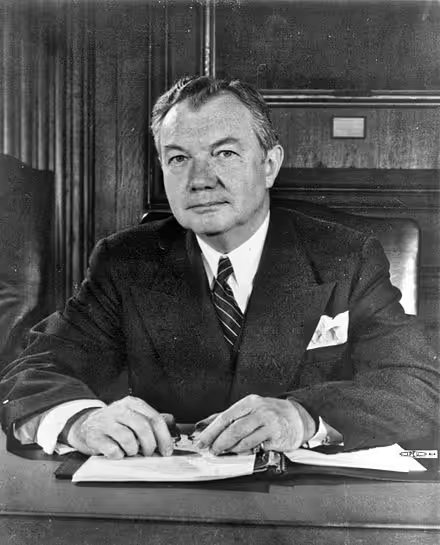
Robert H. Jackson, the only man to serve in all three roles as U.S. Attorney General, U.S. Solicitor General, and U.S. Supreme Court Justice

The Solicitor General of the United States is the attorney for the government who presents briefs and oral arguments before the U.S. Supreme Court.  The person who holds this position, thus, makes more frequent — and more important — appellate arguments than just about anyone.

Often, the U.S. Solicitor General is later appointed to the United States Supreme Court, the earlier job being both a proving ground for that important position, and a place from which the holder can become known to the President of the United States, who makes such appointments.

Thus, I got a chuckle out of this quote from former Solicitor General Robert H. Jackson, who himself was appointed to the U.S. Supreme Court by President President Theodore Roosevelt.  (As a side historical note, Jackson is the only man to have held all three jobs as U.S. Attorney General, U.S. Solicitor General and Supreme Court Justice.)

“I used to say that, as Solicitor General, I made three arguments of every case. First came the one that I planned–as I thought, logical, coherent, complete. Second was the one actually presented–interrupted, incoherent, disjointed, disappointing. The third was the utterly devastating argument that I thought of after going to bed that night.”

This is, of course, precisely what appellate advocacy is like.

For both landlords and tenants, there is curious and confusing phraseology in many if not most commercial leases relative to the payment of rent:

Rent will be paid without any set-off, counterclaim, deduction or recoupment whatsoever.

That sounds like (and is) a lot of legalese, but what does that mean?

It is, in fact, an important provision of commercial leases.  What it means is simply that rent is due from the tenant without delay or reduction based upon claimed breaches of the lease by landlord.  Thus, if the tenant thinks he has defenses to the payment of rent, or claims against the landlord, he must bring them in a separate court action and not use the tactic of offsetting rent — and delaying an eviction — based upon meritorious or frivolous claims of landlord breach.

The provision is not unnecessarily unfair to one side or the other.  Rather, it is a business term for negotiation between the parties.

From a landlord’s perspective, he is surrendering possession of the Premises to tenant and tenant should, month in and month out, pay him for that possession.  If the tenant is “starving” the landlord of rent, while the landlord has to pay his mortgage, taxes, maintenance and insurance, it is a painful and stacked deck against the landlord.  Further, while each month the tenant is getting the benefit of the bargain by occupying the premises, the tenant may prove uncollectible after months or years of litigation.  Further, landlord does not want to find himself in the position of pursuing rent — all the way through a trial — if the defenses of the tenant are entirely fictitious and manufactured just to buy time against an eviction for a rent default.

From the tenant’s perspective, if the landlord has made his building unoccupiable by severely burdensome practices — noise, dust, odors, lack of access or parking, non-operational elevators, bugs, vagrants, etc. — then why should he tender payment every month only to have to litigate in a separate forum to get some or all of that money back?  Further, a landlord can similarly bleed a tenant dry by extracting rent during the tenancy while failing to maintain his building.  And a landlord may prove judgment-proof as well at the end of litigation.

As a result of the weighing of the interests of the landlord and the tenant, there could be compromise language to sometimes standard form lease “no offset” language — for extreme circumstances that “put a tenant out of business.”  But prying that door open even slightly to give the tenant an “argument” against eviction could lead to months or years of costly litigation against a tenant who otherwise would be paying rent monthly.

# # #

Our firm practices extensively in the area of commercial lease drafting and litigation to enforce the same in Ohio and Kentucky.  We invite you to use our professionals to assist you with your investment properties.  Isaac Heintz leads our practice as it relates to commercial lease drafting and Brad Gibson heads our litigation group for its enforcement or defense.

As we have grown, the vision of the Finney Law Firm is sharpening for our clients and the public: A broad array of services offered in one firm, each practice area delivered in a quality fashion.

At our core, we are a real estate firm, with experienced transactional attorneys, a title insurance company that insures residential and commercial titles, and commercial litigators who can address virtually every aspect of disputes relating to real estate: Eviction, foreclosure, title disputes, easement disputes, construction disputes and mechanics lien claims, as well as complex real estate litigation.

Beyond that, we offer quality estate planning and probate administration and our transactional team rounds our its services with corporate formation and development, including acquisitions, dispositions and financing.

Isaac T. Heintz, Kevin J. Hopper, and Eli Krafte-Jacobs, along with paralegals Tammy Wilson and Misty L. Winkler, and Richard P. Turner at the title company, lead our transitional team day in and day out.

Our litigators are well-known for our public interest practice — handing legislative and regulatory matters aggressively, confronting government officials who would illegally interfere with their life, their business and their fortune.  Three times we have ascended to the U.S. Supreme Court, and three times we won the relief we sought with 9-0 victories there.   We apply this same sophistication and vigor to commercial litigation, personal injury, wrongful death and medical malpractice matters.

Bradley M. Gibson, Stephen E. Imm, Julie M. Gugino, and Casey A. Taylor along with paralegal Brandy E. Fitch are our quality litigation team.

Finally, we are proud to recently have expanded our litigation services to include labor and employment law with experienced litigator Stephen Imm.

When a client asks “do you do that,” I am proud to respond “yes, and we do it well.  Let me introduce you to …..”

Let us know how we we can help with your business or personal opportunity or challenge.  It is with you in mind that we have assembled this team of quality practitioners.