

We would not be the first to use the phrase: “You don’t know what you don’t know,” but this is never more true than in the setting of planning and executing on new construction, residential and commercial.

As a general rule, new construction can be had in four different contexts: (i) building on “raw land,” (ii) building on a “developed lot,” (iii) building on land that has an existing building that will be demolished and (iv) renovating an existing building.  Compared to the relative ease of buying and using an existing building, each of these can be fraught with risks and unexpected costs.

Existing building.

Let’s first address the “relative” ease of buying an existing, occupied building.  Now, don’t misinterpret what we say here: You should always thoroughly “kick the tires” in every purchase.  Comprehensive “due diligence” is prudent in every transaction to find construction and maintenance defects, environmental problems, and zoning and other regulatory issues.  But having said that, it is at least possible to look at, touch, feel, and inspection existing building, whether a single family home or commercial structure.  The longer it has been there, the more likely it’s not going anywhere.  You can check the building and zoning file of the applicable City, Village or Township to see if the existing use has been cited as being in violation.  Buying land for new construction is in some ways more complicated.

Raw land.

So, a buyer looks at land and sees no building.  Is that “raw land” or a “developed lot?”  In the terminology used in this blog post, the distinction between a “developed lot” and “raw land” is the “full development” of the site with roadways and utilities (water, sanitary sewer, gas, electric, telephone, and cable television) and properly addressing stormwater drainage and detention.  Also, typically zoning approval for the intended use of lots has been obtained before the “development” of the land and the cut-up of the same into lots.  On the other hand, “raw land” is just that — land without any improvements on it, underground or otherwise.

In the case of “raw land” there are a host of potential pitfalls to achieving a final new construction product:

  • Zoning: Is the proposed use permitted and are proposed lot size, setbacks, and other variables for the proposed use permitted?
  • Utility access: Are public utilities available at the property line of the site (and indeed how much will it cost to extend it to the building).  The party who develops a site is usually responsible for (a) obtaining easements for and (b) paying the cost of extending public utilities to the property line and to the building itself.
  • Soil conditions: The suitability of soil for new construction is a significant variable for new construction.  In short, virtually every piece of land can be built upon from a physical perspective, but one may have to dig, bore, pier, bridge and engage in other engineering techniques to make that possible.  And the cost of building that proper foundation for the new construction can exceed the cost of the land and building.  Further, if the prior owner has moved and compacted sills not he site, it can significantly exacerbate the problem.  When a developer piles soil that is not acceptable compacted, it forces the builder to escalate or pier down to an acceptable depth before starting the construction.
  • Buried waste: In addition to soil problems, it is not at all uncommon to find all sorts of buried materials on what appears to the naked eye to be an open field or pasture.  I have been hired by several property owners seeking to put a pool in their backyard to find buried buses, trees, and blacktop.  This is because when a developer “scrapes” a subdivision to build roads and other improvement, it is common to show all this debris into a “bury pit.” Other subterranean gems my clients have found have been concrete chunks or rip rap, buried tires and even elephant carcasses and school buses (I do not make this up).
  • Title problems.  As is addressed in this blog entry, there are a host of title problems that can arise in the new construction setting: An unreleased mortgage, an unreleased dower interest of a spouse, easements both of record and prescriptive, and adverse possession claims.  In addition to “running title,” a buyer should obtain a proper survey of property to assure that there are no encroachments upon property he intends to acquire.
Developed lots.

In the case of buying a “developed lot” in a subdivision — residential or commercial — the same variables are typically present.  Again, typically zoning, utility availability and storm drainage are addressed in the “development” and “subdivision” process, but the other issues can be of concern.  We were recently approached by a client who inherited a residential lot, but the lot was too narrow for construction of an appropriate residence.  Another found buried tires on the site.  A third found that the developer had not properly compacted the soil, requiring expensive excavation and foundation work.  Further, new subdivisions frequently (almost always) are accompanied by a set of covenants — enforceable by the developer or neighbors — on the design and use of new construction.

Demolition.

Other clients buy one or more existing structures with the intention of demolishing them  and building on the newly-cleared land.  In these circumstances, there may be restrictions (such as historic districts) that prevent demolition.  Further, when old buildings are demolished and replaced, the new construction may need to comply with entirely new set of restrictions than the old building in terms of lot size, setback lines, building height, building materials, covenants, and building code issues.

Renovation.

Renovating existing structures involves a whole new level of intricate issues.  When renovation is sufficiently significant, an entire floor, improvement or even the hole building then has to be brought up to new building codes.  Further, in tearing out old improvements, there are as many or more surprises — structurally, with mold and hazardous materials (asbestos is common) — than with developing raw land.

Due diligence.

A client and friend preaches repeatedly to me that he has learned — from experience — to be skeptical.  Your eyes are lying to you.  Behind the walls and under the ground, in regulatory restrictions and site limitations, don’t believe your own observations alone.  Rather, work diligently before buying property and certainly before digging into the ground to learn all of the pitfalls and variables of the site.  It an save you time, money and heartache.

Contractual protections.

I have aa saying as an attorney: The best contract can’t make the other party honest or turn a scoundrel into an honorable man.  But it can be used to flesh out issues, and to place the burden on a dishonest seller if he is trying to sell you a “bill of goods.”

Some contractual provisions that can be helpful in the new construction setting are:

  • Obtaining representations and warranties in the contract from the seller.
  • Obtaining all of the seller’s investigations and due diligence documents from his acquisition of the subject property and that he obtained throughout his ownership.
  • Have the seller promise to pay the cost associated with extraordinary sub-surface conditions.
  • Allow for generous due diligence investigations of the property in terms of time and property access during the sue diligence period.
Conclusion.

After reading this blog entry, it would be an entirely rational reaction to never want to undertake the risks and challenges of new construction.  Indeed, knowledgeable buyers see danger (read: costs) lurking behind every corner.  But at the same time, a savvy buyer can — with relative safety — protect himself and seize the opportunity that new construction presents.




In recent years, more and more millennials are pursuing higher education.  This trend has, in many instances, pushed back the age at which we are beginning our careers, starting families, and making big purchases.  Thus, NOW is the time that so many of us are looking into buying our first homes.  Here is one thing you need to know, whether you are a prospective buyer or seller:

The Residential Property Disclosure Form (required for residential real property transfers in Ohio per R.C. 5302.30) is not just a formality, but rather, is an EXTREMELY important component of the transaction.

At Finney Law Firm, we represent both buyers and sellers in real estate transactions that have, arguably, gone awry.  The issue often has to do with a disclosure made (or not made) in the Real Property Disclosure Form.  This form requires sellers to answer questions about the condition of the property they are selling.  It covers the structural integrity of the home, water intrusion issues, plumbing, etc.

Home is a big purchase so contracts will have an effectSellers are required to disclose any problems of which they have knowledge.  Even if the property is being sold “as is,” sellers have a duty to not engage in fraud in executing this form (i.e. to not knowingly make any affirmative misrepresentation or conceal a latent material defect in the property).  For example, if the seller knows that the basement floods but checks the box marked “No” next to the section for water intrusion, the seller has arguably engaged in fraud, and a damaged buyer could pursue those claims against the seller.  It is in the best interest of the seller to disclose all that he knows about the property so as to avoid the risk of future liability.

On the flip side, a buyer has certain obligations as well. If the seller in the aforementioned example had said “ten years ago, there was a flood in the basement, but we caulked some cracks and it is no longer a problem,” the buyer is arguably not entitled to rely on that disclosure in assuming that the problem is fixed and that there are no longer any water intrusion issues.  The Ohio Supreme Court has held:

Once alerted to a possible defect, a purchaser may not simply sit back and then raise his lack of expertise when a problem arises. Aware of a possible problem, the buyer has duty to either (1) make further inquiry of the owner, who is under a duty not to engage in fraud, or (2) seek the advice of someone with sufficient knowledge to appraise the defect.

See Tipton v. Nuzum, 84 Ohio App.3d 33, 38, 616 N.E.2d 265 (1992), citing Layman v. Binns, 35 Ohio St. 3d 176, 177, 519 N.E.2d 642 (1988).  Therefore, the buyer should then make further inquiry, by hiring an inspector or asking follow-up questions of the seller, or both. To this point, this can be such an exciting time and even the most cautious buyers can easily become anxious to close on and move into their new home, but it is in the best interest of the buyer to ask questions and investigate anything that might become an issue down the road.  While the extra time or comparably nominal expense of making such further inquiry can seem frustrating, it could save you tens – if not hundreds – of thousands of dollars in repairs and/or legal fees down the road.

Certain legal challenges seem to come in waves for me, and lately one of those waves involves difficulties encountered in the termination of the Cincinnati Area Board of Realtors Purchase Contract, either for failure of the inspection contingency or the financing contingency.

Three guideposts should guide real estate practitioners, buyers and sellers in the exercise of contingencies in a purchase contract:

  • Read the contract.

Just because a contract is contingent upon the satisfactory outcome of a a loan application or a house inspection does not mean that termination is automatic just because the buyer says it is so.

  • Follow the steps for termination set forth in the Contract.

The Contract many times lays out a specific procedure for contract termination.  That procedure should be followed.

  • Get it in writing.

As we address here, the statute of frauds requires the contract and every amendment and termination thereof to be in writing.  Stating it most simply, if it in’t in writing, it did not happen.

As an example, the Cincinnati Area Board or Realtors Purchase Contract provides a procedure for termination of a contract for the failure of an inspection contingency:

If Buyer is not satisfied with the condition of the Real Estate, as revealed by the inspection(s) and desires to terminate this Contract, Buyer shall provide written notification to Listing Firm or Seller that Buyer is exercising Buyer’s right to terminate this Contract within the Inspection Period, and this Contract shall be terminated.

That seems really simple, but the Cincinnati Area Board of Realtors also has a series of supplemental forms for use in residential real estate transactions.  Two of those are:

  • Release from Contract to Purchase.  This form is a supplemental agreement between a buyer and a seller to terminate a contract.
  • Notice of Termination of the Contract to Purchase.  This document is a unilateral (i.e., just a notice signed by one party to the other; it does not require a counter signature).
Seller refuses to acknowledge an “offer” to terminate.

I recently experienced a situation in which the buyer signed and tendered a Release from Contract to Purchase to the Seller for the Seller to sign within the inspection contingency period.   The seller claimed that that form did not constitute sufficient notice of the failure of the inspection contingency pursuant to the language set forth above and thus it was merely an “offer” from the buyer to the seller to terminate the contact.

The seller reasoned that because both (i) the buyer failed to notify the seller of the failure of the inspection contingency pursuant to the contract requirements and (ii) the seller refused the tendered “offer” to terminate, that the buyer was still bound to the contract. Further, since the inspection period had since lapsed, it was now too late to provide such notice, the seller claimed.

What we did in that circumstance was to supplement the submittal to the seller with a termination under the financing contingency, and eventually the seller conceded that the contract had been terminated and returned the buyer’s earnest money.

Seller refuses to schedule inspection.

In another recent dust-up between a buyer and a seller, the seller refused to schedule an inspection of the property pursuant to the inspection contingency.  In this instance, the buyer attempted to so schedule using the automated showing system, and the seller simply would not permit or acknowledge the request.

In that circumstance, the buyer sent a termination to the seller, and we await his response. But what is a buyer to do when the seller refuses to allow access for an inspection?  Clearly, the courts will permit the buyer to terminate either pursuant to the inspection contingency or because the seller has breached the contract by refusing to allow the inspection.

Conclusion.

So, even though it should seem to be a clear right of the buyer to terminate the contract, the form that that communication to the seller takes informing him of the termination could well impact the substance of whether the termination was effective.

This firm is pleased to represent Professional Psychiatric Associates and Dr. Mohamed Aziz in a suit against West Chester Township challenging the Township’s heavy-handed attempts to outlaw a psychiatric care facility on former nursing home property.

Federal Law clearly prohibits discriminating in zoning laws against those who treat mental health conditions versus physical healthcare, which is precisely what the Township was trying to do, starting with a moratorium issued in April quickly after Dr. Aziz acquired the facility.

The Judge in the suit is Timothy Black, and he spoke pretty clearly in a early order in the case:

“The court has held two initial telephone conferences involving counsel for plaintiffs and for defendant. During these conferences, the court reminded both parties of the consequences that could result if the court finds that the Americans with Disabilities Act and/or the Rehabilitation Act have been violated by defendant, or not.”

The statement is direct, elaborate and unusual, in that the Judge — while keeping an open mind — is forecasting his views on Plaintiffs claims and ever so gently nudging the Township in the direction of resolving the claims by means of settlement versus forcing him to make a ruling against the Township in the matter.

The Hamilton Journal-News and Denise Callahan have the story fully developed here.

We just got this alert from our underwriter, First American Title Insurance Co., this morning:

The agent receives an email from a “buyer” purporting to have property under contract and wants the agent to facilitate the closing – often a cash deal or large earnest money deposit from an “out of town” buyer. When the agent agrees, the fraudulent buyer sends funds in the form of a wire or check along with purchase and sale agreement.

The agent might even know or confirm that the property really is listed for sale – and it is.  The amount for the contract even looks right given the list price/value. After a few days, the buyer says the deal fell through and asks for the money back saying, “a wire would be best.”

The check or wire has either not cleared yet, or even if it has, it is still within the period for which payment can be stopped or reversed.  Either way, the agent ends up having paid out good funds, but has no good funds paid in.


With surging real estate demand, it is inevitable that the long-dormant Ohio condominium market would see a return.  Our firm recently has been engaged to draft Ohio condominium documents for the creation of new condominium regimes and the division of property into condominium units.

The proper preparation of condominium documents allows a owner/developer to “cut up” his building or buildings into separate condominium units and sell them to individual buyers.  These can be as simple as townhouse-style residential units that are made legally separate by condominium documents to fully-integrated high-rise buildings that are carefully separated (and operationally integrated) by a declaration and drawings.

Under Ohio law, this process is governed by O.R.C. Chapter 5311.  [For a discussion of the different between a condominium and a landominium under Ohio law, see this blog entry.] 

Much of Cincinnati’s recent condominium activity involves retail, office and residential spaces in downtown and Over-the-Rhine, where both new buildings and old structures are being built or renovated, and then sold in that the legal industry sometimes refers to as “Three Dimensional Property Regimes.”

For existing buildings that are being rented, this involves the further complication under Ohio law [O.R.C Section 5311.26(G]) of converting a rental unit into a salable condominium unit.

To speak with our condominium team, call Isaac Heinz at 513-943-6654 or Dylan Sizemore at 513-943-6659.

1403296771Brian2What does Ohio’s Land Installment Contract Statute mean for commercial properties?

Not much, if you don’t incorporate it into your contract.

Ohio’s Land Installment Contract Statute, Chapter 5313 of the Ohio Revised Code, makes clear that the consumer protections apply only to the sale of residential property, and not to the sale of commercial property. Specifically, R.C. 5313.01(B) defines “Property” as “real property located in this state improved by virtue of a dwelling having been erected on the real property.” Thus, if the property to be sold has not had a “dwelling” erected upon it, Chapter 5313 applies only to the extent the parties incorporate it into their contract.

In a case out of Clermont County in Ohio’s 12th District Court of Appeals, a “run down mobile home” on farmland in which people lived “at least part of the time” satisfied the requirements of a “dwelling,” thus implicating R.C. 5313. Marcus v. Seidner, 2011-Ohio-5592, ¶ 31 (Ct. App.). Conversely, in Johnson v. Maxwell, 51 Ohio App. 3d 137, 140, 554 N.E.2d 1370, 1373 (1988), the 9th District Court of Appeals found that R.C. 5313 did not apply to property on which there was no dwelling.

Such rulings suggest that Ohio law would allow forfeiture of all payments under a commercial land installment contract in the event of breach, no matter the amount paid or for how long such payments had been made. However, as set forth in Maxwell, “forfeiture clauses contained in land installment contracts are enforceable in Ohio, so long as the resulting benefit to the vendor is not ‘extravagantly unreasonable or manifestly disproportionate to the actual damages sustained” by the vendor.’” Id., at 140 (quoting Norpac Realty Co. v. Schackne (1923), 107 Ohio St. 425, 140 N.E. 480, paragraph one of the syllabus. Thus, in commercial land installment contracts, if the parties don’t include remedies that are less “extravagantly unreasonable” than forfeiture where the vendee has paid a substantial portion of the purchase price, it will be up to the judge to determine the appropriate remedy. Courts will also consider whether an increase to the value of the property since the contract was entered into would result in a windfall to the seller. “Given the wide disparity in the value of the property now and at the time appellees sold it, we refuse to disturb the trial court’s attempt at achieving equity.” Fannin v. Reagan, 11th Dist. Portage No. 94-P-0091, 1995 Ohio App. LEXIS 5023, at *13 (Nov. 9, 1995)

So why does this matter?

While Chapter 5313 calls for foreclosure when the buyer has paid 20% or more of the purchase price or paid for more than five years, in a commercial transaction, the parties are not bound to this restriction. Presumably, the court would use the standards of 5313 as a guideline, but there could be a scenario where the judge finds that it would be inequitable to allow forfeiture in a commercial land installment contract even where the buyer paid less than 20% of the purchase price. A properly drafted contract can allow the parties to avoid an uncertain result in the event of a breach.

Preparing to enter into a land installment contract or have questions about an existing land installment contract? Finney Law Firm can help you understand your rights and obligations and draft a contract that will work for you.

IMG_8153

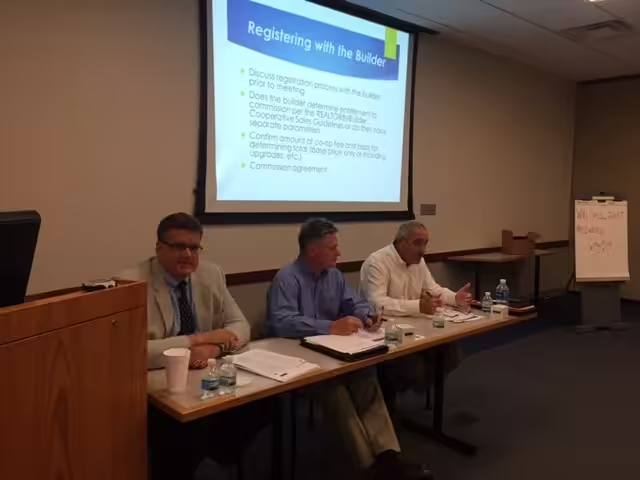
Our own Chris Finney participated in a panel discussion today on Topics in New Construction at the Cincinnati Area Board of Realtors.  Also on the panel were Mike Hoffmaster of Hoffmaster Properties and former President of the Greater Cincinnati Home Builders Association and Jeff Rosa of Sibcy Cline, Realtors.  The course was designed to train lawyers and Realtors on new construction issues to better assist them in serving buyers and builders.

Thanks to Cindy Henninger and Amanda Wilson at the Board for making this happen!

Former President of the Greater Cincinnati Home Builders Association and Cincinnati Home Builder Mike Hoffmaster, Realtor Jeff Rosa of Sibcy Cline. and  Finney Law Firm’s Christopher Finney will present a panel discussion before the Cincinnati Area Board of Realtors entitled “Working together in New Construction” on Thursday, July 7, 2016 at 1 PM at the offices of the Cincinnati Area Board of Realtors.

Please join us!

Information on the panel and sign-up information is here.