Finney Law Firm represents Mark Miller in two lawsuits against Cincinnati City Councilmembers Dennard, Landsman, Seelbach, Sittenfeld, and Young. The first involving violations of Ohio’s Open Meetings Act; the second involving violations of Ohio’s Public Records Act. Read about recent filings in the Public Records Act case here.

In the Open Meetings case – before Judge Ruehlman of the Hamilton County Court of Common Pleas – the Councilmembers recently filed a motion to limit and prevent discovery and publication of any documents produced in discovery. Today we filed our memorandum in opposition to that motion.

The Councilmembers ask the Court to prevent discovery because they claim some of the emails and text messages may contain information embarrassing to themselves or third parties. We point out to the Court that those third parties can easily be invited to state for themselves whether they want the materials released to the public; and that the law requires more than simply reciting the words “risk of embarrassment” before the Court can limit discovery.

Ohio’s Courts, like every other public body, are to be open to the public. By attempting to prevent public access to information produced in discovery, the Councilmembers ask the Court to facilitate their violations of the Open Meetings Act.

The Court has scheduled oral argument for this motion on August 16 at 11 a.m. in Room 300 of the Hamilton County Courthouse.

The Councilmember’s motion can be read here.

Our memorandum in opposition can be read here and below.

[scribd id=383738790 key=key-1gnTG4Ik6Opw29XE8e3I mode=scroll]


Whether they planned it this way since (or even before) they granted certiorari to both Janus v. AFSCME and National Institute of Family and Life Advocates v. Becerra, or whether things just fell into place, two of the three the crowning decisions from the last week of the current term of the U.S. Supreme Court will deal with the important and still-evolving “compelled speech” doctrine under the First Amendment.  And we predict these two cases will be decided in such a way as to advance this doctrine as a bulwark against state and local governments compelling certain speech from private citizens and enterprises.

The compelled speech doctrine

The compelled speech doctrine is that legislators, regulators and other government actors cannot require an individual or group to engage in certain expression. We typically think of the First Amendment as limiting the government from punishing someone because of  his speech.  The compelled speech doctrine also prevents those same government officials from punishing someone for refusing to advance the government’s approved messages.

In West Virginia State Board of Education v. Barnette (1943) SCOTUS advanced the compelled speech doctrine by ruling that a state cannot force a child to stand, salute the flag, and recite the Pledge of Allegiance.  The Court allowed school children who are Jehovah’s Witnesses (for religious reasons) to refuse to participate in the district-required speech. From the decision:

If there is any fixed star in our constitutional constellation, it is that no official, high or petty, can prescribe what shall be orthodox in politics, nationalism, religion, or other matters of opinion or force citizens to confess by word or act their faith therein.

Just last decade, in  Rumsfeld v. Forum for Academic and Institutional Rights (2006), Chief Justice John G. Roberts Jr. stated the principle more directly:

Some of this Court’s leading First Amendment precedents have established the principle that freedom of speech prohibits the government from telling people what they must say.

And this doctrine has been advanced in other cases, such as Wooley v. Maynard (1977) (state officials could not punish a man for covering the state’s motto — “Live Free or Die” — on his license plate) and Hurley v. Irish-American Gay, Lesbian and Bisexual Group of Boston (1995) (government actors violated the rights of parade organizers by requiring that they include a gay rights group and its messages).

Notably as to the Janus decision (discussed below), the court addressed this issue in Abood v. Detroit Board of Education (1977).  However, because that decision did not go as far as the Janus petitioners seek, the Janus case (we predict) will overturn the Aboud precedent.  In Aboud, the Court allowed states to mandate public union membership, but split the dues between collective bargaining activities (compulsion OK) and political activities (compulsion forbidden).

Roberts Court loves the First Amendment

Then, as we have expressed previously, if the Roberts Court stands for anything, it is advancing First Amendment protections, including into areas not previously sacrosanct.  We expect the Janus and NIF&LA cases will continue that trend, but in these cases in the specific area of compelled speech.

Janus

The Janus decision is the third try recently to overturn the “halfway” decision in Abood. Again, in Abood, the Court ruled that the Plaintiff could be forced by the Detroit School District to pay a “fair share” or “agency” fee to the labor union for collective bargaining services, reasoning that not to do so would allow them to be a “free rider” for those services.   The Janus decision directly challenges that hair-splitting, arguing that compelling union membership is indeed compelling support of all of those things the union supports, including their position in contract negotiations, with which a member may disagree.

In 2014, the high court decided Harris v. Quinn, a curve-ball case of the State of Illinois compelling payment of union “agency fees” for collective bargaining by home health care workers who were not direct employees of the state, or in the words of the court “full-fledged public employees.”  The court ruled “no.”  In doing so, however, it did not directly overturn Abood, but Justice Scalia invited Abood challenges by stating in his opinion that it had been incorrectly-decided.

That invited the case of Friedrichs v. California Teachers Association in the 2015-16 term, which certainly would have extinguished the Abood precedent, except that Justice Scalia — who started the firestorm — died after oral argument but before the case could be decided.  The Friedrichs case, which appears to be indistinguishable from Janus, was thus decided 4-4 with the Scalia-short court, upholding the 9th District opinion that was consistent with Abood.

Thus, this coming week we expect that the compelled speech doctrine will get a substantial shot in the arm, albeit by a 5-4 vote, by the Supreme Court in its Janus decision broadly preventing government actors from negotiating union contracts that compel union membership or union dues as a condition employment.

National Institute of Family and Life Advocates v. Becerra

And that brings us to NIF&LA v. Becerra which seeks to invalidate a California law requiring pro-life counseling centers that counsel against abortion (“crisis pregnancy centers”) to to provide patients with specific kinds of information, including, for some, the availability of low-cost or free abortions.

We believe the Court will again advance the compelled speech doctrine by striking the California law.

(This will then raise the further question about pro-life state legislatures who require abortion clinics to provide certain information to patients arguably advancing an anti-abortion message.)

So, a big week is expected for the First Amendment and the Compelled Speech doctrine

Thus, it appears to me that the Supreme Court has written the theme for the last week of the Court term by joining the timing of announcing these decisions (if not the decisions themselves)  for the same day or week.

Crescendoing the 2017-2018 term with these two decisions, the Roberts Court will firmly boost the compelled speech doctrine.


This morning the Ohio Supreme Court accepted our appeal from a Cuyahoga County Court of Appeals case questioning whether Ohio’s Open Meetings Act permits public bodies to vote by secret ballot.

A 2011 Ohio Attorney General’s Opinion Letter says no, as does a 2011 Hamilton County Common Pleas Court decision. But to date, the Ohio Supreme Court has not addressed this question. But the Cuyahoga County Courts disagreed.

This is an important case, meriting an amicus brief in support of jurisdiction from the Ohio Coalition for Open Government. Learn more about OCOG here.

The Ohio Supreme Court now has an opportunity to declare once and for all that secret ballot voting is not consistent with the demands of open government.

Case documents in State of Ohio ex rel. More Bratenahl et al. v. Village of Bratenahl et al.  are available on the Ohio Supreme Court’s website, here.

We will post updates as briefing is completed. Read more about this case here.

Today, attorneys for the City of Cincinnati filed the self-proclaimed “Gang of Five’s” answer to the April 9, 2018 Open Meetings Complaint (read the complaint here, read additional blog posts about the case here and here).

Surprisingly, the Gang of Five deny that they conducted meetings via telephone, email, and text message.  We say surprisingly, because the emails and text messages attached to the complaint make clear that the Gang of Five did conduct such meetings.

The councilmembers’  responses to interrogatories and requests for documents are due later this month, and depositions are set to begin shortly.

[scribd id=380988345 key=key-xzHGFm3H8LOpoQ42PC7i mode=slideshow]

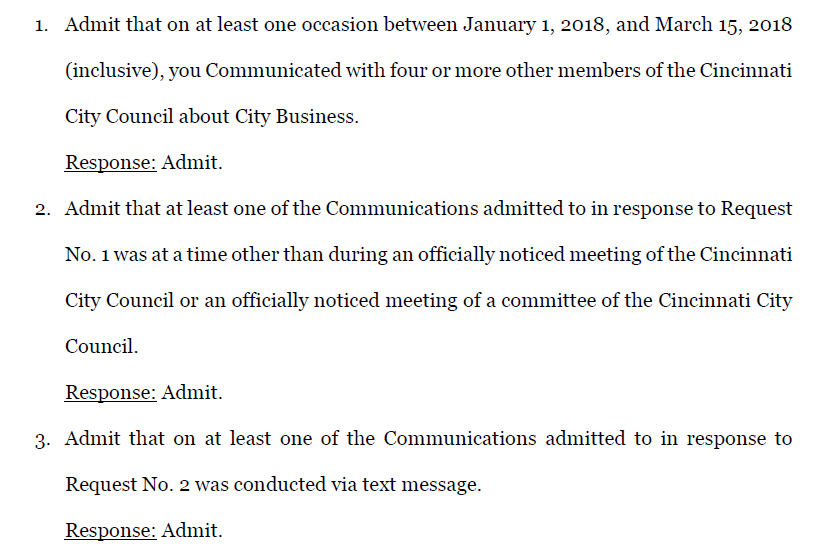
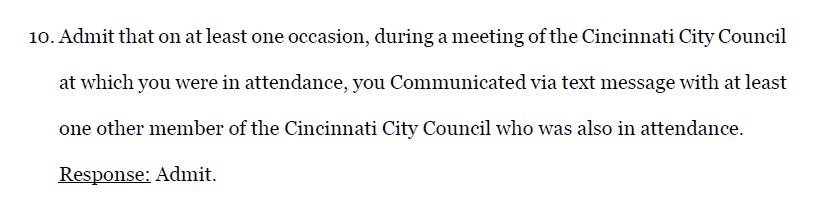
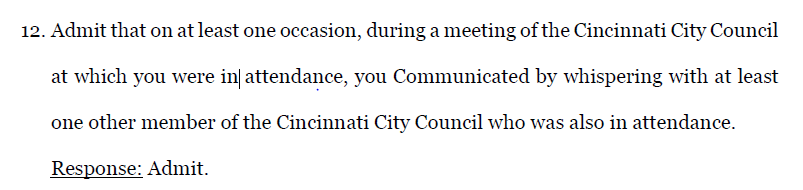
As part of their responses to the first round of discovery in our Open Meetings lawsuit, Cincinnati City Council Members PG Sittenfeld, Chris Seelbach, Wendell Young, Tamaya Dennard, and Greg Landsman – the Self-Proclaimed “Gang of Five” – have now admitted to additional Sunshine Law violations: other meetings conducted via text message, and whispering and texting to each other during City Council meetings.

Thus far, the Gang of five have only responded to our requests for admission, still outstanding are responses to our interrogatories and requests for documents. The City asked for, and we granted, an extension of time to respond to the interrogatories and document requests. Those responses will shed even more light on the topics of discussion during the illegal meetings and result in the production of additional text message correspondence between the Gang of Five.

What is unquestionable now is that the question of firing the City Manager was not the first time the Gang of Five discussed public business outside the public eye, in clear violation of Ohio’s Sunshine Laws and the Cincinnati City Charter.

Next steps are to obtain the additional written discovery responses and then depose the Gang of Five under oath.

As part of his political “house cleaning” when he first took office, Aftab Pureval paid severance packages to outgoing employees and required that they sign non-disclosure agreements. Local government watchdog Mark Miller asked for copies of these records, only to be ignored by Aftab Pureval.

Now, six weeks after Pureval received the request, and with no response whatsoever from Pureval, Finney Law Firm filed suit to force the release of the requested records.

It is expected that the records will show that Pureval used attorneys other than his official statutory counsel in drafting these agreements, and that the agreements are legally unenforceable; that they were simply a means of coercing former employees into silence as he prepared his run for higher office.

Read the complaint below or click here to view it on Scribd.

[scribd id=377796673 key=key-tff3AszQ6iZyPzYNIFo4 mode=scroll]

Today, Finney Law Firm filed suit against the self-proclaimed “gang of five” – PG Sittenfeld, Chris Seelbach, Wendell Young, Tamaya Dennard, and Greg Landsman – seeking production of public records they are withholding in violation of Ohio’s Public Records Law.

On April 9, 2018, Finney Law Firm submitted a public records request on behalf of Mark Miller, to each member of the “gang of five” seeking production of all communications between each of them and any other member of council from March 1, 2018 to March 19, 2018 regarding Harry Black or John Cranley.

This morning, attorneys for the City produced 10 pages of group text messages between all five members, but made clear that they refuse to produce text messages or emails other than the group-messages. As Cincinnati Enquirer attorney, Jack Greiner, told the Cincinnati Business Courier, this is contrary to the requirements of the Public Records Law, R.C. 149.43:

Jack Greiner, an attorney at Graydon Head & Ritchey who represents other Cincinnati media organizations in public records and open meetings matters, said state law requires that public records be kept, that communications between officials are a public record and text messages qualify as communications.

“The format shouldn’t matter,” Greiner said. “The city has a records retention schedule that would cover those. The city has to figure out how they’re going to retain that information and archive it.”

You can read the complaint below or on Scribd here.


[scribd id=376746523 key=key-KDMKBBP0yJvZtvUqNh9n mode=scroll]

This morning the City of Cincinnati released a collection of text messages exchanged between five Cincinnati Councilmembers that made up a series of illegal meetings regarding the question of whether and how to terminate the City Manager.

While the City has yet to produce all of the responsive records, this production demonstrates the need for our lawsuit and injunction to force compliance with the Open Meetings Act. Unfortunately, because the City continues to withhold additional records, our client will be forced to bring another suit against the City and the rogue members to force compliance with the Public Records Act.

You can read the text messages on Scribd or below:
[scribd id=376698656 key=key-45W4n9CmI6tNLgrqLLaZ mode=scroll]

Representing a Cuyahoga County community newsletter publisher, Finney Law firm has filed an appeal of the recent Eighth District Court of Appeals’ ruling in State ex rel. Meade v. Village of Bratenahl, et al.Case No. 2018-0440

Community newsletter publisher brings suit

In 2016, Pat Meade, publisher of MOREBratenahl a community newsletter focused on the community of Bratenahl, Ohio, in Cuyahoga County, brought suit against the Village Council for numerous violations of the Ohio Sunshine Law (R.C. 121.22).

Meade’s suit focused on secret ballot voting by the council as well as inaccurate and insufficient minutes by the council and its finance committee. The case presented a somewhat unaddressed issue of the Sunshine Law: can public bodies vote by secret ballot?

Prior authority

The almost universally instinctive answer is “No!” And indeed, the only caselaw or other authority on the subject also came down against secret ballot voting. In 2011, the Ohio Attorney General issued an opinion concluding that the  “‘open meetings’ requirement of R.C. 121.22 is not satisfied when members of a public body . . . vote by secret ballot.” 2011 Ohio Op. Atty Gen. No. 38. And that in fact, “[c]onstruing R.C. 121.22 as permitting a public body to vote by secret ballot also produces an unreasonable and absurd consequence.” Id.

Just twelve days prior to the issuance of the 2011 Attorney General’s Opinion, the Hamilton County Common Pleas Court issued its own ruling on the question. Again, finding that the statutory requirement that the Sunshine Law be “liberally construed to require public officials to take official action and conduct all deliberations only in open meetings encompass both discussion and voting.” Forest Hills Journal v. Forest Hills Local School Dist. Bd. of Edn., C.P. No. A-1100109, 2011 Ohio Misc. LEXIS 799, at *4 (Oct. 6, 2011).

Secret ballots in Bratenahl

The Village Council, at its January 2016 meeting voted by secret ballot in choosing their president pro tempore, even after one member questioned the legality of a secret ballot vote.

Meade, brought suit, and, during discovery the Village turned over copies of the ballot slips – appended with post-it-notes identifying the councilmember to whom each slip belonged. But in a bizarre set of circumstances, the appended ballots suggest that one member voted twice in the second round; and one ballot in each of the other rounds is unidentified.

Additionally, at one meeting, the Village entered into executive session without the minutes indicating the roll call vote; and the minutes of the council’s finance committee were simply recitations of the motions and votes, with nothing of the substance of the discussions.

Trial and Appellate Court’s response

The Cuyahoga County Common Pleas Court, in a un-detailed decision, simply granted summary judgment to the Village on all claims.

Plaintiff appealed the decision to the Cuyahoga County Court of Appeals, which affirmed the trial court’s decision, declaring that a secret ballot vote isn’t a secret ballot vote if the public body keeps copies of the ballot slips and later produces them as part of discovery in a lawsuit; and that the minutes of one public body can be used to supplement the minutes of a different public body – and without notice to the public.

Simply put, the Court of Appeals significantly altered the landscape of Ohio Sunshine Law, and, from Plaintiff’s perspective, in a manner inconsistent with the statute and Ohio Supreme Court precedent.

Plaintiff petitions Ohio Supreme Court for review of the case

On March 23, Finney Law Firm filed its notice of appeal and memorandum in support of jurisdiction wtih the Ohio Supreme Court. Then on March 26, the Ohio Coalition for Open Government filed an amicus brief urging the Court to accept jurisdiction and review the Cuyahoga County Court of Appeals’ decision. Notably, the Ohio Supreme Court only accepts approximately 7% of all “jurisdictional appeals” such as this case. So even getting the case heard by the Court is a hurdle. Read our memo here, and the OCOG memo here.

Conclusion

Finney Law Firm has a proud history of advocating for open government and we are cautiously optimistic that the Ohio Supreme Court will accept jurisdiction in this case, and that we will be able to once again vindicate the people’s right to know what its government is doing.

March 11-17 is Sunshine Week, highlighting and celebrating laws aimed at preserving transparency and accountability in government.

In Ohio R.C. 121.22 (the Open Meetings Act) and 149.43 (the Public Records Act), are the main sources of law protecting the citizenry’s right to know and appreciate what is being done in its name.

In the past year, Finney Law Firm’s public interest practice group has obtained results for our clients, obtaining public records, and forcing open the doors of government.

State ex rel. Coalition Opposed to Additional Spending and Taxes v. Winton Woods School District – Several and Serial violations of the Open Meetings Act; illegal executive sessions, including numerous executive sessions in which the school board simply recited the laundry list of personnel related matters set forth in the Open Meetings Act.

State of Ohio ex rel. Mick Higgins v. City of Springdale – voting by secret ballot; illegal executive sessions.

Even without litigation, we have obtained results for our clients in drafting and submitting public records requests to public bodies throughout Ohio to allow our clients to better monitor their local officials.

Currently we are preparing for an appeal to the Ohio Supreme Court in a case involving deficient meeting minutes and secret ballot voting by a village council in northern Ohio. Expect to hear more about that case soon.

Click here to learn more about Ohio’s Sunshine Laws in the “Yellow Book” distributed by State Auditor David Yost and Attorney General Mike DeWine.

Click here to read more about Ohio’s Sunshine Laws.

Need help with your local government? Contact us here.