
The Cleveland Park District has a policy requiring people obtain permission before engaging in any “First Amendment Activity” within Cleveland parks. And, once granted permission,  one must  remain within a specific (often remote) designated First Amendment zone.

During a recent Edgewater Live concert (think the old Party in the Park), our client, Alison Abdul-Kareem, attempted to circulate petitions in support of an initiative to place an issue decriminalizing misdemeanor amounts of marijuana on Cleveland’s ballot this November.

Ms. Abdul-Kazeem refused to either apply for a permit, or limit herself to the free speech zone (a 15 minute walk from the area of the park hosting the concert series). Thus, park rangers, enforcing the Park District’s policy proceeded to harass our client, including at one point surrounding her standing only a few feet away from her, thus frightening off any would be petition signers. Our suit, styled Alison Abdul-Kazeem v. Board of Commissioners of the Cleveland Metropolitan Park District, et al. 17-cv-01613, seeks to vindicate the right of Abdul-Kazeem, and others, to exercise their First Amendment rights throughout the public areas of public parks, without the threat of official harassment.

As first year law students learn, because initiative petitioning goes to the essence of self-government and constitutes and implicates core political speech and associational rights, “First Amendment protection for such interaction…is ‘at its zenith.’” (Buckley v. American Constitutional Law Foundation, Inc., 525 U.S. 182, 183 (1999), quoting Meyer v. Grant, 486 U. S. 414, 425 (1988)).

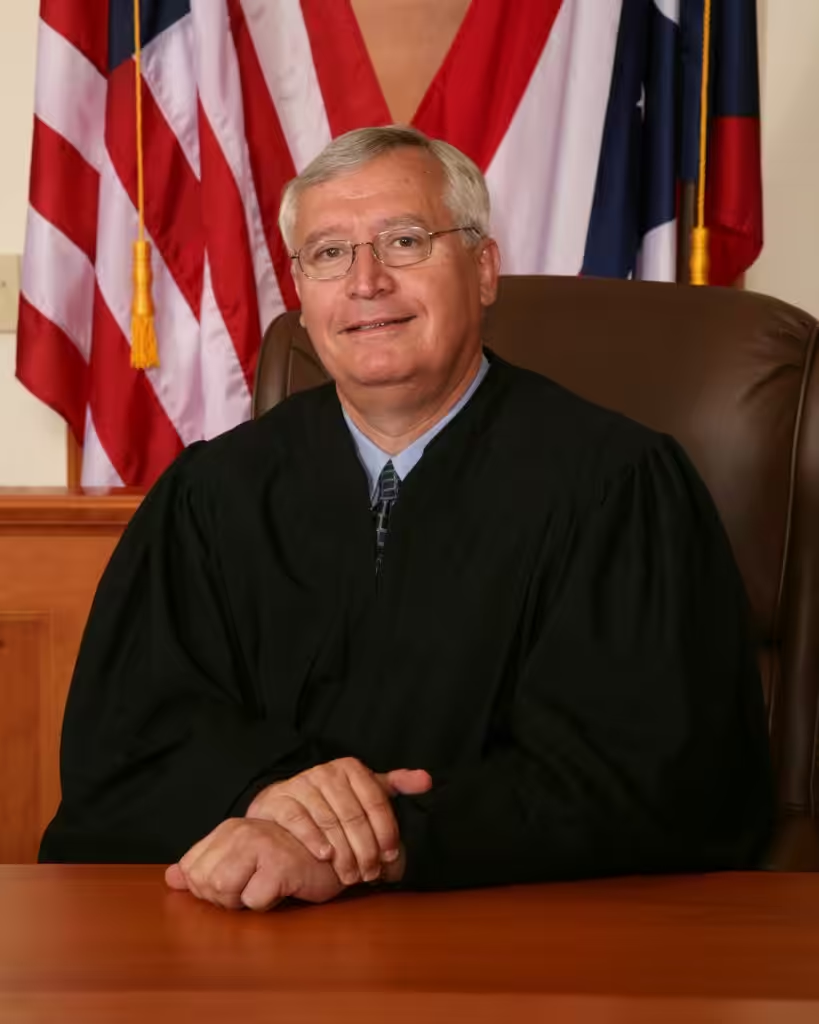
A Finney  Law Firm attorney filed the complaint and motion for a temporary restraining order and preliminary injunction on Tuesday  in the U.S. District Court for the Northern District of Ohio, and Judge Dan A. Polster has ordered the Park District to respond by noon on Wednesday and will hold conference on the motion at 3 p.m. on Wednesday. We are pleased to see the Court acting with such speed in this matter; and are hopeful that the Court will issue the injunction, allowing our client and other petition circulators free access to Edgewater Park in time for the next concert on Thursday – the last such event before petitioning ends for this year (petitions must be turned in by next Wednesday in order to qualify for the November 2017 ballot).

A copy of the complaint and motion are available here and here.

Cleveland.com has an article on the lawsuit here.
In a major ruling in favor of religious freedom, the Supreme Court struck down a provision in the Missouri State Constitution prohibiting churches and other religious organizations from receiving any public funds. In Trinity Church v. Comer, the Supreme Court found that the state’s “Blaine Amendment” violates the First Amendment. The Court’s 7-2 ruling (Justices Sotomayor and Ginsberg dissented), continues a recent trend in support of the First Amendment protections for religious liberty and free speech. You can read the opinion here.

Missouri funds a grant to help charities pay to replace playground equipment using recycled tires. Trinity Lutheran Church, which runs a day care program, applied for a grant. Despite being otherwise eligible for the grant, the state refused to allow the church to participate citing the state constitution’s prohibition:

That no money shall ever be taken from the public treasury, directly or indirectly, in aid of any church, sect or denomination of religion, or in aid of any priest, preacher, minister or teacher thereof, as such; and that no preference shall be given to nor any discrimination made against any church, sect or creed of religion, or any form of religious faith or worship.

Similar provisions exist in approximately thirty states. Named after 19th Century Senator from Maine, James G. Blaine, the Amendments were aimed at preventing public funding of parochial schools.

In issuing its ruling, the Supreme Court distinguished a previous case in which a state prohibition against providing a scholarship to a student who wished to study to become a minister was upheld (Locke v. Davey). “Davey was not denied a scholarship because of who he was; he was denied a scholarship because of what he proposed to do—use the funds to prepare for the ministry. Here there is no question that Trinity Lutheran was denied a grant simply because of what it is—a church.”

“The Free Exercise Clause ‘protect[s] religious observers against unequal treatment’ and subjects to the strictest scrutiny laws that target the religious for ‘special disabilities’ based on their ‘religious status.’” This ruling makes clear that blanket prohibition against any religious based organization from qualifying for a state benefit will not pass constitutional muster.

The Finney Law Firm prides itself on our aggressive stance in countering the actions of bureaucratic bullies through claims resulting not just in a victory in the administrative battle being fought, but also in recovering monetary damages, attorneys fees and injunctive relief against those very bureaucrats.

However, because of abstention under Younger v. Harris, 401 U.S. 37 (1971), and its progeny (that has been significantly scaled back by a the recent Supreme Court decision in Sprint Communications, Inc. v. Jacobs, 571 U.S. __, 134 S.Ct. 584 (2013)) and other principles of administrative law and comity, it is a bit of a challenge of how to “turn the tables” on government actors and bring a challenge under 42 USC Section 1983 concurrent with the administrative proceeding.

We had such a case in 2012.  There, our client was being disciplined by the Ohio Elections Commission in a proceeding we were certain was unconstitutional violation of her free speech rights.

First, we raised First Amendment defenses before the agency.  They were simply deaf to such arguments.  Then, when filing our Section 119 administrative appeal in Franklin County Common Pleas Court, we appended a claim for declaratory and injunctive relief under the First and Fourteenth Amendments to the United States Constitution as allowed by 42 USC Section 1983.

And, of course, to level the playing field against an agency who had the full resources of state govermment against her, such claims include the right to have the client’s attorneys fees reimbursed by the State if the Plaintiff prevails.

In Magda v. Ohio Elections Commission, Franklin County Common Pleas Court Case No. 12-CVH 10-13674, the state opposed that Complaint saying that state law did not tolerate a Section 1983 challenge to accompany an administrative appeal.  The trial court disagreed, and Judge Mark Serrott wrote this decision allowing the challenge to proceed arm-in-arm with the Chapter 119 appeal.

Judge Serrott later granted the State’s Motion for Summary Judgment, denying both our administrative appeal and the Section 1983 challenge to the statute.  That decision was appealed to the 10th Circuit Court of Appeals.  Interestingly, the State at that level did not renew their challenge to the Section 1983 claim accompanying the Chapter 119 appeal.  Thus, the issue proceeded with both claims before the appeals court.

In the end, the Court of Appeals overturned the trial court decision and granted summary judgment to our client on both the administrative appeal and the constitutuonal claims.  Thus, Plaintiff won a permanent injunciton against the enforcement of the statute and reimbursement of the full measure of her attorneys fees dating back to the initiation of the action before the agency under the constitutional claim.

So, yes, a constitutuional challenge (or any claim challenging the authority of the legislature to enact the offending law or the agency to enforce the same in the manner that it has), can be brought along with a Chapter 119 administrative appeal.

This vigorous and creative response to a prosecution by bureaucrats raging out of control in Columbus is a prime example of how the attorneys at the FInney Law Firm succeed in “making a difference” for our clients.

Let us know how we can solve your business and bureaucratic challenges.


Ohio has robust laws in place to ensure that the public business is done in the public and available for public inspection. From protecting citizens’ rights to attend meetings of local government bodies, to newspaper reporters being able to access and report on the financial records of the Cincinnati Streetcar project, or new public works proposals, the Open Meetings Act and Public Records Act, together the Sunshine Laws, provide for citizen oversight of their government.

First, the Open Meetings Act, R.C. 121.22, declares that, “All meetings of any public body are declared to be public meetings open to the public at all times.” This means that, other than those limited exceptions allowing public bodies to go into “executive session,” public bodies (city councils, township trustees, school boards) must conduct their deliberations in meetings open to the public.

Next, the Open Meetings Act requires public bodies to promptly prepare, file, and maintain minutes of all regular and special meetings, and to make those minutes open to public inspection.

Finally, the Open Meetings Act puts teeth to these requirements. Any person can bring suit to enforce these mandates. If you know of a violation or “threatened violation” by your local school board or city council, you can bring suit to force compliance. If successful, the court would enter an injunction against the public body to compel the body to comply with the Open Meeting Act, as well as an award of $500 per violation or threatened violation, and your reasonable attorney fees.

Thus, determination of whether the Open Meetings Act applies requires a multi-step analysis: Is there a “public body” involved? Was there a “meeting”? Was the public excluded from that meeting? And, finally, was such exclusion improper?

In addition to the requirement that public offices and public bodies meet in public and make minutes of those meetings available to the public, Ohio’s Open Records Act, R.C. 149, requires that public offices keep and make available any document, device or item, “created or received by or coming under the jurisdiction of any public office…which serves to document the organization, functions, policies, decisions, procedures, operations, or other activities of the office.”

Again, Ohio law provides for exceptions to the general rule that public records are to be kept and made available to the public (R.C. 149.43 includes both the exceptions and provides for enforcement by the citizenry). Certain confidential records are exempt from disclosure, for instance. If an appropriate request for public records is denied improperly (or ignored), the requester can bring suit to compel the production of the records, and may be entitled to up to $1,000.00 per record, and her reasonable attorney fees.

The analysis of The Open Records Act, also requires multiple steps. Is there a public office involved? Is there a document, device or item (i.e. a “record”)? Was this record created, received or coming under the jurisdiction of the public office? Does this record “document the organization, functions, policies, decisions, procedures, operations, or other activities of the office”? Does the record come under one of the exceptions to the Open Records Act? Was a proper request made?

This area of law has been litigated numerous times, and for every simple proposition of law, there is a court decision that muddies the waters. A recent Court of Claims decision announced that records of court proceedings commenced after July 1, 2009, are not subject to the Open Records Act, and efforts to obtain such records must be brought through a mandamus action pursuant to the Rules of Superintendence under R.C. 2731. This issue will no doubt be further litigated; and ultimately the Ohio Supreme Court will be called upon to clarify this question.

Finney Law Firm currently represents plaintiffs in three cases involving violations of the Open Meetings Act, and has represented both citizen activists and public bodies on questions of the Sunshine Laws. Finney Law Firm’s attorneys have litigated nearly every aspect of Ohio’s Sunshine Laws, and have given presentations on these issues to civic groups, officeholders, and continuing education programs. If you believe a local public body is violating the Open Meetings Act or need assistance obtaining public records, or if your group would like to host a presentation on Ohio’s Sunshine Laws, contact Christopher P. Finney.

On Friday, the Cincinnati Enquirer and USA Today wrote about our case, NorCal Tea Party v. IRS, the only nationally-certified class action challenging the IRS’ and Lois Lerner’s targeting of Tea Party groups for extraordinary review in their non-profit applications.

The new development in that long-running case is that Lois Lerner and her chief lieutenant, Holly Paz, seek to have their deposition testimony sealed, and indeed all pleadings relating to the sealing sealed as well. (You will remember that Lois Lerner pled the 5th before Congress and refused to testify about the scandal, and her role therein.) Indeed, Judge Barrett has ordered a sealed hearing on those motions for this Friday.  You may read all about that here.

Well, today, the Gannett GP Media, Inc., the parent company of USA Today and the Cincinnati Enquirer, filed a motion to intervene in the case for the purpose of forcing open the pleadings, the deposition transcripts and the hearing.

Read about that here.

The Enquirer’s Motion is here and their tendered Memorandum in Opposition to the Lerner/Paz motions is here.

In our firm’s relentless pursuit of public interest law, we consider this issue, and this case, to be among the most consequential matters we have addressed.

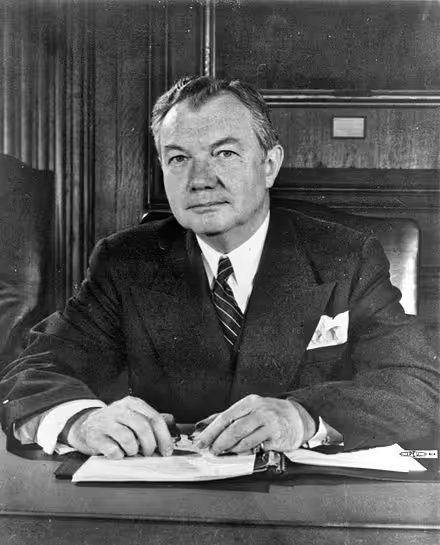
Robert H. Jackson, the only man to serve in all three roles as U.S. Attorney General, U.S. Solicitor General, and U.S. Supreme Court Justice

The Solicitor General of the United States is the attorney for the government who presents briefs and oral arguments before the U.S. Supreme Court.  The person who holds this position, thus, makes more frequent — and more important — appellate arguments than just about anyone.

Often, the U.S. Solicitor General is later appointed to the United States Supreme Court, the earlier job being both a proving ground for that important position, and a place from which the holder can become known to the President of the United States, who makes such appointments.

Thus, I got a chuckle out of this quote from former Solicitor General Robert H. Jackson, who himself was appointed to the U.S. Supreme Court by President President Theodore Roosevelt.  (As a side historical note, Jackson is the only man to have held all three jobs as U.S. Attorney General, U.S. Solicitor General and Supreme Court Justice.)

“I used to say that, as Solicitor General, I made three arguments of every case. First came the one that I planned–as I thought, logical, coherent, complete. Second was the one actually presented–interrupted, incoherent, disjointed, disappointing. The third was the utterly devastating argument that I thought of after going to bed that night.”

This is, of course, precisely what appellate advocacy is like.

Yesterday, the family of O’Bryan Spikes announced that they had retained attorneys Chris Finney and Brad Gibson to represent them and the Estate of O’Bryan Spikes in their claims against those responsible for the Club Cameo tragedy.

Read about that here:

Cincinnati Enquirer >> Family of Cameo shooting victim prepares to sue

WCPO >> Cameo Night Club shooting victim’s family to pursue civil claims for his death

Local 12 >> Family of Cameo shooting victim seeks accountability

WLWT >> Cameo Nightclub shooting victim’s family to pursue civil suit in man’s death

WXIX >> Cameo Night Club shooting victim’s family prepares to sue, seeks public’s help

WVXU >> Family Of Cameo Shooting Victim Preparing Lawsuit

This blog will keep you updated on developments in this case as they occur.

Judge Jerry McBride presided over State ex rel. Richardson v. City of Milford

Our client, former Enquirer reporter Rachel Richardson, tired of its repeated violations of Ohio’s Open Meetings Law sued the City of Milford.

The City decided to defend the case with vigor, claiming that Richardson could not prove her case that impermissible topics were addressed behind closed doors, inasmuch as what occurred in those illegal closed meetings was subject to attorney-client privilege.  In other words, because what they said was secret, we could not prove it violated Ohio law.

Once Judge McBride ruled that the City could not keep their illegal deliberations secret, the case quickly settled.

Read Rachel Richardson’s guest editorial about our “win” in today’s Enquirer.

The attorneys of Finney Law Firm have a long history of fighting for transparency in government. From presenting at workshops on open government to litigating cases seeking redress for violations of Ohio’s Sunshine Laws, we are proud of the work we have done to ensure that Ohioans have every opportunity to know what is being done in their names.

Our recent settlement of a case with the City of Milford is just the latest example of our work to protect the public interest. Our client, Rachel Richardson became aware of several serial violations of  Ohio’s Open Meetings Act, and sought our help in opening Milford’s government up to the people.

Ms. Richardson has an op-ed in the Enquirer about the case here. We are proud to have represented Ms. Richardson and we hope you will take a moment to read her story.

If you or your organization would like to learn more about Ohio’s Sunshine Laws and the public’s right to public records, contact attorney Christopher P. Finney at (513) 943-6655 to schedule an appointment or arrange a presentation.

The Individuals with Disabilities Education Act (IDEA) requires public schools to provide students with disabilities a “free appropriate public education” (FAPE). In order to meet this requirement, school administrators are tasked with creating an “individualized education plan” (IEP) for their students who qualify for services under IDEA. Generally, a student’s IEP should be tailored to accommodate to the unique needs of a student to ensure that he or she can receive an appropriate education. Since enacted in 1975, the federal courts have struggled with defining what level of educational benefit is guaranteed by the law.

In 1982, the U.S. Supreme Court considered the issue in Board of Ed. Of Hendrick Hudson Central School Dist., Westchester Cty. v. Rowley. In Rowley, the parents of a first grade student with a hearing impairment argued that under IDEA their daughter was entitled to an “equal educational opportunity” enjoyed by students without a disability. The Supreme Court rejected the lower courts’ standard relative to “equal opportunity” concluding that a “free appropriate public education” was “too complex to be captured by the word ‘equal’” and required “impossible measurements and comparisons” for courts to make.  The Court, however, made it clear that the law required a “substantively adequate” program of education satisfied by an IEP outlining a program “reasonably calculated to enable the child to receive educational benefits.”

The decision in Rowley provided little guidance to the lower courts that have continued to struggle with the defining the rights of students under IDEA over the last 35 years. Some federal circuits have determined that students are owed “some” benefit under IDEA, while others have ruled that IDEA requires school districts to provide a “meaningful” benefit to students with disabilities. The conflict amongst the circuit courts prompted the Supreme Court to revisit the educational requirements of IDEA last month in the case of Endrew F. v. Douglas County School District. In Endrew, the parents of a student with autism removed him from his public school when they determined that his progress had stalled. The parents enrolled their child in a private school specializing in educating students with autism. After he made vast improvements, the parents returned him to public school where he was given a new IEP. But the parents rejected the new IEP and ultimately filed suit against the school district claiming that it failed to provide their son with a FAPE because the proposed IEP was not “reasonably calculated to enable [their son] to receive educational benefits.”

The case progressed to the Tenth Circuit Court of Appeals which found that the student must be provided “some educational benefit” that must be “more than de minimis” to be adequate. The Tenth Circuit determined that the student’s IEP was acceptable in this case because it was “reasonably calculated to enable [him] to make some progress.”

On appeal, the Supreme Court unanimously rejected the Tenth Circuit’s standard in an opinion authored by Chief Justice John G. Roberts Jr. The Court held that the student’s “educational program must be appropriately ambitious in light of his circumstances.” In refuting the Tenth Circuit’s standard, Chief Justice Roberts explained that, “When all is said and done, a student offered an educational program providing ‘merely more than de minimis’ progress from year to year can hardly be said to have been offered an education at all.”

There is no one standard or clear test that can be applied in these cases as the education of students with disabilities requires a careful consideration of each student’s unique circumstances. The Supreme Court’s decision requires school districts to make these careful considerations in order to provide ambitious educational opportunities for students under IDEA.

Many special education advocates see the Court’s decision as a significant victory for special needs students that raises the bar across the country. But many commentators are hesitant to call the decision a “game changer” for special education, arguing that by and large school administrators are already meeting the Court’s standards. What is clear, however, is that the decision affords special needs students with additional ammunition to advocate for more ambitious and personally tailored IEPs.