As we have grown, the vision of the Finney Law Firm is sharpening for our clients and the public: A broad array of services offered in one firm, each practice area delivered in a quality fashion.
At our core, we are a real estate firm, with experienced transactional attorneys, a title insurance company that insures residential and commercial titles, and commercial litigators who can address virtually every aspect of disputes relating to real estate: Eviction, foreclosure, title disputes, easement disputes, construction disputes and mechanics lien claims, as well as complex real estate litigation.
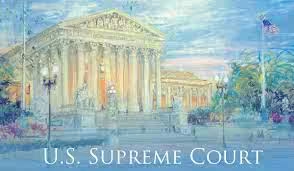
Our litigators are well-known for our public interest practice — handing legislative and regulatory matters aggressively, confronting government officials who would illegally interfere with their life, their business and their fortune. Three times we have ascended to the U.S. Supreme Court, and three times we won the relief we sought with 9-0 victories there. We apply this same sophistication and vigor to commercial litigation, personal injury, wrongful death and medical malpractice matters.
Finally, we are proud to recently have expanded our litigation services to include labor and employment law with experienced litigator Stephen Imm.
When a client asks “do you do that,” I am proud to respond “yes, and we do it well. Let me introduce you to …..”
Let us know how we we can help with your business or personal opportunity or challenge. It is with you in mind that we have assembled this team of quality practitioners.
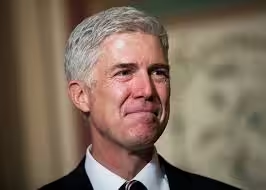
Our firm practices extensively in the First Amendment arena. Thus, it was with great interest that we saw this article on the SCOTUS Blog on U.S. Supreme Court nominee Neil Gorsuch’s First Amendment jurisprudence.
A quick summary:
In many ways, Gorsuch’s opinions in this area are similar to those of the late Justice Antonin Scalia – with the possible exception that Gorsuch has been more willing to find not only that the First Amendment has been violated, but also that defendants were not entitled to qualified immunity in those cases.
It appears the First Amendment will continue to have solid backing from SCOTUS with Justice Gorsuch on the Court.
Relating to Christopher P. Finney’s presentation on February 16th, 2017 before Cincinnati’s Lawyers’ Club entitled “Mr. Finney goes to the United States Supreme Court,” we wanted to present several links for those wanting to do further study on the topic.
First, as background, SCOTUSblog.com exists for the purpose, in part, of compiling and presenting key links for United States Supreme Court cases, from briefs, to oral argument transcripts and audio recordings, as well as in dept commentary. So, most of our links are just back to their site, for which we are greatly appreciative.
Some are links to original documents on the Finney Law Firm scribd.com site.
Next Thursday, Christopher P. Finney will present to Cincinnati’s Lawyer’s Club the topic “Mr. Finney goes to the United States Supreme Court,” a speech on his experiences in having a case accepted by the nation’s highest court, having it presented (another attorney made the oral argument) and winning in a unanimous ruling.
“It has been the highlight of my legal career to date has been to position a case for acceptance by the United States Supreme Court, to have it presented and to win,” said Finney. “The experience was made all the sweeter because up until the nine Justices spoke, not a single judge, at the trial court level or at the appellate level, saw any merit in our arguments. Strategy, persistence and a firm belief in our position prevailed.”
Within just months of forming the Finney Law Firm in 2013, we learned that one of our cases had been accepted for oral argument at the United States Supreme Court — Susan B. Anthony List v. Ohio Elections Commission. Getting a case accepted for oral argument by the United States Supreme Court is the legal equivalent of lightning striking. The Supreme Court typically accepts fewer than 1% of all cases for which certiorari petitions are presented, and many of those arise from either very high profile issues of great public interest or cases of statutory interpretation arising from the D.C. Circuit. In the year in which we presented, more than 10,000 petitions for writs of certiorari were presented, and only 69 were accepted for oral argument.
The Susan B. Anthony List case challenged Ohio’s political “false claims” statute, in which the Ohio Elections Commission sits (used to sit) in judgment of whether statements made during the course of political campaigns — candidate and issue — were “false” and if so, could refer them for criminal prosecution, involving up to six months in jail.
Our legal team presented that case in April of that year, and won a unanimous ruling from the U.S. Supreme Court in June, authored by Justice Clarence Thomas. The case as it ascended to the United States Supreme Court was merely about whether our clients had standing to challenge the subject statute. The Supreme Court decision found that standing existed and remanded the case for further proceedings in the trial and appellate courts, where some months later our clients ultimately prevailed.
Navigating legal shoals to have a case accepted by the United States Supreme Court and positioning it most strongly for victory, including by its written and oral presentation, involve intense strategy and hard work, much like a chess game or a championship boxing match.
That experience in this one case, and two more that the firm had accepted and won on only written briefs, will be presented by Christopher P. Finney next Thursday, February 16, 2017 before Cincinnati’s Lawyers’ Club at the Montgomery Inn Boathouse at 11:30 AM.
Also presenting that same day from 12:45 to 1:45 is Cincinnati attorney Daniel Drew on Civil Asset Forfeiture Reforms.
If you want to attend, you may sign up by contacting attorney Bob Cettel at (513) 325-2279 or via email at cettel@mac.com. The cost is $20 per CLE session for Cincinnati Lawyer Club members and $25 per session for non-members. The cost is $30 per year to join the Cincinnati Lawyers Club.
The Cincinnati Lawyers’ Club was founded in 1920 and gathers attorneys together for civic undertakings and continuing legal education programs. We thank them for this opportunity to present our experiences on this exciting journey to the United States Supreme Court.
The Ohio Department of Education has a remarkable record in teacher disciplinary proceedings over the past five years: Nearly 100% of all proceedings decided by the state board of education result in discipline for the teacher. Yes, the standards for “due process” in ODE administrative proceedings are so robust that nearly no one is ever found “not guilty” of the charges leveled.
That fact alone should make the citizenry shiver, as no one involved in the proceedings seems to ever find a chink in the armor of the Department’s overzealous prosecutions. It has the appearance, if not the reality, of a rubber-stamp procedure from beginning to end.
That one-sided history of adjudication of teacher disciplinary proceedings thus made our win this week in Langdon v. Ohio Department of Educationall the more sweet.
In a proceeding that endured for more than 36 months, including seven days of trial, and taking six months after the close of the hearing for the Hearing Examiner to issue a decision, our client’s teaching license was revoked by the Ohio Board of Education. She was a special education teacher in the troubled Lakota School District, dealing with developmentally-disabled, multi-handicapped children. We then appealed that administrative decision on behalf of our client to the Butler County Common Pleas Court pursuant to O.R.C. §119.12.
Today, the decision in that appeal was issued, and our client was completely vindicated on all points, evidentiary and legal.
In that decision, the Honorable Judge Keith Spaeth from the Butler County Common Pleas Court found “an appalling lack of fairness and due process” throughout the seven-day proceeding to which our client, Michelle Langdon was subjected. Among the due process violations were
failure to provide the client with the most basic notice of the alleged infractions,
a complete failure to ever define “conduct unbecoming” (the basic charge against her), and
a failure to name her accusers.
To the Ohio Department of Education, fundamental fairness and notice of the charges filed apparently are simply an unneeded inconvenience.
The case was filled with amazing parrys and thrusts to force bureaucratic conformity in the cozy Lakota School District bureaucracy.
For example, when a teacher’s aide was repeatedly late, absent and lazy on the job, our client hurt her feelings by saying “I just want you to do your job.” As hard as it may be to believe, this fact pattern was one of the dozens of charges — in challenging the inertia of the educational bureaucracy — against which our client had to defend.
Our client also confronted an administrator in the Lakota Schools for her failure to properly equip the classroom with the furniture and equipment needed for a special needs population. Yes, advocating forcefully for special needs children is the basis for revoking of a teacher’s license according to the Ohio Department of Education.
The Court even cited in its opinion the Hearing Examiner’s strange rulings on procedural and due process issues and the lateness of his decision outside of the statutorily-permitted deadline. Virtually everything about the administrative proceeding was unfortunate and Kafkaesque. This Judge Spaeth clearly understood.
You may read Judge Spaeth’s brilliant decision here. You may read the Finney Law Firm’s briefs before the Common Pleas Court here and here.
This case was a pleasure defending, and the client was a delight.
This is from Judge Sapeth’s decision about our client:
What the evidence and testimony from the administrative hearing does show is that Appellant was a dedicated, caring educator…She was an advocate for these children, and throughout her tenure at Lakota, Appellant went above and beyond the normal duties of a classroom teacher to ensure that her students had a genuine high school experience and resources to help them transition from the classroom to independent living.
We truly were thrilled to help “Make a Difference” for this client in this engagement. The proceeding was important to her license and career, but the bigger principle of reining in an out-of-control state agency was even more important. And here that principle was vindicated.
We now look forward to the expeditious restoration of our client’s teaching licenses and an award of her attorneys fees for forcing her to endure this persecution, which state statute requires.
We learned through a protracted and complicated process about the congressional ethics processes. It was a case we initiated and pursued with some limited degree of success against a sitting member of Congress many years ago.
What we learned is that there are two committees in Washington that have some jurisdiction over whether members of Congress violate the ethics rules that apply to them — the Office of Congressional Ethics and the House Ethics Committee. They have remarkable similar names, so much so that the public would be rightfully confused as to their identities and functions.
The Office of Congressional Ethics is a citizens oversight committee appointed by House leadership that more or less, on private complaints, makes “probable cause” findings for further consideration by the House Ethics Committee. The Congressional Ethics Committee consists of members of Congress. The Office of Congressional Ethics has a rich tradition of investigating and impartially referring meritorious matters to the House Ethics Committee for official action. But the House Ethics Committee is notorious for being the place where all complaints against members of Congress go to die. Some members of Congress thinks the Office of Congressional Ethics is too zealous in its pursuit of members of Congress and, specifically, object to the consideration of anonymous complaints and the pursuit of frivolous matters, requiring members of Congress to expend enormous sums defending themselves.
Yesterday, the U.S House GOP caucus preliminarily voted to significantly restrain the Office of Congressional Ethics — to clip its wings. Today, the same caucus abandoned that decision and left things as they are for now, and for a bipartisan decision on the fate of the Office to be made by the House Ethics Committee.
You may read the story of all of this by Dierdre Shesgreen of Gannett News and the Cincinnati Enquirer here.
It was hard to believe when the client told us her story. In 2015, the University of Cincinnati told 19-year-old Casey Helmicki, a pre-med student, that men and women were not allowed to group together in physics lab. She had even gone up the chain of command at UC to complain, to her professor, to her department chairman, and to the Title IX office, all to no avail.
We filed suit under Title IX, which prohibits sex-based discrimination in university programs,and achieved a relatively quick settlement for our client.
Today’s Cincinnati Enquirer covers the settlement today. You may read about that here.
Chris Finney is part of a distinguished panel of speakers who will present this Thursday and Friday, December 15th and 16th, 2016 at the Millennium Hotel: “Local Government Law from Start to Finish.”
The program is aimed at educating local government officials, county, municipal and township attorneys, as well as attorneys who litigate against government entities in Ohio and federal law addressing these entities.
Topics include (i) Public employment issues, (ii) Public records, (iii) open meetings, (iv) police misconduct, (v) public bidding, (vi) code enforcement aimed at blighted properties and nuisance properties, (v) billboard law, (vi) economic development finance, (vii) taxpayer actions and fee shifting, and (viii) government attorney ethics.
Mr. Finney will join Cincinnati Law Department attorney Terrance Nestor on Friday at 2:30 PM in presenting on Taxpayer Actions and Fee Shifting.
The class runs both Thursday and Friday from 9 AM until 4:30 PM and features numerous attorneys from Cincinnati’s Law Department as well as other municipal attorneys.
You may sign up for or learn more about the program here.
Today’s Journal-News features the settlement that resulted from this law firm’s suit under the Americans with Disabilities Act on behalf of an in-patient psychiatric facility seeking to locate into West Chester Township.
For more than six months following the client’s application for zoning approval, the Township stonewalled Dr. Mohammed Aziz from locating his facility into a former nursing home property, despite the clear language of the Americans with Disabilities Act requiring parity in the treatment of psychiatric patients with those with purely physical ailments. It is simply illegal to treat the facilities differently.
The reason for the law is obvious: Just as occurred in West Chester Township, psychiatric providers and patients nationwide routinely suffer repeated invidious discrimination as compared to other health care providers. In West Chester Township the township administration and some of the Trustees worked the citizenry into a frenzy with assorted falsehoods and canards. Then they imposed a moratorium on zoning approvals, targeting the new facility and preventing a zoning certificate from being issued to allow it to open.
Judge Timothy Black quickly addressed these issues once Finney Law Firm attorneys brought suit.
“Nothing is more satisfying, as an attorney, than to stand an over-reaching bureaucrat or elected official before a Federal judge and force him to explain his behavior,” said Chris Finney. “We are pleased that the law worked as intended in this instance.”
This is one more example of how we “make a difference” for our clients: Deep knowledge of the law, commitment to its proficient practice, and tenacity in pursuit of our clients’ objectives.
It was a long and arduous legal journey expose and punish the $300,000 in illegal campaign contributions aimed to defeat Christopher Smitherman in the 2013 Cincinnati City Council elections, but Finney Law Firm and attorney Curt Hartman indeed “Made a Difference” by doggedly pursuing this case to conclusion.
We are pleased to report that Cincinnatians for Jobs Now and Jonathan White recently paid the $15,000 fine levied against them in the disciplinary proceeding.