Two different federal judges have tossed criminal charges relative to drug stings as “outrageous,” “fabricated crimes” for being an unconstitutional procedure.

The reasoning is not just the substance of the stings, but, as the article tells us, “Judges are getting really frustrated with not having sufficient answers on how these people were targeted or how they came to be the subject of the sting.”

It’s n interesting development where Judges are actively questioning the decisions of prosecutors instead of just defendants.

Read it here.

We are all used to seeing videos of OVI arrests on television.  Bob Huggins, Paavo Jarvi, and other luminaries’ arrest video have regularly appeared on television and www.youtube.com following the arrest.

Well, pursuant to a recent decision from the 12th District Court of Appeals, in Clermont, Warren and Butler Counties (the area covered by the 12th District Court of Appeals) OVI arrest videos are not considered public records.  If the agencies choose not to hand them out, they won’t be disclosed until after the case is resolved.

Read the decision here.

In my career, I have been asked to evaluate two cases in which our firm’s clients were arrested for merely filming the arrest of another person.  In one instance, our client was leaving a bar in Covington, Kentucky and observed another patron (whom he did not know) being arrested.  He whipped out his camera phone and filmed the arrest.  The Covington police arrested him merely for filming the confrontation.  In the second instance, our client was a “sidewalk counselor” outside an abortion clinic.  A fellow protester was being arrested, and he filmed the same with his video camera.  Again, he was arrested.

In both instances, the charges were ultimately dropped, and our firm was asked to evaluate the claim for a constitutional violation.  In both instances, the clients ultimately decided not to pursue the claims, but we determined that the filming of an arrest is protected First Amendment activity.

This Washington Post piece highlights the continuing problem of police agencies not understanding this developing constitutional right, and the resulting arrests.  It’s an interesting topic and one that certainly will develop more fully in the coming years.

Sunday, Adam Liptak had this interesting piece in the New York Times shining a light on a little-known practice of our nation’s highest court: corrections “after the fact” of the original released decision.

The late changes by the Justices do not change the outcomes of the decision — the winners and losers — but they do occasionally change the reasoning, which becomes the basis for decades following for other appeals, and as direction to the Courts of Appeals.

I have dealt with Liptak on our U.S. Supreme Court case (here), and on the COAST/Mark Miller “Tweets” case (here) and must say he is a brilliant writer.  Liptak devotes his coverage exclusively to the Supreme Court and has a keen understanding of the law and the workings of the nation’s highest court.

Once considered a model for open and accountable government, Ohio’s Open Meetings Act (R.C. § 121.22, et seq.) was intended to be “liberally construed to require public officials to take official action and to conduct all deliberations upon official business only in open meetings unless the subject matter is specifically excepted by law.”

What appears to be pretty straightforward language, telling the courts to read the statute in favor of open government, the courts have slowly whittled away at what had been a model law.

But there is hope. Adam Stewart v. Board of Education of Lockland School District challenges a school board’s decision to hold an employee disciplinary hearing in executive session (non-public), even though the employee himself demanded a public hearing. The trial court and court of appeals relied on a 1980 Ohio Supreme Court case that interpreted the law to allow the School Board to hold a non-public hearing despite the employee’s demand.  So where is the hope? The Ohio Supreme Court has agreed to hear the appeal of the decision in the Stewart case. Stewart will have the opportunity to ask the Court to revisit its 1980 decision and re-liberalize Ohio’s Open Meeting Act.

The Finney Law Firm was contacted early this year by a group of landlords owning single family homes in the City of Mt. Healthy.

The City had begun a mandatory rental registration and inspection program for single family homes.  While the City fathers invariably thought the intrusive and expensive program was a good idea, as a matter of law it imposed a scheme of warrantless searches in violation of the 4th Amendment to the United States Constitution.

Finney Law Firm filed suit in early April.  Within days, the City of Mt. Healthy announced it was suspending enforcement of the Ordinance and within weeks Council met and formally repealed the offending Ordinance.

Our clients remain concerned with the constitutionality of the replacement legislation, and will continue to pursue that through conclusion, but we are pleased our public interest litigators addressed this unconstitutional action so quickly and decisively.

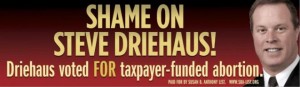
The below post was made shortly after the U.S. Supreme Court accepted review of Susan B. Anthony List v. Ohio Elections Commission on January 10, 2014.

Since that time, the Supreme Court decided in our favor 9-0 (in an opinion authored by Clarence Thomas) in the Susan B. Anthony List case on June 16, 2014 and in COAST Candidates PAC v. Ohio Elections Commission on June 23, 2014. Read about those wins here, here and here.

The print utilized as our graphic is gratefully PRINTED WITH THE AGREEMENT OF THE KAMIL KUBIK FOUNDATION.


It was a momentous event for our brand new law firm.

Within ten days of our formal launch in January of 2014, the United States Supreme Court granted one of its few writs of certiorari to our client, the Coalition Opposed to Additional Spending and Taxes (COAST), to review a 2013 decision from the Sixth Circuit Court of Appeals.  COAST and the Susan B. Anthony List are challenging the jurisdiction of the Ohio Elections Commission to judge and punish claimed claimed false statements made during the course of political campaigns.  At the request of the state of Ohio, both the trial court and the 6th Circuit Court of Appeals dismissed the case without considering the merits.

The case has been written about extensively in national publications.  Read here,  here, here, and here.

To illustrate the difficulty of getting before the Court, during its current term, US Supreme Court will grant discretionary review of fewer than 100 of more than 10,000 applications   The vast majority of litigators will spend their entire careers without ever having a case before the U.S. Supreme Court.

The Finney Law Firm is committed to vigorous representation of our clients, including challenging the authority of government actors to enforce laws that violate the U.S. and Ohio Constitutions, or are otherwise illegal.  This important case is an example of that aggressive approach our attorneys undertake with zeal.

We expect to have a decision by the end of June.