Attorney Rebecca L. Simpson

Some of the most common questions about the Paycheck Protection Program (PPP) over the last couple of weeks have been how it applies to those who are self-employed and/or receive 1099 income.  The Small Business Administration (SBA) has now issued an “Interim Final Rule” addressing many of these questions.  Here are some highlights:

Eligibility

Those who have income from self-employment and file a Form 1040, Schedule C for tax purposes are eligible for the PPP if:

  1. You were in operation on February 1, 2020;
  2. You are an individual with self-employment income (such as an independent contractor or sole proprietor);
  3. Your principal place of residence is in the United States; and
  4. You filed or will file a form 1040 Schedule C for 2019.

One exception applies to partnerships and LLCs filing taxes as a partnership. In general, the partnership must file for the PPP rather than the individual partners.

Calculation of Maximum PPP Loan

  • If you have no employees, in general, your maximum loan amount will be 2.5 times your average monthly net profit, which is calculated using the amount on your 2019 IRS Form 1040 Schedule C Line 31 (the Line 31 amount is capped at $100,000)
  • If you have employees, you will also add in eligible amounts of your W2 payroll to employees in calculating your maximum loan amount
  • If you received and Economic Injury Disaster Loan (EIDL) between January 31, 2020 and April 3, 2020 that may impact your loan amount as well.

Forgiveness of PPP

The rules with respect to how self-employed individuals and independent contractors must spend the funds are similar to the rules for small businesses with one significant exception.  The amount that self-employed and independent contractors can spend on “payroll” for themselves (meaning net profits in their case) is capped at an amount equal to eight weeks worth of net profit (8/52 of 2019 net profits).

Conclusion

This new SBA Interim Final Rule also indicates the SBA will issue further guidance for individual with self-employment income who were not in operation in 2019, but who were in operation on February 15, 2020.

The Finney Law Firm will continue to post updates on the PPP.  If you have questions or need help with your particular situation, please feel free to contact Rebecca L. Simpson (513.797.2856).

In a news release yesterday, Ohio Attorney General David Yost warned creditors that CARES Act checks are protected by Ohio state law.

“The stimulus checks were intended to be used during an emergency – to put food on the table, keep the lights on, and a roof over our heads,” Yost said. “It wasn’t meant to pay off an old bill.”

The law to which Yost is referring is Ohio Revised Code Section 2329.66 which exempts property from “execution, garnishment, attachment, or sale to satisfy a judgment or order” under certain circumstances including:

A payment in compensation for loss of future earnings of the person or an individual of whom the person is or was a dependent, to the extent reasonably necessary for the support of the debtor and any of the debtor’s dependents.

ORC Section 2329.66(A)(12)(d).

Ohio Attorney General Yost also posted a NOTICE OF APPLICAPBILITY OF STATE LAW EXEMPTION TO PAYMENTS UNDER THE FEDERAL CARES ACT on his website, which can be found here.  According to the Notice:

The payments under the CARES Act are in the nature of emergency support, designed to support basic needs of tens of millions of Americans. This is why debts owed to the Federal and State governments are not being withheld from the payments. Although there is no explicit exemption for CARES Act payments under federal law, Ohio law protects them.

In his notice, Yost indicates that the State of Ohio is reserving the right to enforce this state law against creditors who try to collect against these CARES Act checks.

Watch our blog for more updates, and feel free to contact Rebecca L. Simpson (513.797.2856) for more information.


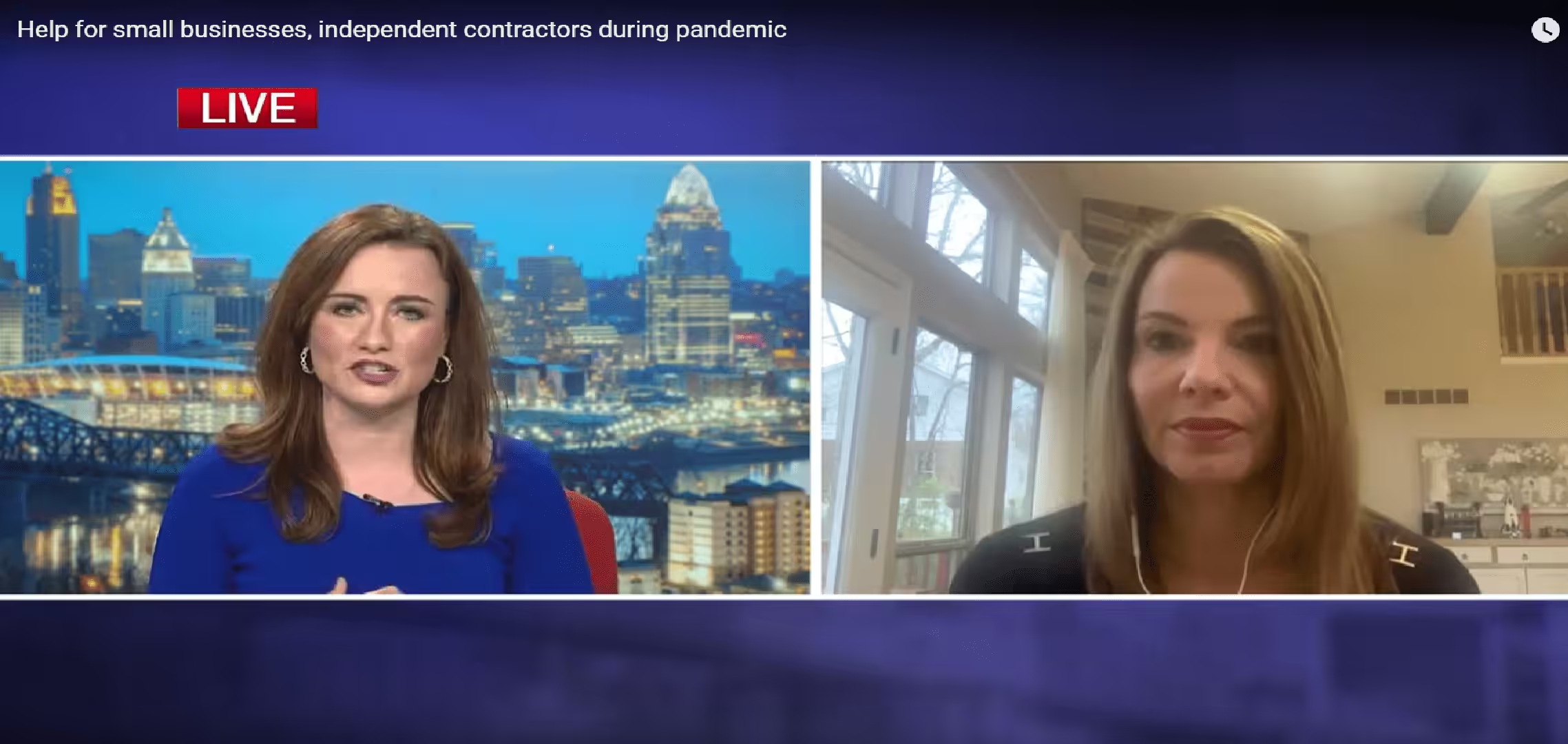
This morning, Finney Law Firm attorney Rebecca L. Simpson appeared live with anchor Angenette Levy on Local 12 to discuss the latest developments with the Paycheck Protection Program.

You may watch the link here.

Attorney Rebecca L. Simpson has been our point person inside Finney Law Firm to research and keep updated on the PPP and to advise clients on the intricacies of how to access Paycheck Protection Program funds for their small businesses each step of the way.  She has already led three webinars on the topic, with two more to come this week.

Contact Rebecca L. Simpson (513-797-2856) for assistance with the program.

Attorney Rebecca L. Simpson
On Friday, April 17, at 9:30 AM, Finney Law Firm Attorney Rebecca L. Simpson will present “Powerful Assistance to Realtors under the Paycheck Protection Act” (“PPP”) to Realtor and affiliate members of the Cincinnati Area Board of Realtors. This special program is free to members and nonmembers.
  • Ms. Simpson has already conducted an extensive webinar on the PPP to EmpowerU. To date for live participants and those watching the recorded webcast (here) that message has reached more than 1,000 viewers. That webinar was primarily aimed at Part #1 of PPP, which dealt with employers with W-2 employees.
  • This program on the other hand primarily is aimed Part #2 of the PPP that just launched today (April 10, 2020):  1099 contractors, self-employed, sole proprietors (for example, real estate investors whose companies have no employees). Ms. Simpson also will explore the various situations of Realtor “Teams” with 1099 contractors and W-2 employees within the teams, part-time Realtors who may also have separate W-2 jobs, and other variables specific to Realtors.
CABR Members can log in to register here and nonmembers can register here. This program is free for both members and nonmembers.
Contact Christy Beaver (513.842.3011) at the CABR for questions about the program and registration.
Contact Christopher P. Finney (513.943.6655) or Rebecca L. Simpson (513.797.2856) for specific assistance for you or your company.
A detailed description of the PPP program is here.

I spoke with two clients last night, one who applied with First National Bank of Lebanon (only $25,000 in loan amount) and one who worked through Heritage Bank (based out of Northern Kentucky) who obtained $745,000.

So, the SBA is not messing around. As promised, these loan funds are being pushed immediately into the economy.

Stay tuned for more updates, and free free to contact Rebecca L. Simpson (513.797.6227) for more information.

Attorney Matt Okiishi

Congratulations is due to Finney Law Firm attorney Matt Okiishi who successfully sued today to force the Hamilton County Health Department to allow our client, Amazon Beauty Supply store in Finneytown, to remain open for business during the COVID-19 crisis.

The store, which sells beauty supplies, also markets soap, shampoo, other essential products and, most importantly, the much-sought-after N95 masks. The Hamilton County Health Department, noting that the store also sells non-essential supplies, had ordered them to be shuttered for the duration of the crisis, which for now extends through the end of May.

The business, an existing client of Finney Law Firm, asked us to sue to force the County to allow them to stay in business. We filed suit within 24 hours of first being contacted, and this afternoon our attorneys reached agreement with the attorneys from the Hamilton County Prosecutor’s office to remain open. The case was assigned to Judge Jody Luebbers who essentially told the parties to work the matter out amicably.  The parties did so, which included an agreement on the number of customers that would be permitted in the store at any one time.

Channel 12 carried the story this afternoon, and the video featuring attorney Matt Okiishi is here.

“There’s little more rewarding in the law,” said Finney Law Firm founder Chris Finney, “than standing an errant government official up in front of a Judge and making him account for his behavior. Today attorney Okiishi enjoyed that exercise and achieved the desired end for our client.”

____________________

For help when you need to stare down an over-zealous government actor, contact  Matt Okiishi (513.943.6659).

We thank Empower U for hosting a Zoom.Us webinar on the Small Business Administration’s new Paycheck Protection Plan (“PPP”) and Emergency Income Disaster Loans (“EIDL”) designed to help small businesses sustain through the unprecedented economic interruption brought on by the COVID-19 pandemic crisis.  The session was held on April 2, 2020 entirely virtual to remain safe.

The webinar video link is here.  Please feel free to share it with others.

The attorneys on this presentation and their contact information are;

Finney Law Firm is offering individualized assistance in navigating regulations and procedures surrounding PPP and EIDL applications.  For professional assistance, contact Rebecca L. Simpson.  If you or your business is encountering employment-related issues arising from the COVID-19 crisis, contact Stephen E. Imm.

If you liked this free video, please consider donating to EmpowerUOhio.Org to encourage this free programming.  Empower U has given more than 400 free adult education programs over the past decade, including valuable programming of this type.

There is a powerful feeling that the community is pulling together, rooting for one another, and digging deep to help each other, and we hope this information is helpful towards that end.

Also, we will continue to update the Finney Law Form blog to provide individuals and small businesses information on the programs that are available to help them through this crisis.

If you want to be added to the Finney Law Firm email updates, click here.

Join Empower U tonight from the comfort and safety of your home via your laptop, tablet or cell phone for a webinar on powerful tools for small business from the federal government in the CARES Act passed last Friday.

>>> The link to sign up for the free seminar is here. <<<

  • If you want to email questions in advance, click here.
  • For specialized assistance for your company, we are offering consultation through the program for a flat $1,500 fee to help businesses through the process.  Click here to get signed up and type “PPP” in the subject line of the email.
  • To have your email to be added to our firm mailing list and receive tonight’s PowerPoint, click here and say “add me to your list” in the subject line.

Joining us tonight are:

  • Attorney Rebecca L. Simpson who will lead the presentation primarily on Paycheck Protection Program and Economic Injury Disaster Loans available very shortly  to small businesses.
  • Attorney Stephen E. Imm who will answer questions of employers and employees about the COVID-19 crisis.
  • Melissa Knies from US Bank who will explain how to apply for the programs.
  • Attorney Christopher P. Finney will moderate.

We have a record audience for Empower U signed up for tonight. Please join us for this important program.


With the advent of the COVID-19 Crisis, Finney Law Firm and Ivy Pointe Title have quickly stepped to the plate, with technology that allows for the practice of law with appropriate social distancing, with attorneys who focus on practice areas to help their clients, and with cutting edge information on emerging programs to help businesses and individuals in need.

Technology allowing for electronic interaction

Finney Law Firm and Ivy Pointe Title  have carefully developed the tools to be prepared for a day such as this:

  • DocuSign allows for execution of documents from your computer.  By federal and state law, e-signed documents are fully enforceable as with “inked” documents. Our team is licensed and trained in DocuSign technology for all documents in which clients will allow an electronic signature.
  • Electronic notary.  Finney Law Firm and Ivy Pointe Title contracted with one of only a handful of licensed e-notaries in Ohio for exclusive provision of e-notary services. Using the platform DocVerify, we have the strongest technology to allow real estate closings and other transactions to proceed.  By Ohio law, it is permissible to have documents signed and acknowledged (notarized) without person-to-person interaction via electronic signature and electronic notary.
  • Electronic payments. We use e-billing and credit card payments (and wire transfers and EFTs) for clients who prefer this method of billing and payment.
  • Electronic discovery and electronic depositions. Your litigation does not need to stop because of the COVID-19 crisis. Most of the work pre-trial can still move forward using e-mail, Zoom.US or Microsoft Teams for depositions, and motion work that can be electronically filed with almost all Courts.
  • Work-from-Home. If you do need to visit our offices, you will find that most of our professionals are not at their desks. Rather, they are safely (for you and them) working from home with the latest technology including Microsoft Surface laptops, Microsoft Teams Video Conferencing, Microsoft Office 365 data in the cloud, so we can access your data from anywhere in the planet, but with tremendous Microsoft security technology and backups.

Practice areas to help your business

Our business lawyers are up to date and prepared to help you through the thicket of issues that arise or are heightened with the COVID-19 crisis:

Attorney Isaac T. Heintz is proficient in contract interpretation, including how to enforce or avoid obligations under a lease or other agreement. He has already written purchase agreements with COVID-19 contingencies to extend due diligence periods to the declared end of the crisis. As you might expect, Isaac has also had many clients initiate their estate planning, or finish long-delayed estate planning work.

Attorney Stephen E. Imm heads our employment law group, and is advising clients on a myriad of new COVID-19 legislation and addressing employment law claims under previously existing law and the new enactments.

Attorney Bradley M.  Gibson heads our litigation group which is dealing with a multitude of business-to-business disputes, including those arising because of the COVID-19 crisis.

Attorney Richard P. Turner runs Ivy Pointe Title and in that capacity has been using every tool at our disposal to continue to close your transactions “accurately and on time, every time.”  These include closings respecting social distancing, and we stand prepared to be one of the first agencies in Ohio to implement fully electronic closings.  We also can do drive-by closings where you come to our office and sign documents from your car, or we come to you and you can sign them on our car hood.

Attorney Christopher P. Finney heads our public interest practice, and the host of issues addressing government-to-business and government-to-individual interaction arising from the COVID-19 crisis.

CARES Act assistance for your small business

Congress just passed the CoronaVirus Aid, Relief and Economic Security Act, which includes the Paycheck Protection Program that will provide what essentially are grants to businesses with fewer than 500 employees and enhanced Economic Injury Disaster Loans (EIDL).

Attorney Rebecca L. Simpson has been counseling clients through this program, and on Thursday night she joins other presenters on a panel addressing “CARES Act, Including Paycheck Protection and Funds for Businesses.”

Conclusion

We are working furiously to meet the needs of our clients in this fast-emerging crisis. Let us know how we can help you or your small business navigate these turbulent waters to come to the other side safely and profitably.

And our hope is that each of you remain healthy throughout this pandemic.



Sculpture outside the Ohio Supreme Court building in Columbus, Ohio

Fox 19’s Jennifer Baker this week writes on a suit filed by Finney Law Firm on behalf of Ohio State Representative Thomas E. Brinkman, Jr.  against the Ohio Supreme Court over its recent decision upholding the last-minute cancellation of the 2020 primary election by Secretary of State Frank LaRose.

The Ohio Constitution pretty clearly requires:

“The decisions in all cases in the Supreme Court shall be reported, together with the reasons therefor.”

(Article IV, section 2(C) of the Ohio Constitution), but the election-cancellation decision did not provide reasoning for upholding the cancellation.

Brinkman seeks to force the Justices to follow the Constitution and state clearly the “why,” the reasoning behind the decision.

Since the suit is against the very Justices who violated the Constitutional provision, we expect they will recuse from the case and appoint sitting lower court judges from throughout the state to sit by designation to consider the issue, an issue of first impression before the Court.

Read the Channel 19 story here.

You can read the lawsuit here.

To speak with a member of our Constitutional Law team, contact Christopher P. Finney (513.943-6655).