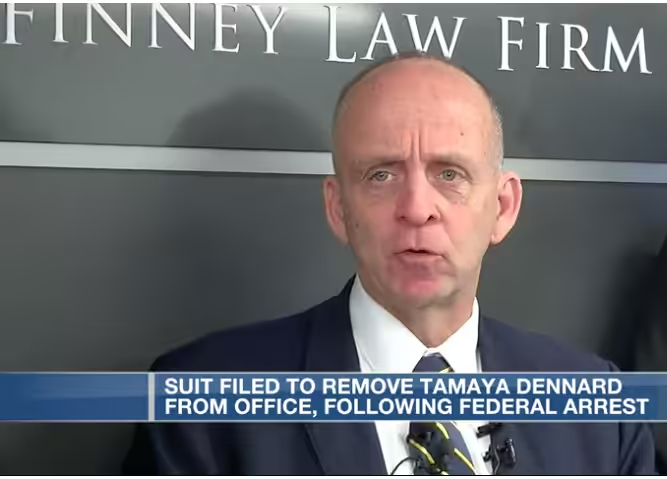
Cincinnati media has given extensive coverage to the Probate Court complaint filed by Attorneys Curt Hartman. Here is a quick round-up:

Television coverage of the filing of the complaint by WKRCWCPO; WLWT; and Fox19

Curt Hartman appeared on WLW with Scott Sloan on Thursday beginning at approximately 95:00, and again on Friday beginning a approximatley 40:00.

WCPO discussed the case against Tamaya Dennard on its podcast Hear Cincinnati

Attorney Curt C. Hartman, of counsel with Finney Law Firm, has filed a complaint in the Hamilton County Probate Court to remove Cincinnati Councilmember Tamaya Dennard from office pursuant to R.C. 733.72-76.

A copy of the Complaint is below or available here.

The Complaint was filed on behalf of Mark Miller and four other Cincinnati electors, including State Representative Tom Brinkman.

Under Ohio law when five electors file a complaint alleging that a city official has received payment for her services to the city in addition to her salary; has an interest in a public contract; or is otherwise guilty of malfeasance or misfeasance, the City Solicitor shall prosecute the case before the Probate Court Judge, and, if Dennard is found guilty, she shall be removed from office.

The statute provides that Tamaya Dennard should be ordered to appear before the Probate Court within ten days of the filing of the Complaint.

A press conference is scheduled for 10 a.m. at the Mt. Adams office of Finney Law Firm, 1077 Celestial Street.

[scribd id=449127398 key=key-ytT0JKTEv0nhWXmTwyek mode=scroll]

In the past few months, Cincinnati City Council has passed new laws regulating residential landlord/tenant relationships, including requiring all landlords to file extensive rental registration forms with the City and a first of its kind law requiring landlords to accept alternative security deposit payments. These new laws change the dynamic and financial viability of residential rental property within the City limits.

Presented below is a summary of new laws contained in six different enactments by  City Council.

Rental Registration

New Section 874-6 of the Municipal code requires all landlords to register with the city and supply the following information for each rental unit within the city limits:

  1. Name, address, and telephone number of the owners;
  2. If owned by an entity, the name, address, and telephone number of a member or corporate officer;
  3. The name, address, and telephone number for “any and all persons in control of the property” who can be reached 24 hours a day, 7 days a week, 365 days a year;
  4. Street address and permanent parcel ID of each rental property;
  5. Monthly rent charged; and
  6. The number and size of each rental unit, including the number of bedrooms, bathrooms, and approximate square footage of each unit.

Landlords must update any changes in information on the form, any change in ownership, or any change in use, including if the property is vacant for sixty days or more.

There is a registration fee of up to $1 per unit to be charged every time a unit is registered or updated.

Failure to register is a Class D Civil offense ($750 fine [$1,500 if delinquent]). After receipt of notice of violation, each subsequent day is a separate violation punishable by a fine of $150 per day ($300 per day if delinquent).

The rental registration law goes into effect on May 13, 2020.

Read Chapter 874 here.

Late Fee Regulation

Chapter 871 of the Municipal Code has been amended to regulate late fees charged to residential tenants. Like the registration requirement, this change applies to all residential rental properties within Cincinnati.

Section 871-8 caps late fees at $50 or 5% of the monthly rent, whichever is greater.

Section 871-9 prohibits:

  1. interest on late fees;
  2. late fees on late fees; and
  3. late fees assessed against a tenant where the late rent that is owed is owed by a third party payer (CMHA or other rental assistance organizations).

The late fee regulation went into effect on January 28, 2020.

Security Deposit Regulations

The most sweeping change is the newly enacted security deposit regulation.

Sections 871-9 of the Cincinnati Municipal Code have been amended to require that all landlords provide a receipt to the tenant when the security deposit is paid (unless such payment is by the tenant’s personal check).

871-9 also now requires that landlords “who own and control more than twenty-five rental units” who require security deposits must offer to accept at least one of the following options in lieu of the required security deposit:

  1. Rental security insurance;
  2. Payment of the security deposit over at least six monthly installment payments due on the same day as the rent;
  3. Payment of a reduced security deposit no greater than 50% of the monthly rent charged for that unit.

Additionally, prior to entering into a rental agreement, the landlord must provide the tenant with a written notice of the available security deposit alternatives. The law also prohibits landlords from requiring any additional security should a tenant select an alternative security deposit arrangement.

The security deposit regulations take effect starting on April 14, 2020.

Notably, the security deposit regulations apply only to those landlords who own twenty-five or more units. So long as a distinct LLC or other entity owns less than twenty-five units total, that owner would not have to accept the alternative security deposits.

The municipal code does not provide any specific penalty for landlords who do not comply with the new security deposit provisions, but does provide that a tenant may bring a lawsuit to obtain an injunction to force a landlord to comply with the Cincinnati landlord tenant laws. The city solicitor could also sue for such an injunction.

Read the security deposit ordinance here.

Conclusion

We expect legal challenges to these new laws. If you have questions about how these new laws may affect you, contact us using this link.

If you have specific questions, contact Christopher P. Finney at 513.943.6655.

Attorney Curt C. Hartman

OK, this does not happen every day.

Yesterday the views of attorney Curt C. Hartman, of counsel to Finney Law Firm, were featured in the pages of the Washington Post on the impeachment proceedings underway in the United States Senate.

You may read the article here.

Curt Hartman helps lead the Finney Law Firm public interest practice, which includes Constitutional Law. Three times his briefing brought us to 9-0 wins before the US Supreme Court and numerous  victories in federal and state Courts of appeals as  well as the Ohio Supreme Court.

You may reach Curt at 513.943.6650.

The Dayton shooting earlier this year was horrific and sad for the victims and their families. One friend of the shooter has found himself in legal jeopardy not for any involvement with the shooting, but for his willingness to assist the law enforcement investigation efforts.

In order to purchase a firearm from a federally licensed firearms dealer, one must complete ATF Form 4473, which asks, among other things, if you are addicted to, or a user of illegal drugs. Since at least October 2016, the form includes a warning that marijuana is still illegal under federal law regardless of whether states have legalized or decriminalized marijuana.

In helping law enforcement, Ethan Kollie allowed federal agents into his home and admitted to habitual use of marijuana and psychedelic mushrooms.  Review of Kollie’s Form 4473s revealed that Kollie had marked “No” in response to the illegal drug question. Thus, upon finding firearms and illegal drugs in Kollie’s home, the federal government had an open and shut case for (1) lying on ATF Form 4473 (18 USC § 924; and (2) being a user of unlawful drugs in possession of a firearm (18 USC § 922(g) & (n).

Kollie admitted that he lied about his drug use on the form because he knew he would not be able to purchase firearms had he answered truthfully.

Lying on Form 4473 is a felony punishable by up to ten year’s imprisonment. For being a user of unlawful drugs in possession of a firearm, the punishment is up to five years in prison.

Keep in mind that Mr. Kollie’s crimes have nothing to do with the shooting. He simply agreed to talk to law enforcement and allowed them into his home, and those discussions and the permitted search of his home resulted in these charges.

Mr. Kollie has plead guilty and is expected to be sentenced in early 2020.

Two major lessons from Mr. Kollie’s conviction: (1) don’t lie on federal forms; and (2) consult an attorney before you allow law enforcement access to your home. Mr. Kollie is learning these lessons the hard way.

St. Clair Township in Butler County, Ohio has filed suit against the City of Hamilton, the Butler County Commissioners, Butler County Treasurer, and Butler County Auditor to recover lost tax revenue owed to it for properties that were annexed and excluded from the Township into the City of Hamilton.

Ohio Revised Code Section 709.19 provides that when property is annexed and excluded from a township, that township is entitled to be made whole via payments of a portion of the property taxes it would have collected over the next twelve years.

In 2016, the City of Hamilton and County Commissioners acted to exclude from St. Clair Township thousands of parcels that had previously been annexed from the township. This action triggered the obligation to make St. Clair Township whole. The City of Hamilton has thus far refused to comply with its obligations under Ohio law.

The complaint details the missteps along the way in excluding the property as well as the failure to make St. Clair Township whole.

The case has been assigned to Judge Craig Stephens of the Butler County Court of Common Pleas.

St. Clair Township is represented by Chris Finney of Finney Law Firm and Curt Hartman of the Law Firm of Curt C. Hartman. Mr. Hartman is lead counsel in the case.

The Journal News has coverage of the lawsuit here.

Read the complaint below or here.

[scribd id=440303771 key=key-YrcnNaHN1kzjq4Cd4PwG mode=scroll]

Lawyers for the City of Cincinnati filed a motion to dismiss the John Doe complaint regarding the Gang of Five Texts messages. The Gang of Five is the name Cincinnati City Councilmembers PG Sittenfeld, Wendell Young, Tamaya Dennard, Chris Seelbach, and Greg Landsman gave themselves when they were conducting city business via email, text message, and conference call.

Politics and apparently, litigation, makes strange bedfellows as the anonymous plaintiffs are suing not only the City, but also, a Finney Law Firm attorney, who sought public records on behalf of clients. And, curiously, the Plaintiffs, who in their filings with the Court claim to be personal friends of the Gang of Five, chose not to name the councilmembers themselves as defendants in the litigation.

The anonymous plaintiffs seek to have the Gang of Five’s text messages destroyed to avoid further public access to what are clearly public records.

If successful, the Plaintiffs will undo decades of public records law in Ohio and create a new avenue of litigation to prevent disclosure of public records. In short, efforts at government accountability would be stifled for years to come.

Read the Complaint here

Read the City’s Motion to Dismiss here.

Our firm prides itself on being full-service. That is, we create value for our clients in matters ranging from routine contract drafting to complex litigation. However, our representation of clients in litigation isn’t just limited to the trial level – we also handle appeals (click here for more on our trips to the Supreme Court of the United Statesand Ohio Supreme Court). After all, if judges always got it right, the rate of overturned decisions would be zero.

Appellate practice is procedurally complex

Appealing a judgment requires adherence to an entirely new set of rules, separate from those involved in lower-court litigation. These rules often involve strict deadlines and harsh penalties for non-compliance. One common though rarely-discussed aspect of the appellate process is the post-judgment bond. Ohio Civ.R. 62 gives courts discretion to impose a bond on a non-prevailing party in litigation pending appeal. That is, if you are a party to litigation and you lose, you may be required to secure a bond in the full amount of the judgment (or more) to prevent the other side from seizing your assets while you pursue an appeal.

One case requiring a post-judgement bond to stay collections pending appeal

Although a rather extreme illustration, one such example of the post-judgment bond scenario is the Gibson’s Bakery v. Oberlin College case. There, Gibson’s Bakery sued Oberlin College alleging that Oberlin officials supported the narrative that the Bakery had a long history of racism and discrimination after a shoplifting incident involving an Oberlin student and, ultimately, suspended their long-standing business relationship. The loss of this business was paralyzing to the Bakery, and a jury returned a verdict in favor of the Bakery for more than $30 million, including compensatory and punitive damages, as well as attorneys’ fees. Oberlin sought a stay of execution of the judgment amount under Civ.R. 62 (so as to prevent Gibson’s Bakery from seizing their bank accounts, equipment, etc. in satisfaction of the judgment) while they pursued an appeal. The court ultimately granted Oberlin’s motion, but conditioned the stay on Oberlin obtaining a bond in excess of $36 million, the full amount of the judgment plus three years’ interest.

Why are post-judgment bonds required?

“The purpose of a stay pending appeal is to preserve the status quo.” Monarch Constr. Co. v. Ohio Sch. Facilities Comm’n, Franklin C.P. No. 02CVH04-4222, 2002-Ohio-2957, ¶14. The idea is that, if the losing party pursues an appeal, they at least believe that the court made an error and that they should not be held responsible for the full amount of the judgment or at all. Accordingly, they would be prejudiced if, for instance, the prevailing party was permitted to execute the judgment against them and then the decision was ultimately overturned (i.e., the appellate court, for whatever reason, finds that the prevailing party was not entitled to the judgment in the first place).

But what about the prevailing party, who would otherwise be forced to wait (potentially, several years) to collect on a judgment that will likely be upheld, at which time the losing party may no longer have assets to cover the amount of the judgment? Enter Civ.R. 62(B)”

When an appeal is taken the appellant may obtain a stay of execution of a judgment or any proceedings to enforce a judgment by giving an adequate supersedeas bond. The bond may be given at or after the time of filing the notice of appeal. The stay is effective when the supersedeas bond is approved by the court.

Furthermore,

. . . an appeal does not operate as a stay of execution until a stay of execution has been obtained pursuant to the Rules of Appellate Procedure or in another applicable manner, and a supersedeas bond is executed by the appellant to the appellee, with sufficient sureties and in a sum that is not less than, if applicable, the cumulative total for all claims covered by the final order, judgment, or decree and interest[.]

Exceptions to the rule

The requirement of a post-judgment bond (or “supersedeas” bond) should not be taken for granted. Courts have found that, in some cases, no bond is required at all if there is adequate security for the prevailing party. See, e.g., Irvine v. Akron Beacon Journal, 147 Ohio App. 3d 428, 451-52 (9th Dist. 2002) (upholding the trial court’s finding that “the Plaintiffs are adequately secured by the Defendant’s solvency and well-established ties to Akron, Ohio and that, therefore, the Defendants are not required to post a bond at this time.”); Lomas & Nettleton Co. v. Warren, 11th Dist. No. 89-G-1519, 1990 Ohio App. LEXIS 2720 (June 29, 1990) (holding that “the posting of a supersedeas bond is not mandatory to stay an execution in all cases”); Whitlatch & Co. v. Stern, 9th Dist. No. 15345, 1992 Ohio App. LEXIS 4218, at *25 (Aug. 19, 1992) (“[U]nder appropriate circumstances, the trial court may exercise its discretion and stay the execution of judgment without requiring the appellant to post a supersedeas bond.”).

Additionally, the government is never required to post a bond. Civ.R. 62(C) (“When an appeal is taken by this state or political subdivision, or administrative agency of either, or by any officer thereof acting in his representative capacity and the operation or enforcement of the judgment is stayed, no bond, obligation or other security shall be required from the appellant.”).

Finally, no bond may be required where the appeal arises out of an administrative decision wherein no money damages are at issue (for instance, a zoning appeal). Trademark Homes v. Avon Lake Bd. of Zoning Appeals, 92 Ohio App. 3d 214, 634 N.E.2d 685, 1993 Ohio App. LEXIS 6239 (Ohio Ct. App., Lorain County 1993) (finding that a supersedeas bond under R.C. 2505.06 is required only where a judgment was rendered for money damages), dismissed, 69 Ohio St. 3d 1449, (1994).

What if the losing party does not or cannot post the bond?

Unfortunately, indigence is often not an excuse recognized by courts. Instead, “R.C. 2505.11 provides a mechanism for substituting the supersedeas bond requirement in connection with an appeal.”GPI Distribs. v. Northeast Ohio Reg’l Sewer Dist., 8th Dist. Cuyahoga No. 106806, 2018-Ohio-4871, ¶ 27 (rejecting appellant’s argument that it could not post bond because it was indigent). That is, “[a] conveyance of property may be ordered by a court instead of a supersedeas bond in connection with an appeal” (i.e., in lieu of money). R.C. 2505.11.

If the movant/appellant fails to post a bond, when required, no stay of execution is perfected and the trial court retains jurisdiction, thus, rendering dismissal of the appeal appropriate.See generallyDennisonv. Talmage, 29 Ohio St. 433 (1876) (dismissing appeal for failure to pay bond); Collins v. Millen, 57 Ohio St. 289 (dismissing appeal for failure to pay bond). See alsoHoward v. Howard, 2d Dist., 1989 Ohio App. LEXIS 3643, *5-6 (Sept. 19, 1989), citing State ex rel. Klein v. Chorpening, 6 Ohio St. 3d 3 (1983) (“Until and unless a supersedeas bond is posted the trial court retains jurisdiction over its judgment as well as proceedings in aid of the same.”).

Let us help in your appellate matter

We are proud of our appellate success in Ohio, Kentucky and Federal Courts, including important against-the-odds victories at:

  • the United States Supreme Court (we had lost the issue three times in the trial courts of Southern Ohio and twice in the 6th Circuit Court of Appeals, and yet won 9-0 at the Supreme Court on an important First Amendment issue) and
  • Ohio Supreme Court (we lost at the trial court and then lost 3-0 in the appeals court, but won 7-0 at the Ohio Supreme Court on an open meetings issue).

The above authorities provide just a glimpse of how the appellate process can be tricky.

If you’d like to discuss your rights and responsibilities on appeal, please don’t hesitate to contact Casey Taylor ((513) 943-5673 ) or Brad Gibson ((513) 943-6661).


In June 2019, Cincinnati City Solicitor Paula Boggs Muething filed suit against the state of Ohio, arguing that a state law provision prohibiting cities from enacting their own firearms regulations violates the Ohio Constitution. Unfortunately, it seems, she went off “half-cocked.”  We say this because, while the suit was brought in the name of the City of Cincinnati, the Cincinnati City Council never voted to authorize the lawsuit.

State Representative Tom Brinkman

On July 19, 2019, State Representative, and Cincinnati resident, Tom Brinkman sent a letter to Ms. Boggs Muething demanding that she seek an injunction to restrain the abuse of corporate powers (in essence to sue herself to keep her from bringing suit in the City’s name without specific authorization from the City Council).

Ms. Boggs Muething rejected Mr. Brinkman’s demand, thus permitting Brinkman to file suit himself on behalf of the City. Brinkman filed suit on August 13, 2019, and a few days later, the court ordered Brinkman’s suit consolidated with the original lawsuit against the State of Ohio.

While the lawsuit has been presented as an attack on the City’s efforts to regulate firearms, the lawsuit simply seeks to have the City Solicitor live within the bounds of her authority. If the Cincinnati City Council wishes to authorize the Solicitor to bring suit, she would be authorized to do so. But, to date, the council has not authorized such a suit and it is improper to have the solicitor deciding on her own to bring suit in the City’s name. This is an abuse of her power and everyone concerned about transparency and accountability should agree that Council’s authority should not be usurped.

The State of Ohio filed a motion to dismiss the City’s original complaint, the city’s response to that motion is due August 19, 2019.

Read Brinkman’s Complaint here  and Motion for an Injunction here. Fox 19’s coverage of the suit is available here.