


In August of 2019, a unanimous Ohio Supreme Court declared that secret ballot voting violates Ohio’s Open Meetings Act in a win for Finney Law Firm and its client, Pat Meade.  The decision was authored by Justice R. Patrick DeWine and can be read here and below.

The issue: Do votes of public bodies have to be made in public?

In the Bratenahl case, the City Council had selected its president pro tem by secret votes on slips of paper handed to their law director, so others on Council and the audience could not see how their council members individually voted.  The secrecy was quite intentional. The result, ultimately after three separate rounds of paper ballots, was then announced by the law director. Thus, the question was squarely presented in court as to whether votes could be made in secret.

To us, the question of whether “opening meetings” includes public votes was obvious, but it was not so obvious to the Cuyahoga County Common Pleas Court, which ruled against our client on summary judgment.  The Cuyahoga County Court of Appeals (8th District) agreed with the trial court by a 3-0 decision.

Finney Law Firm heads to the Ohio Supreme Court

So, having lost unanimously before all four Judges to hear the issue, we, along with our client, determined to proceed before the Ohio Supreme Court, an against-the-odds process as the Ohio Supreme Court accepts only approximately 5% of appeals presented.  Thus, it was a significant accomplishment just to have the case heard by the Justices.

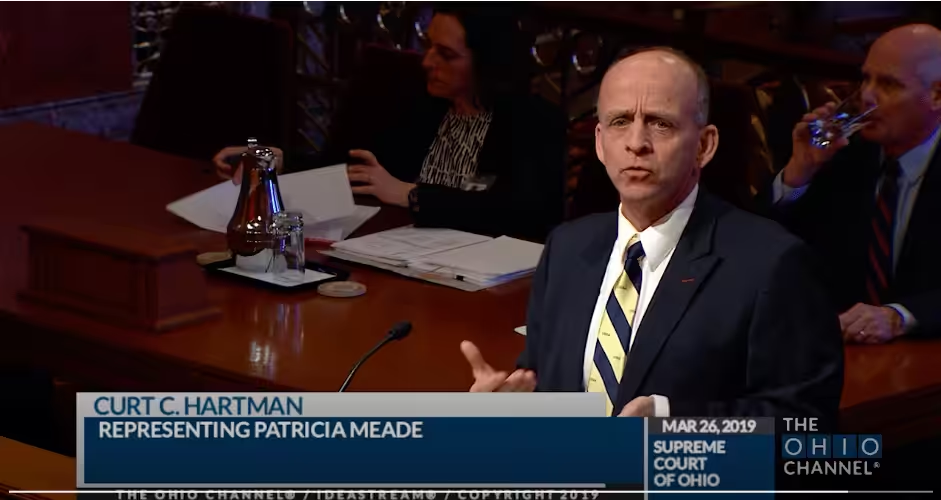
In March of this year, Mr. Hartman presented argument for the client before the seven Justices of the Court.  The City’s defenses included that (a) they can legally vote in secret and (b) because of the passage of time, the case was moot.

The Ohio Coalition for Open GovernmentThe Ohio Association of Broadcasters, and the Reporters Committee for Freedom of the Press filed an excellent amicus brief in the case.

Victory before the Ohio Supreme Court 

Today’s 7-0 decision held — something that seemed simple to this firm and our client — that it is not possible to comply with the mandate that Ohio meetings of public bodies be open, without deliberations and votes being in public as well.  They also quickly dispatched of the mootness argument.  It is a short and well-reasoned decision that firmly decides this this issue that otherwise was of first impression before the Court.

The precedent

The message for public bodies in Ohio by a series of decisions of the Ohio Supreme Court is that they mean business about openness in Ohio government.  They have ruled against public bodies trying to do end-arounds to evade Ohio’s openness requirement through deliberations by e-mails and a series of round-robin or revolving door meeting of fewer than a majority of the body.

Conclusion

We appreciate the firmness expressed by Justice DeWine and a unanimous Ohio Supreme Court demanding openness from all of Ohio’s governmental bodies.  The message should now be unmistakable for elected and appointed bodies desiring to conduct their work in secrecy.

The experience also shines a bright spotlight on the sophistication and persistence of Finney Law Firm’s litigators in the strategy, briefing and argument of this case beyond defeats at the trial court and the court of appeals.  The trial and appellate practice team we have assembled can be used to help “Make a Difference” for your own litigation challenges.

It has been an honor to represent our client Pat Meade in this important case.
The Decision

Read the full decision below:
[scribd id=421844918 key=key-BsieQbDRQkMIbo7zIke1 mode=scroll]

Our firm was recently retained to represent Stacy and Jason Hinners in a suit against the city of Huron Ohio and its council members for violating Ohio’s Open Meetings Act.

In 2017 and 2018 the city council voted during an executive session to award a Bonus and salary increase to the city manager. Ohio’s Open Meetings  Act is clear, while the council can deliberate on these issues in executive session, they can never take formal action or vote in executive session. But by authorizing a pay increase and bonus payments, that’s exactly what the Council did.

In this case in Erie County, Ohio, Hinners v City of Huron, Case No. 2019 CV 0275 the Hinners actually alerted the city to the violations and asked the city to undo the illegal payments. Instead the city informed the Hinners that the council would simply “ratify” the illegal payments.

The Hinners filed suit; and true to their word, the council voted the next day to ratify the illegal payments. But not before first arresting Mrs. Hinners on the pretext of “disrupting a public meeting” in violation of her civil rights.

Mrs. Hinners is represented by Subodh Chandra in the criminal case. You can read more about the criminal case at the Chandra Law Firm’s website.

A visiting judge has been appointed to hear the Open Meetings case, retired judge Michael Jackson formerly of the Cuyahoga County Common Pleas court. Judge Jackson has set a short schedule for the case. Trial is scheduled for February 2020.

Given that the city’s first response was to arrest our client, we expect that the city will mount an aggressive defense and we are prepared to mount an equally aggressive offense. We have already issued our first round of written discovery and anticipate deposing the council members in the next few months.

Read the Complaint below or here. And read the City’s Answer here.

[scribd id=419874630 key=key-AeIUceCLZP9RZIKCPjpA mode=scroll]

Unless you live under a mossy rock, last week you read or saw that the Finney Law Firm won a swift and important victory for our clients in an important civil rights case.

At 10 PM Monday night, our firm filed a lawsuit exposing the unlawful handcuffing, arrest and search of a black Realtor and his homebuyer by nine police officers responding to a caller falsely claiming a breaking and entering at a home for sale in Price Hill.

At the same time as the filing, Channel 19 broke the story with a detailed newscast using body cam videos from the officers showing guns drawn, handcuffing for a protracted 4-5 minutes, and an illegal search of the innocent pair.  The house was for sale and had a “for sale” sign in the yard and a lockbox providing keyed access to the home.  The Realtor properly had made an appointment for the showing and legally made entry into the home via the key provided.

Our clients, Realtor Jerry Isham and his home buyer Tony Edwards, entrusted the important case to our firm.

In addition to the constitutional violations by the responding police officers, the City had illegally destroyed seven of the body camera videos months after our firm formally requested them, in itself actionable in a law suit.

At 2:30 PM the following day, fewer than 16 hours and 30 minutes after the filing of the suit, the City settled the case for 100% of the demand of the clients, including police and Realtor training seminars on police interaction on home sales.

In this instance, the Finney Law Firm provided swift and full justice for the Plaintiffs, but also sent a message into the community about respect for the constitutional rights of African American citizens engaged in entirely lawful behavior.

You may see the Channel 19 story here and read about the settlement in the Enquirer here.

In addition to our appreciation to our clients for entrusting our firm with this case, we also thank the City Solicitor’s office and Mayor Cranley for their leadership in quickly recognizing the legitimacy of the claims and settling them.

Tonight, Channel 19 has a well-researched story by Jennifer Edwards Baker of our clients, Jerry Isham — Realtor — and his buyer Tony Edwards, innocently looking at a house in West Price Hill for possible sale, when they were rousted by eight Cincinnati Police Officers with guns drawn.  The police then illegally detained and handcuffed the pair, and illegally searched Mr. Isham’s pockets.

They had done absolutely nothing illegal; they had done absolutely nothing wrong.

It’s truly as if CPD officers have received no training on the constitutional limit on the exercise of their their policy powers.

Incidentally, CPD illegally destroyed seven of the body cam and dash cam videos of the incident after they were subject to a formal public records request from the City.

Read the Ch. 19 story here:   Lawsuit: Realtor, prospective home buyer illegally detained by CPD after retired cop calls 911.

The Fox 19 video story is here.

For more information, call Chris Finney at 513-720-2996.


In May, Finney Law Firm notched its fourth in a series of wins in class actions against point-of-sale inspection ordinances in Ohio and Kentucky.  Previous judgments or settlements have been achieved against Covington, Kentucky, Oakwood, Ohio and Portsmouth, Ohio.  Each Ohio case was co-counseled with attorney Maurice Thompson and the non-profit law firm the 1851 Center for Constitutional Law.

It seems to have become a trend for municipalities to enact ordinances that mandate municipal inspections of rental properties (interior and exterior) either before a new tenant moves in or annually and pre-sale.  Very simply, all of these ordinances are unconstitutional searches of property under the Fourth Amendment to the United States Constitution.

Maurice Thompson of the 1851 Center has proficiently developed and pursued this line of cases and the legal theory underlying each case.

Our suits have succeeded in each instance in obtaining injunctive relief against the impermissible enactment, and the class action recovers the illegally-obtained inspection fees for the property owners affected.

For more information on our public interest litigation practice, contact Christopher P. Finney at 513-943-6655.


Updated with links to recent filings below

More than three months after the open meetings lawsuit against Cincinnati’s self-proclaimed “Gang of Five” – Councilmembers Tamaya Dennard, Greg Landsman, Wendell Young, Chris Seelbach and PG Sittenfeld – there is a new development with the filing of a lawsuit against the City of Cincinnati, Binary Intelligence, and a Finney Law Firm, essentially seeking to undo Ohio’s public records laws.

Bizarrely, the case is brought by two “John Does” in an effort to conceal their identities, but whom allege their communications with members of the Gang of Five have been produced in response to public records requests coming since the resolution of the Finney Law Firm suit, and a public records suit won by Angenette Levy and Channel 12. The Levy lawsuit provided a judicial declaration that there is no practical difference between text messages and emails in the context of public records law, and that the fact that a communication is made from or stored on a personal device does not mean that the communication is not a record under Ohio law. Read the text messages released in response to Angenette Levy’s suit here.

The John Does seek to enjoin the City from maintaining its file of communications to and from the Gang of Five and to force Finney Law Firm to destroy the public records he has obtained from the City in response to requests he has made on behalf of clients.

A hearing on the Plaintiffs’ motion for a temporary restraining order is scheduled for Tuesday, July 2 at 3 pm before Judge Michael Barrett.

Media Roundup:

Channel 12’s story is here.

Cincinnati Enquirer coverage is here.

Channel 9’s coverage is here.

Channel 19’s coverage is here.

The City’s memo in opp to the motion for a temporary restraining order is here, Exhibits A-E are here, here, here, here, and here.


[scribd id=415030882 key=key-aBcXlVnsaTxHkdQBzGFx mode=scroll]


Perry Township in Montgomery County, Ohio, has been in the news recently regarding a mass resignation of police officers and the controversial hiring of a new police chief.

One concerned citizen contacted our office after she felt township officials were attempting to intimidate her when she sought information and spoke out against the hiring.

Bonnie Bertelson

In March, we submitted requests to the trustees and the fiscal officer for copies of their communications regarding the mass resignation of police officers and the hiring of chief Tim Littleton. In the weeks since we submitted the request, the township has failed to even acknowledge the requests. Our suit seeks an order compelling production of the records.

We expect that the records will show that a substantial amount of the deliberations about the hiring of the police chief occurred via email and text message and otherwise outside of meetings open to the public.

The mass resignation and hiring has been the subject of news reports in the Dayton Daily News and by Fox45.  A sampling of that coverage is available here,  here, and here.

The case, styled State ex rel. Bonnie Bertelson v. Perry Township, has been filed in the Montgomery County Common Pleas Court. Read the Complaint below or here.

We are particularly concerned about the efforts of certain trustees to intimidate our client and silence criticism of their actions. As Hamilton County Common Pleas Judge Robert Ruehlman recently noted, too often elected officials think they are “self-employed” and forget that, in fact, they work for the people. We intend to make sure the Perry Township Trustees take this lesson to heart.

[scribd id=406607613 key=key-FbFxE6pKT204Rm4iQ3Zu mode=scroll]

A Finney Law Firm attorney  filed suit on Thursday against the Columbus Ohio Historic Resources Commission, seeking to enjoin violations of Ohio’s Open Meetings Act.

The Commission routinely fails to create minutes of its meetings and has failed to locate audio recordings of its meetings.

Our client is a Columbus resident whose efforts to navigate through the Commission’s Byzantine permitting regime have been hamstrung by the inability to review minutes of past Commission meetings.

Read the complaint below:

[scribd id=403531067 key=key-zq6eaudtynjudWABGXrI mode=scroll]

Pursuant to the Agreed Entry and Order by Judge Ruehlman, Cincinnati Councilmembers Tamaya Dennard, Greg Landsman, Chris Seelbach, PG Sittenfeld, and Wendell Young – the self-proclaimed “Gang of Five” turned over emails between them.

What stands out is the substantial amount of public business being discussed and conducted in secret emails using private accounts rather than their city provided email accounts. We can only be so certain that we have in fact received all of the emails. As we know that Wendell Young deleted his text messages, we may never truly know whether the Gang of Five has turned over everything or not.

Read below or Use this dropbox link

[scribd id=403386369 key=key-VaOUJyWGyFAA09j3rQmy mode=scroll]