Over the weekend, I spoke with about a dozen 1099 or business-owner clients who (a) either still did not know about the Paycheck Protection Program or (b) did not intend to apply for various reasons.  Some discussion of that.

  1. If you don’t know about the program, educate yourself. It is broad and generous. It encompasses almost every sole proprietor, 1099 contractor and business owner in the nation.  Read about it generally here and watch this webinar for employers with W-2 employees and this webinar aimed primarily at sole proprietors and 1099 contractors.
  2. Do I have to suffer closure or severe economic damage under the COVID-19 crisis  to be eligible? No. This program makes virtually no distinction between those severely impacted and those still operating “normally.” You do need to certify some impact from the COVID-19 crisis.
  3. Isn’t this just another SBA loan program with lots of paperwork and loan fees? No, not at all.  (a) First, it is a “forgivable loan.” (b) The primary condition is that you must continue to employ your employees for 8 weeks (or call them back if you already laid them off) after the loan is made. (c) If you meet that and a few other simple conditions, the “loan” becomes a grant. (d) It is east to apply. (e) There are no fees. (f) There is no loan guarantee.  (g) Even creditworthiness is not considered. This program is designed quickly to get cash into the hands of businesspersons so they can maintain their payroll and avoid bankruptcy.
  4. How do I apply? Call your bank.  If you need more help, contact Rebecca L. Simpson of our office (513.797.2856).  Candidly, it is fairly easy and straightforward.
  5. But I read the program already is out of money? Yes, this is true, but it appears likely that Congress is poised to authorize another $300 billion this week.  Our view is the program will be fully funded until every eligible business which applies has been funded.
  6. Does the program apply to churches and other non-profits?  The program does have special rules for churches, but it generally applies to all 501-C3s and C-19s (veterans organizations).
  7. I don’t need the money; let someone else in need have the funds. This is certainly a justification for not applying, just so you have thought this through for yourself and your business.  When this program is gone, we see it as highly unlikely it will be renewed on such generous terms.

Every businessperson has their hands full right now, navigating the shoals of uncertainty and change the COVID crisis has presented, but this program almost certainly is well worth your time and attention.

Rebecca L. Simpson

This morning, Finney Law Firm attorney Rebecca L. Simpson conducted a seminar hosted by the Cincinnati Area Board of Realtors on the Paycheck Protection Plan. A hearty thanks to Christy Beaver for pulling together this program.

This morning’s seminar focuses on how Realtors can qualify and apply for the program.

It is posted here.

This seminar comes on the heels of another seminar hosted by Empower U about the Paycheck Protection Program focusing on employers with W-2 employees.

A link to that previous webinar is here.

Please contact Rebecca L. Simpson (513.797.2856) if you need assistance with the PPP program.

Attorney Christopher P. Finney

Today, Finney Law Firm and the 1851 Center for Constitutional Law filed suit in Federal District Court in Columbus, Ohio to enjoin the mandatory “stay at home” orders of the Ohio Department of Health.  Named as a Defendant in the action Dr. Amy Acton in her official capacity as Director of the Ohio Department of Health.

The Plaintiff, Tanya Rutner Hartman, owner of Gilded Social: The Fancy Occasion Shop, a Columbus bridal shop, alleges that the official orders of Dr. Acton fail to have any meaningful due process protections built in for a fair hearing to determine what is an “essential” business and can stay open while the state imposes restrictions to prevent further spread of the virus.

The case has been assigned to Chief Federal District Court Judge Algenon L. Marbley for the Southern District of Ohio, sitting in Columbus. He has ordered the State of Ohio to brief the matter by 5 PM Friday, April 17, 2020 (tomorrow) and will hold a telephonic hearing Monday at 10 AM.  He has promised a decision by Wednesday, April 22, 2020.

A copy of the Complaint is here.

The news release from the 1851 Center is here.

A Cleveland.Com story on the case is here.

For more information, contact Maurice Thompson of the 1851 Center for Constitutional law  or Christopher Finney (513.943.6655).


The stated desire of Congress and the Administration in the Paycheck Protection Program (“PPP”) has been to get money into the hands of business owners — and keep workers off the unemployment line — absolutely as quickly as possible.

But that hasn’t prevented the endless delays and bickering between the democrat House and the GOP Senate in getting full appropriation for the program approved.

Read here that the Small Business Administration website now reads that it is “unable to accept new applications for the Paycheck Protection Program based on available appropriations funding. Similarly, we are unable to enroll new PPP lenders at this time.”

Watch this blog for further updates and contact Rebecca L. Simpson (513.797.2856) for more information on this program.  She is keeping updated on the rules and the daily developments.

As part of our property valuation work, we have received calls from property owners in Ohio and Kentucky asking how the affects of COVID-19 will come into play in property valuation challenges brought this year.

Effective (or target) date of valuation challenge

As an initial matter it is important to know the valuation date at issue. In Ohio, the “tax lien date” is always one year in arrears, so a challenge that is brought this year is actually challenging the value of the property as of January 1, 2019. In Kentucky, the tax lien date is current, so a challenge filed this year is challenging the value as of January 1, 2020.

Timing of when to file a valuation challenge

Because the valuation is as a specific point in time, it is important to consider what was affecting value on that specific date. When hiring an appraiser for a BOR (Board of Revision) in Ohio, or PVA (Property Valuation Administrator) in Kentucky, the appraiser gives her opinion of value as of the tax lien date. So, for instance, if the overall market takes a tumble in March, that would typically not affect the value of a property two month’s earlier. But may suggest that the values were already heading downward in January.

Thus, a hotel or restaurant property owner contemplating a challenge in Kentucky based upon the drop in income due to the COVID-19 virus and the stay at home order, is unlikely to see much weight given to the effects of COVID-19. That said, comparable sales in the past few months (which may reflect the effect of COVID-19 on the real estate market may have some evidentiary weight worth presenting to the PVA.

A challenge next year may be more successful than this year in Kentucky.

For Ohio property owners, COVID-19 is less relevant this year. This is because, as discussed above, the relevant tax lien date is January 1, 2019. As with Kentucky challenges, comparable sales in the past few months can be used as evidence of the value as of January 1, 2019, although the BOR will likely give such sales less weight than sales closer to the tax lien date.

In Ohio, only one challenge per three-year cycle

In Ohio the county auditors revalue properties every three years (the “triennial”). For Hamilton and Clermont Counties 2019 is the last year of the triennial. A new triennial will start with the 1/1/2020 value determined later this year by the County Auditors. In Warren County, the last year of the triennial is 2020 – meaning that the Warren County Auditor will determine a new three year value as of 1/1/2021.  As a general rule, property owners may only file one challenge per triennial (R.C. 5715.19(A)(2)). So a cautious approach me be the better approach.

If you’ve already filed a challenge in Ohio, it is worth a shot to raise the issue of COVID-19, but as discussed above, it may fall on deaf ears. For Hamilton County property owners, the best bet may be to wait until 2022 to file for the value as of 1/1/2021. For Warren County property owners, a better approach may be to file next year challenging the value as of 1/1/2020 (this may be a futile effort), but you will be able to refile again in 2022.

Legislative change?

The Ohio legislature is working on multiple bills in rapid succession to stabilize the economy and prevent economic hardship to businesses and property owners.  Perhaps this will be one area where the inequity of January 1 versus April 1, 2020 property values will be addressed.

Thus, in light of the spate of COVID-19 relief acts, it would not be surprising to see the state legislatures act to provide property tax relief with a 4/1/20 or 5/1/20 effective or target date for 2021 valuation challenges.  We will keep an eye on the legislatures in Ohio and Kentucky and update our blog as we learn more.

Conclusion

Ultimately, property owners should temper their expectations that the BOR or PVA will recognize the effects of COVID-19 on property values in this year’s challenges.

Hopefully the financial effects of COVID-19 will not be long-lasting. But if they are, it may be a better basis for a valuation challenge in 2021 or even 2022 (for an effective date after the COVID crisis broke out).

Contact Christopher P. Finney  (513-943-6655) for assistance with your property valuation challenge.

Attorney Rebecca L. Simpson

Some of the most common questions about the Paycheck Protection Program (PPP) over the last couple of weeks have been how it applies to those who are self-employed and/or receive 1099 income.  The Small Business Administration (SBA) has now issued an “Interim Final Rule” addressing many of these questions.  Here are some highlights:

Eligibility

Those who have income from self-employment and file a Form 1040, Schedule C for tax purposes are eligible for the PPP if:

  1. You were in operation on February 1, 2020;
  2. You are an individual with self-employment income (such as an independent contractor or sole proprietor);
  3. Your principal place of residence is in the United States; and
  4. You filed or will file a form 1040 Schedule C for 2019.

One exception applies to partnerships and LLCs filing taxes as a partnership. In general, the partnership must file for the PPP rather than the individual partners.

Calculation of Maximum PPP Loan

  • If you have no employees, in general, your maximum loan amount will be 2.5 times your average monthly net profit, which is calculated using the amount on your 2019 IRS Form 1040 Schedule C Line 31 (the Line 31 amount is capped at $100,000)
  • If you have employees, you will also add in eligible amounts of your W2 payroll to employees in calculating your maximum loan amount
  • If you received and Economic Injury Disaster Loan (EIDL) between January 31, 2020 and April 3, 2020 that may impact your loan amount as well.

Forgiveness of PPP

The rules with respect to how self-employed individuals and independent contractors must spend the funds are similar to the rules for small businesses with one significant exception.  The amount that self-employed and independent contractors can spend on “payroll” for themselves (meaning net profits in their case) is capped at an amount equal to eight weeks worth of net profit (8/52 of 2019 net profits).

Conclusion

This new SBA Interim Final Rule also indicates the SBA will issue further guidance for individual with self-employment income who were not in operation in 2019, but who were in operation on February 15, 2020.

The Finney Law Firm will continue to post updates on the PPP.  If you have questions or need help with your particular situation, please feel free to contact Rebecca L. Simpson (513.797.2856).

In a news release yesterday, Ohio Attorney General David Yost warned creditors that CARES Act checks are protected by Ohio state law.

“The stimulus checks were intended to be used during an emergency – to put food on the table, keep the lights on, and a roof over our heads,” Yost said. “It wasn’t meant to pay off an old bill.”

The law to which Yost is referring is Ohio Revised Code Section 2329.66 which exempts property from “execution, garnishment, attachment, or sale to satisfy a judgment or order” under certain circumstances including:

A payment in compensation for loss of future earnings of the person or an individual of whom the person is or was a dependent, to the extent reasonably necessary for the support of the debtor and any of the debtor’s dependents.

ORC Section 2329.66(A)(12)(d).

Ohio Attorney General Yost also posted a NOTICE OF APPLICAPBILITY OF STATE LAW EXEMPTION TO PAYMENTS UNDER THE FEDERAL CARES ACT on his website, which can be found here.  According to the Notice:

The payments under the CARES Act are in the nature of emergency support, designed to support basic needs of tens of millions of Americans. This is why debts owed to the Federal and State governments are not being withheld from the payments. Although there is no explicit exemption for CARES Act payments under federal law, Ohio law protects them.

In his notice, Yost indicates that the State of Ohio is reserving the right to enforce this state law against creditors who try to collect against these CARES Act checks.

Watch our blog for more updates, and feel free to contact Rebecca L. Simpson (513.797.2856) for more information.

Introduction

You may want to a use trusts for a multitude of reasons, including, but not limited to, avoiding probate, maintaining control of assets after death, and tax minimization. One of the more crucial reasons for you to use a trust is to allow for flexible property management.  The use of a trust to manage property is prudent when there are laws and regulations in place that limit the ownership, sale, and transfers of that property. This holds especially true when dealing with firearms. This post will discuss (a) some of the issues that the use of firearm trusts may address; (b) the relevant laws and regulations surrounding firearms; (c) what a firearm trust is; and (d) recommendations for planning for an estate that includes firearms.

What Issues Can Firearm Trusts Address?

Probate administration is an invasive process where the court makes much of your family’s private information public.  The types and values of the guns subject to probate administration are part of the public record.  Furthermore, if your firearms are part of the probate estate, then the parties receiving the firearms will be reflected in the public.  Often, this information is available online.  If you create a firearm trust, you can avoid the specifics of your firearm collection from becoming public knowledge and the recipients of the same.

Control of your firearms after death may be important considering the felonious implications of certain criminals and non-citizens possessing certain firearms. Those implications may make it difficult for you to legally transfer certain firearms to your heirs and beneficiaries, particularly when you do not know everything about their pasts. By creating a firearm trust, you can address that uncertainty.

In that same vein, under the current laws and regulations surrounding firearms, you may avoid certain regulatory requirements for the transfer of firearms at your death by putting your firearms into a firearm trust. For example, a transfer tax associated with the transfer of certain firearms may be avoided.

Generally, outright possession of a firearm limits possession to single individuals. However, if you create a firearm trust, one of the many results is flexibility of ownership. For example, if you name multiple co-trustees to the firearm trust, then those co-trustees may each enjoy the use of the firearms in the firearm trust. By knowing the laws and regulations, a competent estate planner should be able to take advantage of the many benefits provided by firearm trusts.

What Are the Laws and Regulations Surrounding Firearms?

There are many laws and regulations regarding firearms in the United States.  Generally, in accordance with the principles of federalism, states pass their own laws and regulations regarding firearms.  However, the federal government has its own firearm laws and regulations, including, but not limited to, the Gun Control Act of 1968 (the “GCA”); the National Firearms Action of 1934 (the “NFA”); and the various regulations implemented by the Bureau of Alcohol, Tobacco, Firearms, and Explosives (the “ATF”).

Congress passed the GCA in response to the assassinations of John F. Kennedy and Dr. Martin Luther King Jr.  The GCA is composed of Title I and Title II.  Title I of the GCA addresses most firearms in the United States, including shotguns, rifles, and handguns.  Despite being under the GCA, Title I Firearms are not largely regulated by the federal government, unless those Title I Firearms enter interstate commerce.

The federal government’s abilities to regulate Title I Firearms in interstate commerce are addressed in Bezet v. United States, 714 F. App’x 336 (5th Cir. 2017). The Bezet Court found that the federal government may regulate, through the Commerce Clause, the importation of certain firearms and ammunition, and the use of certain imported parts in the assembling of firearms.  Furthermore, in Bezet, the GCA withstood intermediate scrutiny because Congress enacted the provision of issues with the important government objective of “buttress[ing] states’ individual efforts to curb crime and violence” through a “comprehensive national response.”  Using the same logic, the Bezet Court found that the federal government did not infringe on any Second Amendment rights because the law did not completely prevent consumers from obtaining firearms. The consumers merely had to overcome certain hurdles.  So, while the GCA may not impose many federal restrictions on firearms, it still has teeth.

Title II of the GCA “revises and incorporates provisions of the original NFA,” which Congress passed, under the Taxing Powers, in response to the organized criminal activity of the early twentieth century.  In its original form, the NFA governed the possession and sale of certain firearms and taxed the manufacturing and sale of said firearms.  The firearms regulated under the NFA were, and still are, accounted for under Title II of the GCA.  Consequently, the firearms that fall under Title II of the GCA (i.e., machine guns, short-barreled rifles, short-barreled shotguns, suppressors, and other destructive devices) have been deemed “Title II Firearms.”

The original NFA regulations on the manufacturing and transferring of Title II Firearms included requirements like (a) filing an application with the ATF; (b) paying a $200 stamp tax; (c) providing fingerprints; (d) providing photographs; (e) undergoing background checks; and (f) seeking approval from a Chief Law Enforcement Officer (“CLEO”).  Some of these original regulations did not apply to trusts, so estate planners and their clients started using the “Firearm Trust Loophole” as means to circumvent some of the NFA’s regulations. For example, estate planners and their clients used firearm trusts to bypass the fingerprinting and CLEO approval requirements. In lieu of those regulatory requirements, the ATF tasked the federal government with the job of verifying and investigating applications. The abuse of the Firearm Trust Loophole came to a head in 2013 to 2014, where trustees and officers of other entities filed over 160,000 Title II Firearm applications, none of which were subject to the close scrutiny imposed on individuals by the ATF.  In response to this, The ATF closed the Firearm Trust Loophole by implementing Rule 41F, in 2016.

The ATF does many things regarding the federal regulation of firearms.  For example, the ATF provides guidance as to which types of firearms will fall under the NFA.  Likewise, the ATF helps to enforce various federal firearm regulations. However, one of the more critical roles of the ATF is to create federal firearm regulation through notice and comment rulemaking, as seen with Rule 41F.

The ATF’s reasoning for Rule 41F was “to ensure that the identification and background check requirements apply equally to individuals, trusts, and legal entities who apply to make or receive NFA firearms.”  In that spirit, Rule 41F changed the NFA in multiple ways.  Rule 41F added the term “Responsible Persons” to broadly encompass entities that were not covered under the original NFA. Responsible Persons specifically refers to partnerships, associations, companies, corporations, and trusts.  Furthermore, Rule 41F did away with the requirement that a CLEO had to sign off on the manufacture and acquisition of Title II Firearms.  However, Rule 41F did not entirely remove CLEOs from the picture, in that Responsible Persons, who are attempting to transfer Title II Firearms, must forward an application to a CLEO in the Responsible Persons’ domicile.  In addition to those changes, the ATF created Section 479.90a of Rule 41F to regulate the unplanned possession and distribution of Title II Firearms at the owner’s death.

What is a Firearm Trust?

A firearm trust is just what it sounds like, a trust used to legally transfer and possess firearms, and avoid regulatory requirements to that effect.  Firearm trusts can be used to ensure privacy, create situations where multiple beneficiaries may use the trust firearms, and ensure that firearms do not fall into the wrong hands.  Despite their continued utility, firearm trusts were once special compared to other trusts in that they were considered separate entities from the trustees and the beneficiaries. However, this became less true when the ATF passed Rule 41F.

Currently, trusts are bound by the regulatory requirements regarding the acquisition, ownership, and transfer of Title II Firearms. That being the case, it is important, now more than ever, for your estate planner to understand the relevant firearm laws and regulations that may surround your firearms, and how to draft an estate plan accordingly.

How Should Your Estate Planner Draft a Trust for Your Firearms?

Because of the laws and regulations surrounding firearms, there are certain things you should consider when creating a firearm trust, including, but not limited to, the type of trust, the language in the trust, the trustees and their powers, and the beneficiaries of the trust.

Regarding the type of trust used, you should consider creating a revocable inter vivos trust. Regarding the firearm trust language, your estate planner should use terms that reference the specific firearms you own and the applicable federal and state firearm laws and regulations. Likewise, the estate planner should use language that makes clear your intent to comply with said laws and regulations. To allow for the most utility, the language of the firearm trust should ensure that the firearm trust is a stand-alone trust, not one incorporated by another trust.

Regarding naming a trustee for the firearm trust, as with any other trust, there are factors to consider.  First, if dealing with a revocable inter vivos trust, you should consider naming yourself as a trustee, or co-trustee, which would allow you to benefit from the use of the trust firearms during your lifetime. Second, the trustee and the successors should be individuals who are legally capable of owning firearms (i.e., non-felons and citizens who have not renounced their citizenship).  Third, you and your estate planner should consider the possibility that a trustee, who is eligible at the time the estate planner drafts your firearm trust, may later become ineligible. To remedy that issue, your estate planner should draft a provision that outlines the appropriate course of action to deal with said situation.  Those provisions might take the form of treating an ineligible successor trustee as predeceasing a successor trustee, or a trust protector provision that allows an individual to elect eligible successor trustees.

Regarding the trustee’s powers, you and your estate planner should grant the trustee broad powers.  The broad powers should ensure that the trustee can fill out the requisite transfer forms, be reimbursed for costs that the trustee incurs while owning and transferring firearms, and have discretion regarding if, and when, the trustee must transfer firearms to beneficiaries.

Regarding naming beneficiaries, you should name eligible beneficiaries. Likewise, you and your estate planner should come up with an alternate plan of disposition to address situations where a beneficiary might later become ineligible to legally own certain firearms.  That may be done by providing a charitable remainder to certain entities that can possess and dispose of the firearms correctly.  Alternatively, you could decide to leave the firearms in further trust for other beneficiaries or dissolve the trust and distribute the firearms outright.


Conclusion

The creation of a firearm trust is a responsible thing for you to do. However, if you do not plan for the disposition of your firearms, the executor of your estate is not going to be entirely without direction. The ATF created Section 479.90a of Rule 41F to guide executors of estates through the disposition of Title II firearms in unplanned estates.

Section 479.90a provides that an executor of an estate may possess a decedent’s registered firearms but must apply to transfer the firearms to the decedent’s heirs before the close of probate.  In said application, the executor must, among other things, name the estate as the transferor and sign on behalf of the decedent. To avoid having to deal with uncertainty and regulatory red tape associated with unplanned estates and Section 479.90a, please feel free to contact the Finney Law Firm.

Please contact Isaac Heintz (513.943.6654) or Jennings Kleeman (513.797.2858) to discuss your estate planning needs.




Jane Schulte

There have been numerous articles written about Remote Online Notarization (or RON) in the past few months, surrounding the Covid-19 pandemic, and the real estate industry’s need to perform work digitally to ensure that sales, purchases and refinances can occur during the social distancing orders currently in place.

However, there has been some confusion surrounding terminology and differences in digital closings, and we are writing this article is to provide some clarity.

E-closing

An e-Closing or electronic closing is a mortgage closing in which all the documents are created, accessed, presented, signed, notarized and recorded electronically. They remain in their digital form and nothing is printed out. An e-Closing is conducted with the signor(s) and Notary in each other’s physical presence, thus not accomplishing the objective of full separation of the notary/closer and the parties.

Hybrid closing

A hybrid closing is the same as an e-Closing except that the Promissory Note is papered out and wet-signed (sometimes along with the mortgage), so again the procedure does not accomplish the objective of physical separation.

Remote Online Notarization (RON)

A RON closing, on the other hand, uses an e-Notary to perform notarial acts when the signor is not in the same physical location as the notary.  The signor appears before an e-Notary in a live, recorded two-way audio/visual conference where identification is verified with a photo ID along with knowledge-based authentication technology.  A platform such as DocVerify, provides a tamper-evident seal and uses encryption and multi-layered security to prevent fraud.

Conclusion

Ivy Pointe Title is pleased to announce that it has an in-house e-Notary to provide these services for cash, lender and refinance real estate transactions.  Craig Donohoe, our in-house closer, is now able to perform RON closings for any lender, realtor, borrower or seller who would like the opportunity to sign their documents in the comfort of their homes or businesses, not only to avoid social contact at this time, but also in the future for convenience, speed and efficiency that has not previously existed in our industry.  We also have a second dedicated outside e-notary, Ted Dahmus, who is committed to priority e-closings for Ivy Pointe Title.

For more information on how to place your RON title and closing order, please contact Rick Turner (513.943.5660).


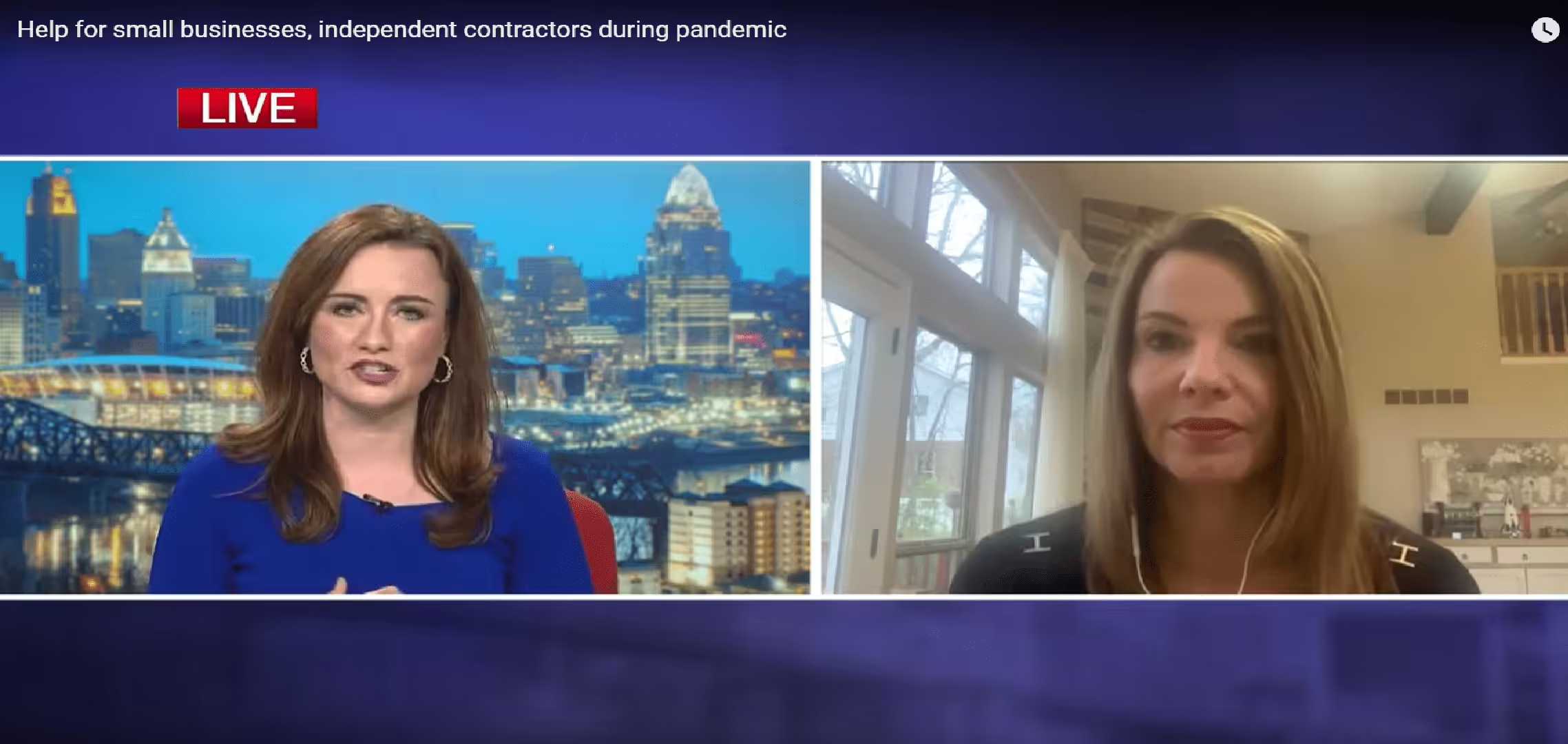
This morning, Finney Law Firm attorney Rebecca L. Simpson appeared live with anchor Angenette Levy on Local 12 to discuss the latest developments with the Paycheck Protection Program.

You may watch the link here.

Attorney Rebecca L. Simpson has been our point person inside Finney Law Firm to research and keep updated on the PPP and to advise clients on the intricacies of how to access Paycheck Protection Program funds for their small businesses each step of the way.  She has already led three webinars on the topic, with two more to come this week.

Contact Rebecca L. Simpson (513-797-2856) for assistance with the program.