The Finney Law Firm is pleased to announce the addition of three new attorneys to our transactional practice group, focusing on real estate, estate planning and corporate law:


FLF_DylanSizemore_5x7_lowW. Z. “Dylan” Sizemore
Dylan is a 2014 graduate of the University of Cincinnati College of Law, where he was awarded the Tyler Short Award for Entrepreneurial Excellence.

He earned his bachelor’s degree from the University of Kentucky, Summa Cum Laude. Dylan is an Iraq War Veteran, having served as Company Commander and platoon leader. Dylan’s practice will focus on real estate and corporate law.  Read more >


FLF_JulieMGugino_lowJulie M. Gugino
Julie is a 2001 cum laude graduate of Salmon P. Chase College of Law and a 1995 graduate of the University of Cincinnati, Summa Cum Laude.

Julie has extensive experience in all three practice areas of our firm, transactions, litigation and public interest litigation.  Julie re-joins our team after seven years apart. Julie’s practice will focus on real estate and real estate-based litigation.  Read more >


FLF_PaulSian_5x7_lowPaul S. Sian
Paul is a 1997 graduate of the University of Detroit School of Law and earned his MBA from Wayne State University in 2001.

Paul previously worked as a tax law specialist for the IRS and as a Claims Judge Advocate for the U.S. Army Reserve.  He is licensed in Ohio and Michigan. Paul has joined the firm “of counsel” and his practice will focus on real estate and estate planning law. Read more >


We are pleased to expand the services we provide with these three new professionals.  Let us know how we can help you seize a business opportunity or unravel a litigation knot.

Finney Law Firm (“FLF”) is hiring for a litigation paralegal position based in its Eastgate office. The position will work closely with FLF attorneys during all phases of the litigation process, from client retention and case initiation through trial, post-trial, and appeals.

Essential job functions:

  • Assist attorneys with case related and new client calls
  • Maintain calendar of deadlines, hearings, depositions, and other case related appointments
  • Organize and maintain case documents
  • Assist attorneys with case law and local rule research
  • Assist attorneys with preparation, filing, and service of various case pleadings upon opposing parties
  • Assist attorneys with the gathering and preparation of documents for deposition and trial

In order to provide top-level attorney support and client services, the following are also required job functions:

  • Assist in answering of firm calls and routing of same to appropriate persons of the firm
  • Assist in greeting firm guests upon arrival
  • Work with attorneys and the firm’s accounting department on new matter set up and invoicing
  • Assist the Director of Administration with operational needs as requested

Position Qualifications:

  • Possession of a Bachelor’s degree (or paralegal certification) and at least 2 years of paralegal experience
  • Proven organizational skills
  • Excellent attention to detail
  • Proficient in Microsoft Office products and Westlaw
  • Ability to communicate and interact professionally with attorneys, clients, court representatives, and other interested parties

Interested applicants may submit their cover letter and resume to Anna Ausman at Anna@FinneyLawFirm.com.

This article from the National Association of Realtors explores some of the means by which cybercrime is hitting real estate transactions.

Finney Law Firm, LLC and Ivy Pointe Title, LLC are equipped with the latest technology, tools and standards required by the CFPB to assure secure transactions, but…you can never be too careful.

Read and implement these NAR tips to make sure you and your clients and customers are not victims!

Realtors have amazing new tools at their fingertips almost daily with emerging web sites and smart phone apps.  Still, we are impressed with the new web site and mobile app of the Hamilton County Auditor.

HamiltonCountyAuditor.org  has a smart new interface and valuable tools for Realtors, including:

  • Property search, which quickly allows you to access property description, auditor’s valuation, tax information and sales history.
  • Detailed instructions for property valuation complaints.
  • On-line forms such as the CAUV form, rental registration form, and a Homestead exemption form.
  • A calculator that estimates the impact of upcoming tax levies on your property’s taxes.
  • Streetview photos and aerial/CAGIS imaging of the property.

Dusty Rhodes also has a nifty mobile phone app available both for I-Phones and Android phones that allows for limited information under the property search function such as Auditor’s valuation, sales history and streetview and aerial images of the property.

We recommend that every Realtor, commercial and residential, load the mobile app to their phone.  It is a powerful tool.


We are proud to act as local counsel in the case Nor Cal. Tea Party v. IRS before Judge Susan J. Dlott.  We write here that last month Judge Dlott certified the matter as a class action, an important development in a very important piece of litigation.

Here, Forbes Magazine’s Peter J. Reilly writes on the litigation.  He takes a decidedly conspiratorial and liberal bent against the Plaintiffs in the matter, alleging dark money connections and “weaponization of non-profits,” a new favorite accusation from left-leaning pundits.

He concludes:

At least for the upcoming election cycle, they have pretty well defanged the IRS, but it may be that this litigation is meant to be part of stomping on it and grinding it into the dust.


Every parcel of real property in Ohio undergoes a major “reappraisal” by the County Auditor’s office every six years and then a minor “update” in the three years in the middle of that six-year cycle.  Different counties in Ohio are on a different six year and three year cycle.

Below are listed the counties that went through a major “Reappraisal” in 2015 (that new value first appearing on the January 2016 tax bill) and a minor “update” in 2015 (that new value also first appearing on the January 2016 tax bill).

The other thing important about the valuation cycle is that regardless of whether another tax complaint was brought previously, every property owner has the right to challenge his property’s assessment before the Board of Revision in the new triennial.

The schedule of counties starting a new triennial this year follows:

2015 Reappraisal Counties

Allen

Coshocton

Guernsey

Sandusky

Vinton

2015 Update Counties

Belmont

Brown

Crawford

Cuyahoga (Cleveland)

Erie

Fayette

Highland

Huron

Jefferson

Lake

Lorain

Lucas (Toledo)

Morgan

Muskingum

Ottawa

Portage

Stark

Warren

Williams

If you want our assistance with a property valuation challenge, call Anna Ausman at 513-943-6651.

why you need an LLC

Why Do You Need An LLC?

There may come a time when small business owners are confronted with the question of why do you need an LLC (also known as Limited Liability Company)? Is there something special that an LLC can provide to business owners that would nudge them towards getting an LLC versus operating on their own without any type of business operating form?   The biggest benefit to be had with an LLC is that of protecting ones’ personal assets from a debt or legal liability which may arise out of the business activities.

Like a corporation an LLC is a legal designation for your business. An LLC can be run by a solo business owner, as a partnership amongst different people or can even be owned by other corporations or other LLCs. An LLC provides the limited legal liability similar to what corporations have but offers the flexibility tax wise to be treated as a partnership or as a sole business owner. The federal government and most states don’t treat an LLC as a separate entity for tax purposes as a corporation is normally treated.   (For more information see https://www.sba.gov/content/limited-liability-company-llc)

The primary benefit for the LLC as mentioned above is shielding your personal assets from legal liability for a possible wrong committed by you or one of your employees while operating the business. Say for instance you run a food based business where you prepare meals for others to purchase. If someone was to get sick after eating your food and blamed you for the illness (whether your food was the cause of the illness does not really prevent someone from suing you if they believe otherwise), they could sue you for any injury suffered as a result of the food poisoning. On the basic and not very expensive side a claim could request something basic as paying for lost work days as well as some compensation for pain and suffering. At the extreme end if a person required extensive hospitalization due to the food poisoning or death was a result, those claims in the lawsuit could be quite large and therefore expensive.

Where a lawsuit resulted in an costly claim against you and you don’t have limited liability company protection, the person suing you could seek recovery by going after your home, your cars, your savings, your kids college funds, retirement accounts and more. Even where some of your assets may be protected by state laws (homestead exemption for your home, retirement plan exemptions) the liability amount you owe does not go away unless you file for bankruptcy. What once started out as a business to help you make extra money has now become a liability that affects the money and assets you personally own. Having an LLC can limit your liability to just those of the business assets in the event of a lawsuit.

Types of Businesses Where You Would Want an LLC

As noted above a food based business in one to definitely consider having an LLC, as it is advantageous to protect your personal assets from any legal issues coming from operating that type of business. There are also plenty of other types of businesses to consider the LLC for and in fact you may want an LLC for just Food businesses need an LLCabout any type of business you run in order to have that added layer of protection. Businesses where you interact with people on a daily basis is a perfect example of where the LLC protection can come in handy.

One example of a business with regular interactions with people include cosmetic type businesses where you are applying makeup, creams, hair treatments and more on your paying customer. If someone were to have an allergic reaction to a hair dye that causes them to lose hair or suffer some sort of rash a lawsuit could be an end result. You can have all the signed disclaimers/waivers in the world to try and protect you, but if it is shown you are in some way negligent those disclaimers will not protect you.

Another business example where LLC protection is great to have is where you are driving people around or delivering products for pay.   In this case if someone were to get injured while you are driving them around or delivering something (i.e driving for Uber, Lyft or some other ride sharing company) you may be on the hook personally for any injuries suffered. While some of the ride sharing companies have insurance to cover your passengers (and maybe even cover you) they also are hoping your primary insurance covers any damage or injuries first and they will come in second to cover any claims.  A problem that could arise is your own insurance company denies coverage to you and any fare paying passengers since you did not disclose to the insurance company that you are transporting passengers in your car for pay.

Insurance and ride sharing is a complex topic that I will cover more in depth in a future article, but for purposes of this LLC article just know that if you don’t tell your insurance company that you are transporting people for pay they could deny any claims for injuries or damage resulting from your “business”. If your insurance company won’t pay, and the ride sharing company pays for only part of the claim or decides not to pay anything at all, your personal assets are at greater risk than if you had LLC protection.

How The LLC is Run is Also Important 

Properly managing and operating the LLC is also critical. If the only thing you do is fill out the LLC paperwork, send it in to your local state business authority and nothing else, you will have little to no protection for personal assets in a lawsuit. With an LLC you must keep your personal and business assets separate. That means separate bank accounts, keeping separate your business expenses from your personal expenses, separate financial records and more. If you fail to keep the LLC separate from your personal assets a judge can find that you are not operating a true LLC business thus opening up your personal assets to be used to cover any damages you may pay to settle a lawsuit.

Having insurance for you and your business is also always advisable. When talking to your insurance company you should ask them about their umbrella policy option. Make sure you inform the insurance company about what your business does and the fact that you have an LLC that needs to be covered under the umbrella. Umbrella insurance policies are good to have since like an umbrella they provide good insurance coverage for you personally and for your business activities for many different types of claims that don’t necessarily fall under your homeowners or auto insurance policies.

For tax purposes, depending on the type of LLC you have setup and how you want to run your business there may be little to moderate change come tax filing season. Ultimately the profits you earn from running your business get reported on your tax returns. Doing the tax portion correctly and using all the correct forms is one piece of evidence that shows your LLC is indeed a true business. As with anything tax related it is always best to consult with a Certified Public Account or other tax professional who specializes in helping small businesses.

Final Thoughts on LLC

An LLC is a valuable means of protecting your personal assets from potential legal liabilities of your business. While you may do everything perfectly with Protect your assets with an LLCregards to your business, that does not mean someone won’t come along and sue you. Having an LLC set up to run your business with helps ensures that you have extra protection and limits the risk that your personal assets could be used to pay for damages arising out of a lawsuit. To determine if an LLC is best for you talk to a local business planning attorney or corporate attorney in your area.

Do you need an LLC or have more questions about forming an LLC?

Paul Sian is a licensed attorney in the States of Ohio and Michigan.  If you have any questions on forming an LLC, have questions about running your business, or have some business related legal questions feel free to contact me at paul@finneylawfirm.isoc.net or via phone at 513-943-5668.

After 30 years as a real estate attorney, I thought I had seen everything: Bill Erpenbeck, mortgage fraud, short sale fraud, and the massive fraud perpetrated on America by Wall Street in the housing crisis.  Indeed, well before the mortgage crisis hit with full force, I authored a continuing education course entitled “Fraud” and taught it to thousands of Realtors, builders and lenders exposing rampant fraud in the residential and commercial real estate industry .

But still I was shocked in the past two years to be personally involved in two cases involving outright theft of real property right here in Hamilton County.  One of those cases is highlighted in the Cincinnati Enquirer here.

Background: The passive, unilateral nature of our property recording system

Assuming that the Hamilton County Commissioners’ abolition of registered land has been effective (read here), the land registration system is entirely passive from the County’s perspective in both Ohio and Kentucky.  This system of land record recordation is typical throughout the nation.  What this means is that by and large the government officials responsible for accepting documents for recording do just that — they accept what is presented to them, and then index them.  They do nothing at all to check their validity.

To transfer real property, one simply brings in for recordation a deed that is purportedly signed and acknowledged (notarized) by the current owner.  In Ohio, the Auditor will transfer the real estate on his records and “green light” the deed for recording by the Recorder.  The County Recorder simply time-stamps and records whatever original instruments are presented to him in proper form and with a property legal description.  In Kentucky, the County Clerk performs these same functions.

It is no one’s job at the Auditor’s office or Recorder’s office to verify signatures — or even to check that the notary public acknowledging the signature is licensed by the state.

The system is “passive” in that the offices receive the instruments for recording, and as long as their grantor information lines up with public records, they index and record the transfer on their records.

Just prepare and sign a deed transferring property into your name

So, the new scam I have seen is follows this pattern:

  1. The fraudster forms a limited liability company that he owns and controls.  Anyone can do this with an attorney, through LegalZoom.Com or even just by completing simple forms available from the Secretary of State of each state.  (NOTE: Each state requires each LLC to have a “statutory agent” to receive formal legal notices, but many states — including Ohio do not require the ownership of the LLC to be publicly identified.  Kentucky does require LLC ownership to be disclosed.)
  2. The criminal then finds a suitable real property — presumably one that has vacant and neglected for some time.
  3. Then, the fraudster prepares a deed transferring that property into the name of his new LLC.
  4. He signs that deed or finds someone to sign it, and has it acknowledged (notarized).
  5. The notary public is required by law to verify that the signer of the deed, but many simply do not.  Further, if the target property is in a corporate name, it is unusual for the notary to check that the signer has authority in fact to sign for the seller.  (NOTE: In the fraud referenced in the article linked above above, he himself acted as the notary, and signed someone else’s name to the deed in place of the actual owner.)
  6. That fraudster then markets the property for sale and quickly — for consideration — transfers the property to a new buyer, pocketing the cash and disappearing into the woods.

The system is further undermined because office supply and stationary shops will produce a notary seal for anyone — or for a fictional name — without checking if that person is in fact a registered notary public.  Thus, the signer and the notary public can be fictional on a deed.

Experienced real estate professionals are shocked this could happen

I have had the chance over the past year to tell the story before audiences of experienced Realtors of two separate frauds in Hamilton County in which I personally participated — once representing the actual owner whose property was “stolen” in this fashion and once representing the end buyer.  In each instance, the Realtors were shocked and dismayed that our land title registration system could be so easily gamed.  But it can and does happen.

How buyers can protect themselves

As we have explained here, when buying real property there are only two layers of protection for the buyer: (i) the Seller, who makes broad promises by means of a general warranty or limited warranty deed has continuing obligations to the owner under that deed to assure that title is “good,” and (ii) the coverage provided by an owner’s policy of title insurance.

Many sellers have “nothing to their name,” and thus the promises they make under warranty deeds could be worthless — and it is difficult for a buyer to ascertain whether a seller has the means to stand behind their promises.  Thus, when I sit at a closing table and hear a buyer tell me why they have no need for an owners’  policy of title insurance — or worse, for their Realtor to explain that it is worthless — I cringe.  I don’t want to argue to convince a buyer to purchase something that I am selling and profiting from, but at the same time  I do know there are risks the buyer is undertaking if he does not obtain that coverage.  The “theft of real property” described above is one of these risks that is difficult or impossible for the closing agent to detect, but one fully covered by title insurance.

The end of the stories

We mention two scenarios above where our clients were victims of property theft.  In the first instance, our client was the buyer — and he had purchased an owners’ policy of title insurance.  Thus, he was made whole by the underwriter as son as the real owner made a claim to title to the real estate.  In the second instance, our client was the owner at the time of the “theft.”  He instituted a “quiet title” action to recover record ownership of his property and won a default judgment against the wrongdoer, vesting title back in the rightful owner’s name.  That client elected not to pursue the tortfeasors — the thieves, the notary, the closing agent — any further to save time and money.

Conclusion

The moral to this story is twofold: (i) don’t kid yourselves, it is dangerous out there, and (ii) title insurance covers a multitude of “sins” when real estate title goes bad.

Let Finney Law Firm and Ivy Pointe Title, LLC help you avoid and insure over these risks of real estate investing.  Call Rick Turner of Ivy Pointe Title with any questions at 513-943-5660.

In the commercial leasing world, the provisions regarding the maintenance, repair and replacement of the heating, ventilating, and air conditioning system (HVAC) are often a point of contention. The reason for this is that the repair and replacement of the HVAC can be expensive, and the scope of the repair and replacement can be directly affected by the actions (or inaction) of the tenant. This summary will review some of the considerations and suggest possible resolutions to consider to address the HVAC.

Typical Landlord Lease

The initial draft of a typical retail commercial landlord’s lease will pass all costs associated with the maintenance, repair and replacement of the HVAC through to the tenant. From a practical perspective, this type of clause may not properly allocate the costs of the HVAC to the tenant based on the tenant’s use of the system. For example, this type of clause may require the tenant to pay for costs for a system that is damaged prior to tenant’s lease, or could result in the tenant having to replace the system in the last month of the term. From a landlord’s perspective, this type of clause may result in the tenant attempting to prolong the life of the HVAC beyond its useful life to avoid having to pay for the replacement of the unit.

Condition on Commencement

The condition of the HVAC on the commencement of the lease can affect the required costs associated with the maintenance, repair and replacement. If the HVAC is new, then there should be a warranty on the system and the tenant should seek a lease clause ensuring the warranty is passed through to the tenant. If the HVAC is not new, the tenant should have the HVAC inspected to determine the condition of the system and predicted useful life. If there is a concern regarding the condition of the HVAC, the tenant should consider negotiating some type of warranty and/or limit on the costs for repair/replacement for the system by the landlord (e.g. annual cap, etc.).

Maintenance, Repair and Replacement

The lease should allocate the responsibility for the maintenance, repair and replacement of the HVAC between the landlord and the tenant. If the landlord is relying on the tenant for the maintenance, the landlord should consider requiring tenant maintain a contract with an HVAC service provider for biannual or quarterly service. If the landlord is relying on the tenant for the maintenance and/or repair of the HVAC, the landlord should consider requiring tenant maintain a log regarding the same as a condition of the lease. The landlord will want to review any maintenance agreement or repair log on a regular basis to ensure that they are being maintained.

Landlord’s Concerns

The landlord will not want to cover the payment for costs of the repair and/or replacement of the HVAC if the system is damaged by the tenant. For example, if the tenant fails to regularly change the filters or props open the doors of the premises causing damage to the system, the landlord will not want to cover the cost of repairing or replacing the system. The landlord will want to limit any warranty and/or agreement to cover costs to exclude damage to the HVAC caused by the tenant.

Replacement of HVAC

Most tenants are not thrilled with the possibility that they will have to pay for the replacement of the HVAC towards the end of the term. This can lead to a tenant attempting to bandage the HVAC to avoid the replacement. A better solution may be for the landlord to agree to pay for the replacement, and have the tenant reimburse a proportionate share of such costs for the remainder of tenant’s term. This should create an incentive for the tenant to seek the replacement of the HVAC when the repair costs are high and/or functionality of the system is compromised.

Summary

Although not uncommon, a simple clause in a commercial lease requiring the tenant to maintain, repair and replace the HVAC may not properly allocate the costs between the parties or be in the best interest of the landlord. A clause addressing the HVAC that takes into consideration the interests of the tenant and the landlord can help avoid conflict between the parties regarding the HVAC. Further, it will reduce the incentive of the tenant to seek a new location at the end of the term if the tenant faces the prospect of having to replace the HVAC if they continue operations at the premises. So, both the landlord and tenant have an incentive to think through the HVAC clauses at the beginning of the leasing relationship.

Chris and Dusty

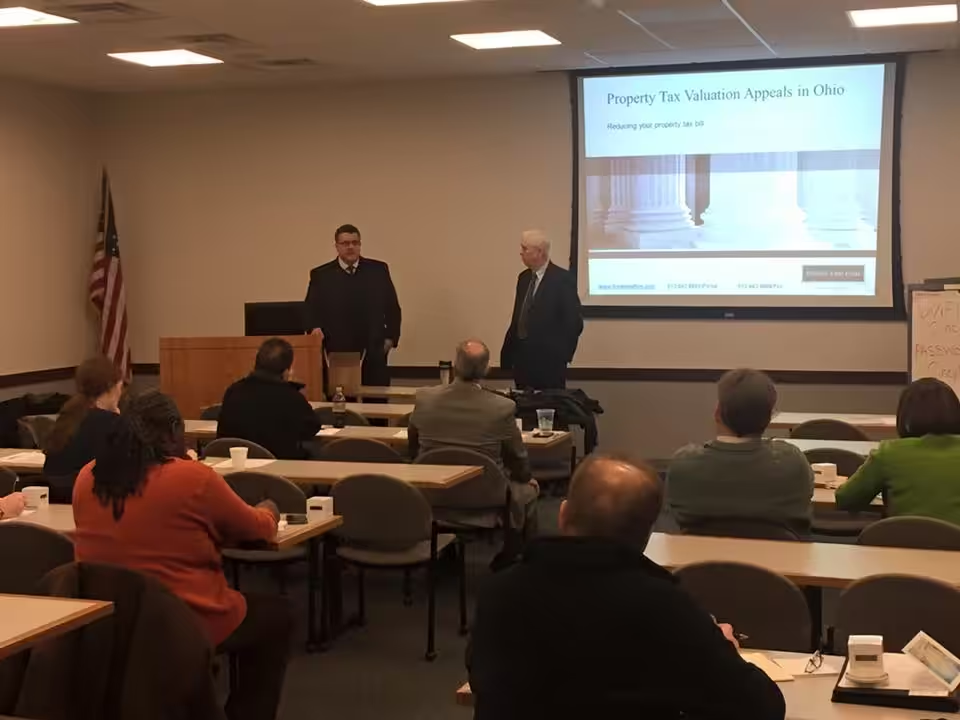
On Friday, January 20th, our own Chris Finney taught a 3-hour continuing education class before the Cincinnati Area Board of Realtors with Hamilton County Auditor Dusty Rhodes.  Rhodes has graciously co-taught this course — approximately 12 times — over the past seven years with us.

The class, presented to about 35 Realtors, teaches about intricacies of the property tax bill, as well as hands-on, step-by-step, do-it-yourself instructions about how to prepare a complaint and present a case before the Boards of Revision in each of Ohio’s 88 counties.

A detailed self-help video of a similar presentation is available here.

The filing deadline in Ohio is March 31 of each year.  If you want this firm to assist you in the presentation of your Complaint, please contact Anna Ausman at (513) 943-6651.