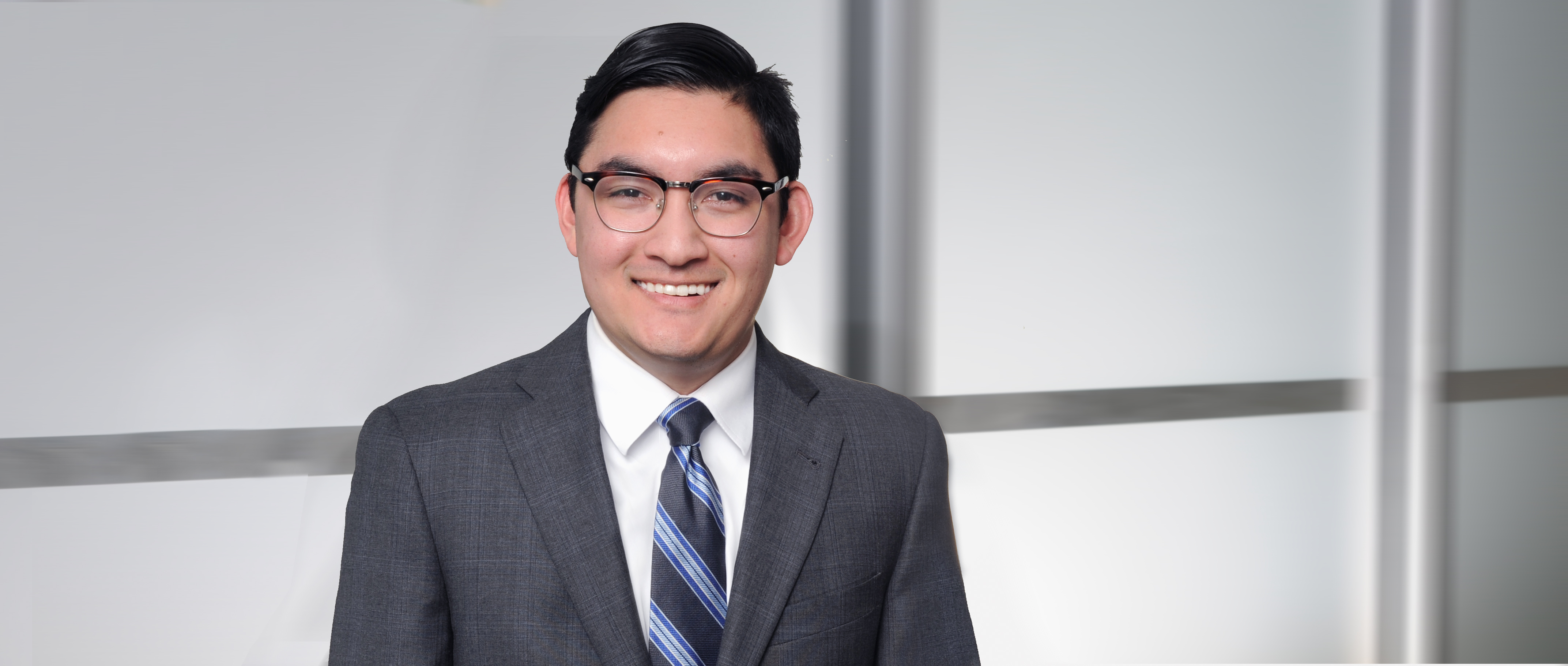
Finney Law Firm attorney Matt Okiishi

Today at 3 PM Finney Law Firm attorney Matt Okiishi co-presents to the public (not just CBA members) at the Cincinnati Bar Association with attorney Kelly Mulloy Myers on “legal issues in the wake of COVID-19.”

It is simply a 30-minute program of pre-selected questions submitted by the public on the noted topic.

A link to the Facebook announcement about the program is here and you can sign up for the program thru that link.


Finney Law Firm is pleased to announce that Attorney Eli Krafte-Jacobs has obtained his Ohio title insurance license.  Eli is a part of our Commercial Real Estate Title and Closing Practice Group.

Consistent with our mission to Make a Difference for our clients, Eli works directly with the Firm’s affiliated title company Ivy Pointe Title, LLC to provide a comprehensive suite of commercial real estate title, title insurance and closing coordination services, with transparent communication and timely delivery.  Our professional team possesses the core competency and capacity to handle even the most challenging commercial real estate transactions.

Contact Eli Krafte-Jacobs, 513.797.2853.


As we have written here and here, the coverage provided by title insurance is particularized to the policy issued, and that is usually tailored to the property insured.

Background

In other words, when someone wants to buy a property, the title insurance company hires a title examiner who conducts a title search of the subject property and ascertains monetary liens, easements, covenants, restrictions, and other encumbrances against that property to be insured. Then, a title insurance policy is prepared that lists as exceptions to coverage the encumbrances found to be of record. It has to be this way; an insurer simply can’t insure against and over valid easements and other encumbrances.

As we have discussed previously, then, for a buyer/insured to know the quality of title he is receiving, it is not enough to obtain an Owner’s Policy of Title Insurance.  Someone has to read the policy and read and understand the encumbrances excepted from coverage.

For almost all parcels in urban and suburban areas, there are some easements, and if you are not careful there could be monetary liens that need to be released. These might be subdivision (residential and commercial) covenants, reciprocal easement and maintenance agreements, utility easements (which circle every commercial and residential subdivision) and other easements and covenants.

Very occasionally, typically in a rural area with no recent development, you will find a parcel with no easements, no covenants, no restrictions, and no monetary liens, but it’s a relative rarity.

My friend is buying an investment property

So, this week, a friend of mine called me.  He was helping his daughter who invests in real estate with financing a property for a “flip.”  Someone else has selected another title company, and he asked me to assure that the title would be clear.

I told him, as I have advised on this blog, someone needs to review the deed, and someone needs to carefully review both the title insurance policy and the exception documents referenced therein.

So, he asked the title insurance company for a copy of the policy pro forma, or a commitment for title insurance and the exception documents.

The clueless clerk at a title company

In return, a clueless clerk at said title company sent a blank form policy, with only pre-printed Schedule B-1 exceptions. These are such standard things as taxes not yet due and payable, things a  survey would disclose, and mechanics liens. Many of these pre-printed exceptions can be deleted by means of a Title  Affidavit provided by the seller at closing, but none of them reveal the exceptions to be taken by a title examination of the specific property.

In other words a title company would be crazy to issue such a policy, as it would insure over actual title deficiencies that would create a loss to the title company to remove such restrictions or pay for any “damage” arising from their existence.

An innocent inquiry to get the real policy

Therefore, I wrote to the clueless clerk as follows:

I have reviewed the documents you sent to my client in this matter, and candidly they are not at all helpful or informative.

 A title policy is only as good as its terms, and the terms of a title policy are dependent on the exceptions to coverage set forth in Schedules B-1 and B-2.  The form you sent is just a blank form.  Now, if you are promising to issue a policy with no exceptions, except those pre-printed, that is great.  Just confirm that.  If not, we will need to (a) know exactly what the exceptions are to the policy being issued (i.e, this actual policy to this actual buyer for the purchase price for this actual property) and (b) see and read the exception documents, meaning we will need copies of them.

 Let me know and thank you.  

I thought it was pointed, but polite.

What just happened?

Her response simply stunned me:

Every policy that we issue is free of exceptions except for those that are pre-printed.

I hope this clarifies the issues laid out so we can remain on schedule.

This is amazing. Her response indicates that on every policy (not just this one) that they write, they don’t bother to perform a title examination, and make no exception to coverage.

I mean this is fantastic for buyer, but not the underwriter. Every title problem magically is insured over, and a buyer is always assured they have fee simple, unencumbered, absolutely clear title in every closing.

I want some of that coverage!

Conclusion

So, I told my client: “Close”! You can’t get coverage that good from me or any other title company.  That is simply amazing.

[Now, notwithstanding her promises, I look forward to seeing the language of the actual policy when it is delivered to my client, and my subsequent insistence that the title company issue precisely the coverage that had been promised. This should be fun!]

Yes, that really happened this week.

The Finney Law Firm’s attorneys along with Maurice Thompson of the 1851 Center for Constitutional Law have been leading the legal fight against the lack of due process hearings in the Ohio “Stay at Home” order issued by the Ohio Department of Health and its Director, Dr. Amy Acton.

We have filed suit against the present Order and lost our Motion for Temporary Restraining Order at a hearing before Chief U.S. District Court Judge Algenon Marbley on April 20, 2020. He has set a further hearing on a Motion for Preliminary Injunction for Monday, May 11 at 9:00 AM.

Tonight, the Ohio Department of Health finally issued its new regulations here.

As the New York Times reports here, the 10-day pause in SBA funding for Paycheck Protection Program (“PPP”) applications enabled lenders to get in order and carefully complete their paperwork for tens if not hundreds of thousands of new applicants, but when the portal finally opened up today at 10:30 AM, it was overwhelmed, causing the server to crash.  This allowed only a trickle of applications to be successfully processed on the first day of Round II of PPP funding.

As the article says, “bankers were expecting the money to once again run out quickly,” meaning knowledgeable market participants predict that there will be winners and losers among the contestants for a still-limited supply of federal monies. Those who get processed quickly will get full funding; those that do not may get nothing.  Clearly, Congress will need to approve a third and perhaps fourth round of funding for the program to fund all eligible small businesses.

Contact Rebecca L. Simpson (513.797.2856) for help accessing PPP funds or assuring your path to their forgiveness.

Saturday’s Wall Street Journal featured the lawsuit filed by the 1851 Center for Constitutional Law‘s and Finney Law Firm‘s suit against Dr. Amy Acton and the Ohio Department of Health for their failure to provide due process hearings for businesses forced to close under her Emergency COVID-19 Pandemic Orders. The client seeking relief in the lawsuit is Tanya Rutner Hartman and her business, a bridal shop, Gilded Social, LLC.

A link to the article is here.

A link to the original Complaint is here.

For more information, contact attorney Christopher P. Finney (513.943.6655).


Today, the US House of Representatives passed the second phase of funding for the Paycheck Protection Program, providing another $310 billion in funding for the forgivable small business loans.  President Trump has said he plans on signing the bill tonight.

This means tens of thousands of applications pending at banks and other lending institutions throughout the country can now be funded.

It is not clear if this supplemental funding will mean full funding for the program.  Many businesses, sole proprietors and 1099 contractors have not yet even filed their applications.

Here is the podcast from today on 550 WKRC Radio with Brian Thomas. The broadcast starts at 69:50.

The discussion in this show again addressed the Finney Law Firm suit on behalf of Tanya Hartman and her business, Gilded Social, a bridal dress shop, who desires a due process hearing on the forced closure of her business in the COVID-19 crisis.

Contact Christopher P. Finney (513.943.6655) if you care to discuss your rights as a business owner under a COVID-19 closure order.

Here is the podcast from today, starting from the top of the show.

The discussion in this show addressed the Finney Law Firm suit on behalf of Tanya Hartman and her business, Gilded Social, a bridal dress shop, who desires a due process hearing on the forced closure of her business in the COVID-19 crisis.

We lost yesterday in getting a Temporary Restraining Order to stop Ohio’s practices without due process. The Judge has called for a Preliminary Injunction hearing for May 11.

Contact Christopher P. Finney (513.943.6655) if you care to discuss your rights as a business owner under a COVID-19 closure order.

We have many clients whose application for a forgivable loan under the Paycheck Protection Program are currently pending and waiting for new funding from Congress, the US Senate passed a bill today to allocate $320 billion in additional funds. Action by the US House is expected Thursday.

Read more here from the New York Times.

Again, our advice is to apply and be patient. Congress will be fully funding this program.