

Tens of thousands of Ohio businesses have been forcibly closed due to the order of Ohio Health Director Dr. Amy Acton, who on her own decided which categories of businesses would be deemed “essential” and “non-essential” during the COVID-19 crisis.

Today, a hearing was held before Judge Algenon Marbley, Chief Judge of the United States District Court for the Southern District of Ohio, on a motion for Temporary Restraining Order in the case of Hartman et al. v. Acton et al.  In that case, Finney Law Firm attorneys Curt C. Hartman, Rebecca L. Simpson and Christopher P. FInney along with the 1851 Center for Constitutional Law argued simply that Tanya Hartman and her bridal shop, Gilded Social, are entitled to a due process hearing as to whether retail shops such as hers are properly categorized as “non-essential” and therefore subject to mandatory closure by the State.  In other words, she simply asked for a hearing to ascertain the propriety of her closure under Ohio law and the US Constitution.

Now, I preface this by noting that I previously have appeared in front of Judge Marbley, and not only respect him as a Judge, but genuinely like him . He has at all times shown himself to be a knowledgeable and wise jurist, and a kind man as well.

Today, Judge Marbley, for a variety of reasons, ruled that Ms. Hartman and tens of thousands of similarly-situated businesses in Ohio have no right to a due process hearing following their forced closure by the State — at least on the emergency basis sought.

Rather, he scheduled a second hearing on May 11 on a Preliminary Injunction, a similar kind of relief but one that would last until resolution of the merits of the case.

One reason enunciated by Judge Marbley I found particularly unfortunate for the decision was that Ohio could not possibly hold hearings for the tens of thousands of businesses who might appeal their closure order. In other words, that due process would simply be overwhelming to the state bureaucrats if that right was recognized.

This notion is a frightening one indeed, reminding me of the forced internment of more than 120,000 US citizens of Japanese heritage during World War II without due process. In 1944, Fred Korematsu (Korematsu v. United States, 323 U.S. 214 (1944)) challenged the “yellow scare” incarceration of Japanese Americans based solely upon their ancestry. Naturally, the outrageous, unconstitutional and racist Order was borne of fear that Japanese Americans might hold dual loyalties and harm the United States  during the War.  The U.S. Supreme Court ultimately upheld President Roosevelt’s Executive Order 9066 that resulted in that forced internment, citing that irrational fear.  From Wikipedia:

In a majority opinion joined by five other justices, Associate Justice Hugo Black held that the need to protect against espionage by Japan outweighed the rights of Americans of Japanese descent. Black wrote that: “Korematsu was not excluded from the Military Area because of hostility to him or his race”, but rather “because the properly constituted military authorities…decided that the military urgency of the situation demanded that all citizens of Japanese ancestry be segregated from the West Coast” during the war against Japan.

Can you imagine if Justice Black had added as a reason for that now-discredited decision that the U.S. Courts could not possibly sustain petitions for freedom by 120,000 individuals? It would deeply offend our claim as a nation to equal justice under the law. What if the Governor incarcerated all 10,000,000 Ohioans (which effectively he has done)? Would it be an exception to a Habeas Corpus petition that the system would be overwhelmed to provide justice to that many Ohioans?

We don’t lose our Constitutional rights when everything is going swimmingly. Rather, they become subverted from circumstances that instill such fear in our populace that the Courts elect to ignore the clear meaning of our Constitution. In other words, fear drives bad court decisions.

Today, the State of Ohio repeatedly played the fear card — the boogie man of disease and death — if we simply afforded Ohio businesses due process rights in response to the devastation of their life’s work. And it worked.

Judge Marbley has a chance to correct this unfortunate decision at the upcoming Preliminary Injunction hearing and we hope to provide him with the legal arguments and evidence he needs to reach the correct conclusion to allow due process rights to be afforded to these businessmen and women who have had their hard work and risk of capital snatched from them by unthinking, uncaring arbitrary bureaucrats.

We very much look forward to Round #2.

The SBA burned through $342 billion in Paycheck Protection Program’s (“PPP”) loan funds in just over a week. And of course it ran out of funds long before all applications were processed, leaving many businesspersons waiting to see if the program will be properly and fully funded (we think it will).

Where did the money go?

Well, the SBA has issued a good and short PowerPoint presentation on the destination of the loaned funds to date.  That is here.

If you need help accessing PPP funds or the companion Emergency Income Disaster Loan funds, please contact Rebecca L. Simpson (513-797-2856).

Over the weekend, I spoke with about a dozen 1099 or business-owner clients who (a) either still did not know about the Paycheck Protection Program or (b) did not intend to apply for various reasons.  Some discussion of that.

  1. If you don’t know about the program, educate yourself. It is broad and generous. It encompasses almost every sole proprietor, 1099 contractor and business owner in the nation.  Read about it generally here and watch this webinar for employers with W-2 employees and this webinar aimed primarily at sole proprietors and 1099 contractors.
  2. Do I have to suffer closure or severe economic damage under the COVID-19 crisis  to be eligible? No. This program makes virtually no distinction between those severely impacted and those still operating “normally.” You do need to certify some impact from the COVID-19 crisis.
  3. Isn’t this just another SBA loan program with lots of paperwork and loan fees? No, not at all.  (a) First, it is a “forgivable loan.” (b) The primary condition is that you must continue to employ your employees for 8 weeks (or call them back if you already laid them off) after the loan is made. (c) If you meet that and a few other simple conditions, the “loan” becomes a grant. (d) It is east to apply. (e) There are no fees. (f) There is no loan guarantee.  (g) Even creditworthiness is not considered. This program is designed quickly to get cash into the hands of businesspersons so they can maintain their payroll and avoid bankruptcy.
  4. How do I apply? Call your bank.  If you need more help, contact Rebecca L. Simpson of our office (513.797.2856).  Candidly, it is fairly easy and straightforward.
  5. But I read the program already is out of money? Yes, this is true, but it appears likely that Congress is poised to authorize another $300 billion this week.  Our view is the program will be fully funded until every eligible business which applies has been funded.
  6. Does the program apply to churches and other non-profits?  The program does have special rules for churches, but it generally applies to all 501-C3s and C-19s (veterans organizations).
  7. I don’t need the money; let someone else in need have the funds. This is certainly a justification for not applying, just so you have thought this through for yourself and your business.  When this program is gone, we see it as highly unlikely it will be renewed on such generous terms.

Every businessperson has their hands full right now, navigating the shoals of uncertainty and change the COVID crisis has presented, but this program almost certainly is well worth your time and attention.

Rebecca L. Simpson

This morning, Finney Law Firm attorney Rebecca L. Simpson conducted a seminar hosted by the Cincinnati Area Board of Realtors on the Paycheck Protection Plan. A hearty thanks to Christy Beaver for pulling together this program.

This morning’s seminar focuses on how Realtors can qualify and apply for the program.

It is posted here.

This seminar comes on the heels of another seminar hosted by Empower U about the Paycheck Protection Program focusing on employers with W-2 employees.

A link to that previous webinar is here.

Please contact Rebecca L. Simpson (513.797.2856) if you need assistance with the PPP program.

Attorney Christopher P. Finney

Today, Finney Law Firm and the 1851 Center for Constitutional Law filed suit in Federal District Court in Columbus, Ohio to enjoin the mandatory “stay at home” orders of the Ohio Department of Health.  Named as a Defendant in the action Dr. Amy Acton in her official capacity as Director of the Ohio Department of Health.

The Plaintiff, Tanya Rutner Hartman, owner of Gilded Social: The Fancy Occasion Shop, a Columbus bridal shop, alleges that the official orders of Dr. Acton fail to have any meaningful due process protections built in for a fair hearing to determine what is an “essential” business and can stay open while the state imposes restrictions to prevent further spread of the virus.

The case has been assigned to Chief Federal District Court Judge Algenon L. Marbley for the Southern District of Ohio, sitting in Columbus. He has ordered the State of Ohio to brief the matter by 5 PM Friday, April 17, 2020 (tomorrow) and will hold a telephonic hearing Monday at 10 AM.  He has promised a decision by Wednesday, April 22, 2020.

A copy of the Complaint is here.

The news release from the 1851 Center is here.

A Cleveland.Com story on the case is here.

For more information, contact Maurice Thompson of the 1851 Center for Constitutional law  or Christopher Finney (513.943.6655).


The stated desire of Congress and the Administration in the Paycheck Protection Program (“PPP”) has been to get money into the hands of business owners — and keep workers off the unemployment line — absolutely as quickly as possible.

But that hasn’t prevented the endless delays and bickering between the democrat House and the GOP Senate in getting full appropriation for the program approved.

Read here that the Small Business Administration website now reads that it is “unable to accept new applications for the Paycheck Protection Program based on available appropriations funding. Similarly, we are unable to enroll new PPP lenders at this time.”

Watch this blog for further updates and contact Rebecca L. Simpson (513.797.2856) for more information on this program.  She is keeping updated on the rules and the daily developments.


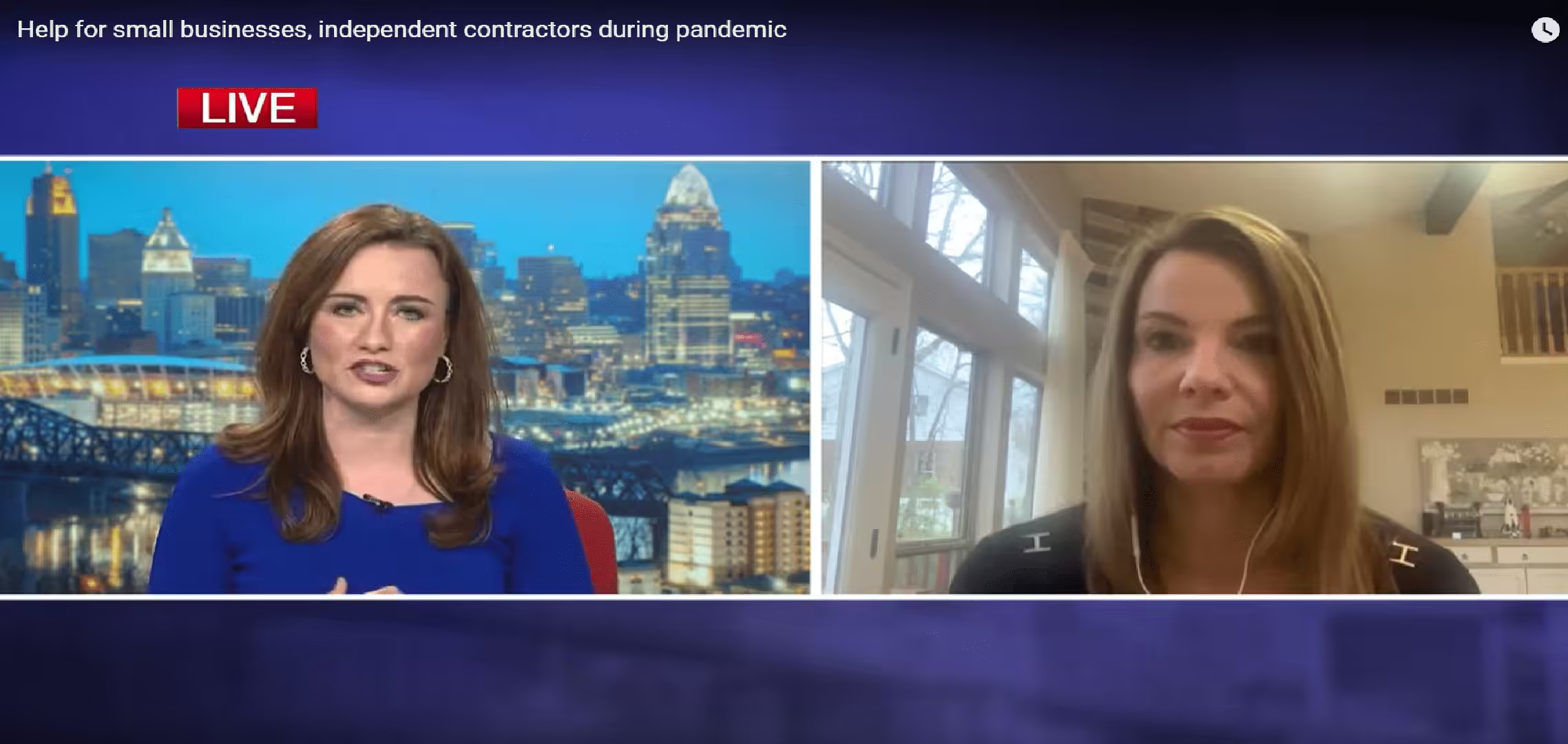
This morning, Finney Law Firm attorney Rebecca L. Simpson appeared live with anchor Angenette Levy on Local 12 to discuss the latest developments with the Paycheck Protection Program.

You may watch the link here.

Attorney Rebecca L. Simpson has been our point person inside Finney Law Firm to research and keep updated on the PPP and to advise clients on the intricacies of how to access Paycheck Protection Program funds for their small businesses each step of the way.  She has already led three webinars on the topic, with two more to come this week.

Contact Rebecca L. Simpson (513-797-2856) for assistance with the program.

Attorney Rebecca L. Simpson
On Friday, April 17, at 9:30 AM, Finney Law Firm Attorney Rebecca L. Simpson will present “Powerful Assistance to Realtors under the Paycheck Protection Act” (“PPP”) to Realtor and affiliate members of the Cincinnati Area Board of Realtors. This special program is free to members and nonmembers.
  • Ms. Simpson has already conducted an extensive webinar on the PPP to EmpowerU. To date for live participants and those watching the recorded webcast (here) that message has reached more than 1,000 viewers. That webinar was primarily aimed at Part #1 of PPP, which dealt with employers with W-2 employees.
  • This program on the other hand primarily is aimed Part #2 of the PPP that just launched today (April 10, 2020):  1099 contractors, self-employed, sole proprietors (for example, real estate investors whose companies have no employees). Ms. Simpson also will explore the various situations of Realtor “Teams” with 1099 contractors and W-2 employees within the teams, part-time Realtors who may also have separate W-2 jobs, and other variables specific to Realtors.
CABR Members can log in to register here and nonmembers can register here. This program is free for both members and nonmembers.
Contact Christy Beaver (513.842.3011) at the CABR for questions about the program and registration.
Contact Christopher P. Finney (513.943.6655) or Rebecca L. Simpson (513.797.2856) for specific assistance for you or your company.
A detailed description of the PPP program is here.

As our clients have noted from six years and a half years of our work to “Make a Difference,” Finney Law Firm  is actively working to assure that our attorneys are constantly up to date on developments in the law, and then impart that information to clients and the public with blog entries, e-newsletters, seminars, webinars and media appearances.

Our performance during the COVID-19 crisis has met and exceeded that standard.  And, because our clients hunger for information to help them to weather this unprecedented storm, the response has been overwhelming.

Here is our performance by the numbers since the beginning of March:

  • 28 COVID-related blog entries with critical legal updates for clients, including information on the PPP and EIDL programs from the SBA.
  • Those blog entries have had more than 6,300 “reads” since the crisis began.
  • 6 major Constant Contact e-mail blasts with important COVID-19 legal developments.
  • More than 13,250 “opens” of those emailed newsletters, a record number in one month.  We are seeing that the information is so valuable that there are a record number of “forwards” from clients to their contacts with our information, and those “forwards” are opening and reading the communications as well.
  • We have had 8 major TV and radio appearances relating to COVID-19 issues.
  • We have gotten calls from all over the nation for help on the PPP program from the SBA.
  • We have done or will do 4 webinars on the PPP program. Between the webinar live attendees and those watching the recordings, we will have reached more than 1,000 participants.
  • We have retained exclusive relationships with 1 Ohio e-notary and 1 Kentucky e-notary to become one of the first title companies to be able to do entirely electronic, remote closings over the internet through Ivy Pointe Title.

All of this is designed to assure we are as effective as we can be in serving you, by understanding the law, which is developing daily, by developing the contacts to achieve your objectives, and by imparting that knowledge in a usable format so you can implement to win on legal and economic battlefields that are daily emerging.

I congratulate and thank our team — lawyers, paralegals and staff — for contributing to this area of service to our clients.  And thank our clients — existing and new — for recognizing this sophisticated and cutting-edge approach to the practice of law for their benefit.

Let me know personally how the Finney Law Firm can help you to weather this storm.  My email is Chris@FinneyLawFirm.Com and my phone numbers are 513.943.6655 (o) and 513.720.2996 (c).

Look, the Paycheck Protection Program is enormous, offering help to every small business in America with W-2 employees and the administration and Congress asked them to launch with six days’ lead time. What did you expect?

Yes, there are problems with the launch.  But you are all sitting in lock-down at home anyway.  We counsel patience.  The President and Congress are united in their desire to get this money out where it is needed.

Read more here.

Attorney Rebecca L. Simpson of the Finney Law Firm has carefully studied the PPP and the Emergency Income Disaster Loans (“EIDL”) to help our small business clients access these funds.  Feel free to call her at 513.797.2856 if you have questions about these programs or need help accessing PPP or EIDL funds.